Weekly Digest of the Regnum Christi Daily Meditations: Mar 22 – 29, 2026
WEEKLY DIGEST OF rc
DAILY MEDITATIONS
Week of March 22 - 29, 2026
Sunday, March 22, 2026 – Take Away the Stone
Monday, March 23, 2026 – Do Not Sin Any More
Tuesday, March 24, 2026 – Always Do What Is Pleasing to Him
Wednesday, March 25, 2026 – Mary’s Mission
Thursday, March 26, 2026 – I Know Him
Friday, March 27, 2026 – You Are Gods
March 22, 2026 – Take Away the Stone

Fifth Sunday of Lent
John 11:1-45
Now a man was ill, Lazarus from Bethany, the village of Mary and her sister Martha. Mary was the one who had anointed the Lord with perfumed oil and dried his feet with her hair; it was her brother Lazarus who was ill. So the sisters sent word to him saying, “Master, the one you love is ill.” When Jesus heard this he said, “This illness is not to end in death, but is for the glory of God, that the Son of God may be glorified through it.” Now Jesus loved Martha and her sister and Lazarus. So when he heard that he was ill, he remained for two days in the place where he was. Then after this he said to his disciples, “Let us go back to Judea.” The disciples said to him, “Rabbi, the Jews were just trying to stone you, and you want to go back there?” Jesus answered, “Are there not twelve hours in a day? If one walks during the day, he does not stumble, because he sees the light of this world. But if one walks at night, he stumbles, because the light is not in him.” He said this, and then told them, “Our friend Lazarus is asleep, but I am going to awaken him.” So the disciples said to him, “Master, if he is asleep, he will be saved.” But Jesus was talking about his death, while they thought that he meant ordinary sleep. So then Jesus said to them clearly, “Lazarus has died. And I am glad for you that I was not there, that you may believe. Let us go to him.” So Thomas, called Didymus, said to his fellow disciples, “Let us also go to die with him.” When Jesus arrived, he found that Lazarus had already been in the tomb for four days. Now Bethany was near Jerusalem, only about two miles away. And many of the Jews had come to Martha and Mary to comfort them about their brother. When Martha heard that Jesus was coming, she went to meet him; but Mary sat at home. Martha said to Jesus, “Lord, if you had been here, my brother would not have died. But even now I know that whatever you ask of God, God will give you.” Jesus said to her, “Your brother will rise.” Martha said to him, “I know he will rise, in the resurrection on the last day.” Jesus told her, “I am the resurrection and the life; whoever believes in me, even if he dies, will live, and everyone who lives and believes in me will never die. Do you believe this?” She said to him, “Yes, Lord. I have come to believe that you are the Christ, the Son of God, the one who is coming into the world.” When she had said this, she went and called her sister Mary secretly, saying, “The teacher is here and is asking for you.” As soon as she heard this, she rose quickly and went to him. For Jesus had not yet come into the village, but was still where Martha had met him. So when the Jews who were with her in the house comforting her saw Mary get up quickly and go out, they followed her, presuming that she was going to the tomb to weep there. When Mary came to where Jesus was and saw him, she fell at his feet and said to him, “Lord, if you had been here, my brother would not have died.” When Jesus saw her weeping and the Jews who had come with her weeping, he became perturbed and deeply troubled, and said, “Where have you laid him?” They said to him, “Sir, come and see.” And Jesus wept. So the Jews said, “See how he loved him.” But some of them said, “Could not the one who opened the eyes of the blind man have done something so that this man would not have died?” So Jesus, perturbed again, came to the tomb. It was a cave, and a stone lay across it. Jesus said, “Take away the stone.” Martha, the dead man’s sister, said to him, “Lord, by now there will be a stench; he has been dead for four days.” Jesus said to her, “Did I not tell you that if you believe you will see the glory of God?” So they took away the stone. And Jesus raised his eyes and said, “Father, I thank you for hearing me. I know that you always hear me; but because of the crowd here I have said this, that they may believe that you sent me.” And when he had said this, he cried out in a loud voice, “Lazarus, come out!” The dead man came out, tied hand and foot with burial bands, and his face was wrapped in a cloth. So Jesus said to them, “Untie him and let him go.” Now many of the Jews who had come to Mary and seen what he had done began to believe in him.
Opening Prayer: Lord, I wish to have you roll away the stone which is sealing my heart and help me to be abundantly alive in you. I pray for the grace of a happy death.
Encountering Christ:
- “The One You Love Is Ill”: There was much activity in the beginning of this account. Jesus received alarming news about a dear friend. Life in Jerusalem was becoming dangerously tense. The disciples still lacked understanding and cohesion. But Jesus always had clarity and did not stumble. When his Father could be most glorified, Jesus acted. Our lives can be complicated, sometimes very complicated. When we find ourselves in troubling circumstances, we can imitate Our Lord by seeking only to glorify the Father with our actions and words. Lord, please help us to see with your eyes; help us to always turn to you in prayer and act in ways that glorify God
- “The Teacher Is Here And Is Asking for You”: Amidst the danger and confusion, Jesus went to Bethany and there encountered Martha. True to form, Martha was anxious, but Jesus was patient and led her to a beautiful confession of faith. Jesus also saw past the obvious intensity of the situation, and with tender sensitivity, asked for Mary, who he knew was quietly at home, mourning the loss of her brother, Lazarus. In this deeply painful moment, he sought her out. And when she went to him and shared her anguish, he revealed the tenderness of his heart. He “became perturbed and deeply troubled,” and wept. It is said that in Jesus’ time, they recognized his humanity but wrestled with his divinity, whereas today we recognize his divinity but wrestle with his humanity. What a gift to read about these moments where Jesus reveals his humanity and his tender love, and to accept his tender and personal love toward us as well.
- “Take Away the Stone”: Jesus was not afraid to enter into the ugliest of places to bring life. He did this on a natural level with Lazarus when he had the gravestone removed, and he does this in our stony hearts as well. There are dark places in our hearts—regrets, painful memories, or festering wounds—which can be likened to an interior death. Too often we seal them in with a heavy stone of denial, when we should instead beg Our Lord to take away the stone, remove the self-protective bandages, and bring us back to the fullness of life.
Conversing with Christ: Dear Lord, what a mess I can be—like the living dead or walking wounded. Help me to turn to you and recognize you as the source of my resurrection and life. Help me to believe and live!
Resolution: Lord, today by your grace I will pray for the souls of those who will die this day, that they may enjoy the grace of a happy death.
Mary Wolff has a unique understanding of “life in the trenches” from many years of motherhood and her years living in the Holy Land. She spends countless hours in Adoration, interceding especially for priests and for all on the front lines of life. She is crazy-in-love with the Trinity, Our Lady, and her son Mike; she loves to laugh, is a devoted fan of chocolate, and enjoys watching Navy beat Army. Mary can be reached at marybwolff@gmail.com.
March 23, 2026 – Do Not Sin Any More
Monday of the Fifth Week of Lent
John 8: 1-11
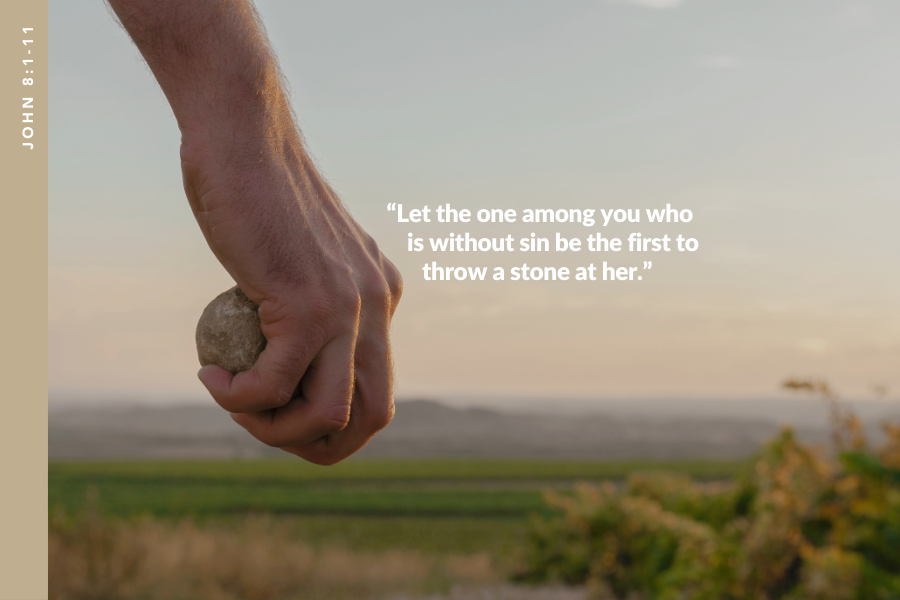
Jesus went to the Mount of Olives. But early in the morning he arrived again in the temple area, and all the people started coming to him, and he sat down and taught them. Then the scribes and the Pharisees brought a woman who had been caught in adultery and made her stand in the middle. They said to him, “Teacher, this woman was caught in the very act of committing adultery. Now in the law, Moses commanded us to stone such women. So what do you say?” They said this to test him, so that they could have some charge to bring against him. Jesus bent down and began to write on the ground with his finger. But when they continued asking him, he straightened up and said to them, “Let the one among you who is without sin be the first to throw a stone at her.” Again he bent down and wrote on the ground. And in response, they went away one by one, beginning with the elders. So he was left alone with the woman before him. Then Jesus straightened up and said to her, “Woman, where are they? Has no one condemned you?” She replied, “No one, sir.” Then Jesus said, “Neither do I condemn you. Go, and from now on do not sin any more.”
Opening Prayer: Lord, I marvel at your wisdom and penetrating insight. You can see into the hearts of both the accused and the accusers. You see into my heart as well; I am a confusing mix of good and bad. Please enter into my dark places to heal me, and write your love on my heart. I pray for the grace of a pure heart.
Encountering Christ:
- “Jesus Went to the Mount of Olives”: We know from the Passion narratives that Jesus often went to the Mount of Olives to pray to his Father. This encounter with the sinful woman essentially begins by noting that Jesus spent the prior evening in prayer. Quiet prayer in the still of night can sometimes feel particularly powerful. Too often we are caught up in the “doing” and forget Jesus’ powerful example of proper order. We should be deeply rooted in prayer, so that we are strong enough to accomplish our work—and so that our work is truly his
- “This Woman Was Caught in the Very Act”: Only the woman was accused of this act of adultery, although there was obviously a partner in crime. Every sin has a ripple of cause and effect, even those committed alone. We are made for communion, and our actions—both evil and good—affect others. Lord, may we, like you, seek to build up ourselves and our community by living virtuous lives, trusting that our good actions affect many more.
- “Go and Do Not Sin Any More”: Jesus was extraordinarily kind to this woman! He was gentle, protective, and forgiving. But because his love for her was so deep, he wanted the highest good for her and therefore challenged her to “go, and from now on do not sin any more.” Some seem to forget this final line—this mark of true respect for her. Jesus did not come to affirm us in our sins. He came to redeem us and teach us how to live lives of true goodness and love. Let us not fall into a misguided compassion for others that may cause us to think, “Who am I to judge?” and excuse all sins. Rather, let us admonish one another lovingly. Like Jesus, through our words and example and prayers, let us hate the sin, but truly love the sinner.
Conversing with Christ: Dear Jesus, so often when I read the Gospels I want to cheer when you put the self-righteous in their place. I love how you stand up to the scribes and Pharisees, but I seem to forget that I too can be judgmental. Please help me to recognize sin for what it is and to fight it. At the same time, please help me to respond with true love to others who sin, even if it means I may have to step out of my comfort zone a bit for that person.
Resolution: Lord, today by your grace I will try to spend some extra time praying for the conversion of sinners.
For Further Reflection: There is some discussion as to whether this woman was Mary Magdalene. Many scholars now agree with that supposition. If true, then this woman later stood at the foot of the Cross. She saw with her very eyes the price paid for her forgiveness in this encounter with Jesus. Spend time reading your favorite Passion narrative, and imagine yourself, your sins, and your story entering into the moments that unfold, and see very tangibly and very personally the price paid for your sins.
Mary Wolff has a unique understanding of “life in the trenches” from many years of motherhood and her years living in the Holy Land. She spends countless hours in Adoration, interceding especially for priests and for all on the front lines of life. She is crazy-in-love with the Trinity, Our Lady, and her son Mike; she loves to laugh, is a devoted fan of chocolate, and enjoys watching Navy beat Army. Mary can be reached at marybwolff@gmail.com.
March 24, 2026 – Always Do What Is Pleasing to Him
Tuesday of the Fifth Week of Lent
John 8:21-30
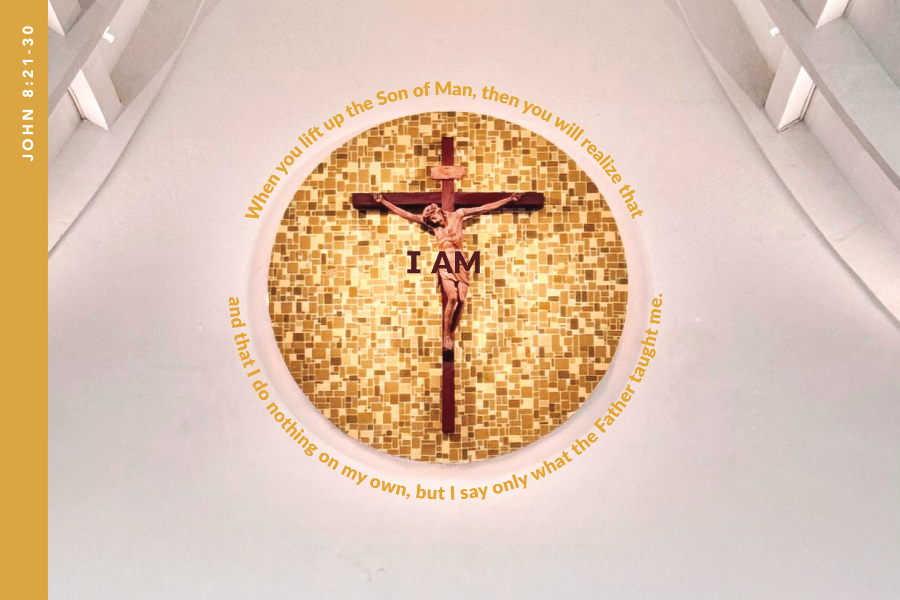
Jesus said to the Pharisees: “I am going away and you will look for me, but you will die in your sin. Where I am going you cannot come.” So the Jews said, “He is not going to kill himself, is he, because he said, ‘Where I am going you cannot come’?” He said to them, “You belong to what is below, I belong to what is above. You belong to this world, but I do not belong to this world. That is why I told you that you will die in your sins. For if you do not believe that I AM, you will die in your sins.” So they said to him, “Who are you?” Jesus said to them, “What I told you from the beginning. I have much to say about you in condemnation. But the one who sent me is true, and what I heard from him I tell the world.” They did not realize that he was speaking to them of the Father. So Jesus said to them, “When you lift up the Son of Man, then you will realize that I AM, and that I do nothing on my own, but I say only what the Father taught me. The one who sent me is with me. He has not left me alone, because I always do what is pleasing to him.” Because he spoke this way, many came to believe in him.
Opening Prayer: Dear Jesus, as I read your words, I felt almost as confused as your first listeners seemed to be. But as I reflect more, I begin to recognize that you are leading me on a very specific path, and I too begin to believe more deeply. Please help me follow you to union with the Father.
Encountering Christ:
- “You Belong to This World”: The initial part of this discourse seems to touch on aspects of the first stage of the spiritual life: the purgative way. The Pharisees were living less than exemplary lives. They “belonged to the world” and they were in sin. We too can be caught up with the things of this world. We can develop a form of selfish tunnel vision that cuts us off from Jesus. In the purgative way, we strive to overcome habitual, sometimes serious sin that has kept us from Jesus.
- “Who Are You?”: There was a subtle shift in their questioning when the Pharisees asked, perhaps humbly, “Who are you?” This is a bit like the illuminative way of the spiritual life. In this stage, a soul is open, inquiring, and eager to learn more, to grow more, and to apply to oneself the truths revealed by Jesus. For his part, Jesus always points us to the Father.
- “Always Do What Is Pleasing to Him”: “I do nothing on my own, but I say only what the Father taught me. The one who sent me is with me. He has not left me alone, because I always do what is pleasing to him.” These final lines of the exchange are a beautiful description of the unitive way: a union of one’s life and very being—one’s mind, heart, and soul—with the Father. Jesus is the model par excellence of this union. This encounter concludes with the wonderful statement that “many came to believe in him!” May we all reach union with Our Lord!
Conversing with Christ: Lord, you were incredibly patient with the Pharisees, and even when you seemed to be condemning them, you were leading them to union with your Father. Please always do likewise with me; please help me to be humble and open, and lead me to true and pure union with the Father.
Resolution: Lord, today by your grace I will kneel before you in the tabernacle or monstrance and consider how very like the Pharisees I can be. I will beg you to open my heart to see the way I must follow, so that I do not die in my sin, but so that my journey will lead to a beautiful union with the Father.
Mary Wolff has a unique understanding of “life in the trenches” from many years of motherhood and her years living in the Holy Land. She spends countless hours in Adoration, interceding especially for priests and for all on the front lines of life. She is crazy-in-love with the Trinity, Our Lady, and her son Mike; she loves to laugh, is a devoted fan of chocolate, and enjoys watching Navy beat Army. Mary can be reached at marybwolff@gmail.com.
March 25, 2026 – Mary’s Mission

Solemnity of the Annunciation
Luke 1:26-38
The angel Gabriel was sent from God to a town of Galilee called Nazareth, to a virgin betrothed to a man named Joseph, of the house of David, and the virgin’s name was Mary. And coming to her, he said, “Hail, full of grace! The Lord is with you.” But she was greatly troubled at what was said and pondered what sort of greeting this might be. Then the angel said to her, “Do not be afraid, Mary, for you have found favor with God. Behold, you will conceive in your womb and bear a son, and you shall name him Jesus. He will be great and will be called Son of the Most High, and the Lord God will give him the throne of David his father, and he will rule over the house of Jacob forever, and of his kingdom there will be no end.” But Mary said to the angel, “How can this be, since I have no relations with a man?” And the angel said to her in reply, “The Holy Spirit will come upon you, and the power of the Most High will overshadow you. Therefore the child to be born will be called holy, the Son of God. And behold, Elizabeth, your relative, has also conceived a son in her old age, and this is the sixth month for her who was called barren; for nothing will be impossible for God.” Mary said, “Behold, I am the handmaid of the Lord. May it be done to me according to your word.” Then the angel departed from her.
Opening Prayer: Lord, I believe that you are making all things new within me. I hope in you, Lord Jesus, that your promise of mercy that you have made to me will be fulfilled, in this life and in the next. I love you, Lord, for I know you have thought of me from all eternity, with a special mission in mind. Give me the strength to fulfill that mission!
Encountering Christ:
- God’s Love for Mary: The first thing the Annunciation reveals to us is that God has loved us from all eternity. “Do not be afraid,” the angel says, “for you have found favor with God.” God has a special predilection for each and every one of us, and from all eternity we have found favor in his heart. Let’s take a moment to thank Our Lord for his eternal love, remembering the words of the prophet Jeremiah: “With age-old love I have loved you.”
- Mary’s Mission: God’s love for Mary had a specific and momentous mission attached to it: “You will conceive in your womb and bear a son, and you shall name him Jesus.” Mary accepted this mission in faith, knowing that God had prepared it for her. God also has a mission prepared for us. Perhaps we have already discerned that mission, or perhaps we are still searching. Regardless, we continually need to ask God for the grace to say, “May it be done to me according to your word.”
- Love Casts Out Fear (cf. 1 Jn 4:18): Mary showed that the words of St. John in his First Letter hold true for all of us: There is no fear in love. Mary was able to say, “Behold, I am the handmaid of the Lord” only because she was sure of God’s love for her, and because she loved the Lord immensely. Now, we aren’t all the Blessed Virgin Mary, but even our imperfect attempts at love are still enough to cast out the devil’s weak attempts to make us afraid. Lord, keep perfecting our love, so that we may accept your will!
Conversing with Christ: Lord, you know how imperfect my love is. Still, I know you have loved me from all eternity, and that you have created me for a specific mission. Lord, grant me the grace to say with Pope Clement XI:
“I want whatever you want
The way you want it
For as long as you want it.”
In this way, I will be your missionary, Lord, totally open to your will. Fiat!
Resolution: Lord, today by your grace I will offer up a small difficulty or confusing moment as coming from you, my loving Lord.
For Further Reflection: Welcoming the Word: A Retreat Guide on the Annunciation by Fr. John Bartunek, LC (available on RCSpirituality.org).
Brian Flanagan is a Regnum Christi member from Atlanta, Georgia.
March 26, 2026 – I Know Him
Thursday of the Fifth Week of Lent
John 8:51-59
Jesus said to the Jews: “Amen, amen, I say to you, whoever keeps my word will never see death.” So the Jews said to him, “Now we are sure that you are possessed. Abraham died, as did the prophets, yet you say, ‘Whoever keeps my word will never taste death.’ Are you greater than our father Abraham, who died? Or the prophets, who died? Who do you make yourself out to be?” Jesus answered, “If I glorify myself, my glory is worth nothing; but it is my Father who glorifies me, of whom you say, ‘He is our God.’ You do not know him, but I know him. And if I should say that I do not know him, I would be like you, a liar. But I do know him and I keep his word. Abraham your father rejoiced to see my day; he saw it and was glad.” So the Jews said to him, “You are not yet fifty years old and you have seen Abraham?” Jesus said to them, “Amen, amen, I say to you, before Abraham came to be, I AM.” So they picked up stones to throw at him; but Jesus hid and went out of the temple area.
Opening Prayer: Lord, life—particularly the spiritual life—can be confusing, and this can be frustrating, but because the struggle helps me to realize how very much I need you, it can also lead to a deeper sense of humility. I humbly ask for this grace: the gift of trust in your wisdom and understanding, particularly during times of confusion.
Encountering Christ:
- “Now We Are Sure That You Are Possessed”: Having the benefit of over two thousand years’ worth of twenty-twenty hindsight, we might wonder at the lack of faith shown by the Jews here. And yet, if we are honest, perhaps we have been as confused as they were by Jesus’ words. Jesus tried to lead them to the truth, but truth can be blinding to earthly eyes and hearts and minds. And sin—pride, vanity, sensuality—can prevent understanding from entering in. Are we really truth-seekers, or do we have a question about, or answer for, everything? Is our prayer one-way? Or do we stop to humbly listen to Jesus? He will always lead us to the truth.
- “You Do Not Know Him”: For first-century Jews, the name of God was not spoken or even written, so referring to him with such familiarity was incredible blasphemy! In fact, the accusation of blasphemy was one of the primary reasons for Jesus’ death sentence. Jesus was trying to give the Jews the gift of knowing his Father. Too easily the words “Our Father” roll off our tongues, but the gift of a Father, an Abba, a Daddy, who also happens to be the Creator of the universe is Jesus’ gift to us as well. Jesus thought it was so important for us to know his Father that he was willing to die to reveal it to us. Let us fall to our knees and, with deep humility, thank him.
- “He Saw It and Was Glad”: In the Garden, life was perfect; our parents enjoyed a beautiful relationship with the Father. But the serpent brought sin and pride to the scene and, to this day, the enemy continues to sow division in humanity’s relationship with the Father. Throughout salvation history, however, God has worked to restore our filial relationship with him. He sent his Son to accomplish redemption, which enables God’s people—all of his children—to enter into an intimate Eden-like relationship with him. So, yes, the prophets longed for and rejoiced to see Jesus’ “day.” May we rejoice as well, with hearts full of gratitude, for the gift of such a Father and such a Savior.
Conversing with Christ: Dear Lord, please forgive me for the times that I steamroll you in our prayer conversations. Forgive me for the times that I think I know better than you. I am in utter awe of your generosity toward me and, like the prophets, I am “very glad” that you are my Savior.
Resolution: Lord, today by your grace I will imitate your beloved disciple John and, interiorly, put my head on your heart. As I do so, I will intercede for priests who may be far from you, your Father, and your tender love.
For Further Reflection: I will pray with Psalm 103, reflecting especially on verse 13: “As a father has compassion on his children, so the Lord has compassion on those who fear him.”
Mary Wolff has a unique understanding of “life in the trenches” from many years of motherhood and her years living in the Holy Land. She spends countless hours in Adoration, interceding especially for priests and for all on the front lines of life. She is crazy-in-love with the Trinity, Our Lady, and her son Mike; she loves to laugh, is a devoted fan of chocolate, and enjoys watching Navy beat Army. Mary can be reached at marybwolff@gmail.com.
March 27, 2026 – You Are Gods
Friday of the Fifth Week of Lent
John 10:31-42
The Jews picked up rocks to stone Jesus. Jesus answered them, “I have shown you many good works from my Father. For which of these are you trying to stone me?” The Jews answered him, “We are not stoning you for a good work but for blasphemy. You, a man, are making yourself God.” Jesus answered them, “Is it not written in your law, ‘I said, ‘You are gods’? If it calls them gods to whom the word of God came, and Scripture cannot be set aside, can you say that the one whom the Father has consecrated and sent into the world blasphemes because I said, ‘I am the Son of God’? If I do not perform my Father’s works, do not believe me; but if I perform them, even if you do not believe me, believe the works, so that you may realize and understand that the Father is in me and I am in the Father.” Then they tried again to arrest him; but he escaped from their power. He went back across the Jordan to the place where John first baptized, and there he remained. Many came to him and said, “John performed no sign, but everything John said about this man was true.” And many there began to believe in him.
Opening Prayer: Lord, I humbly ask for this grace: a holy integration of my intellect, my will, my heart, and the actions of my life.
Encountering Christ:
- “You, A Man, Are Making Yourself God”: The Jews were enraged by Jesus’ seemingly casual reference to God as his “Father.” In truth, it was admirable that they wished to defend God’s honor and highly reverence the name of “God,” not realizing God was standing before them. In our time, the name of the Lord is tossed about casually, even used as an angry swear word. The Second Commandment “prescribes respect for the Lord’s name” (CCC2142). We do well to meditate on the Holy Name of Jesus, reciting our vocal prayers slowly and reverently. “O Lord, our Lord, how awesome is your name through all the earth!” (Ps 8:2).
- “I Am in the Father”: Jesus is the perfect model of union with the Father, which we too should pray to attain in our lives. In fact, the Shema states clearly: “Hear, O Israel! The Lord is our God, the Lord alone! Therefore, you shall love the Lord, your God, with your whole heart, and with your whole being, and with your whole strength” (Deut 6:4-5). This loving union is the key to being properly integrated and living holy lives. When we are united with God, our words and our works are in harmony, and we are like gods, as revealed in Psalm 82:6, “Gods though you be, offspring of the Most High all of you.”
- “Many There Began to Believe in Him”: It is almost comical how people can see the same exact thing, or hear the same exact words, and have quite different impressions. Even within our own spiritual lives, there are times we have great faith and other times we feel cold or even angry with God. How ironically human that souls who so ache for the love that only God gives can sometimes feel antagonistic toward him. Let us follow the example of the “many”; let us listen to John the Baptist and the wisdom of other saints, and to Jesus himself, and believe with our will, even when our hearts don’t “feel it”!
Conversing with Christ: Dear Jesus, our human pride can make us so arrogant. We can doubt and question and challenge you, and even disrespect your name. Jesus, please soften my heart, enlighten my mind, and rid me of pride. I want to know you and love you and serve you, all the days of my life.
Resolution: Lord, today by your grace I will picture myself in the company of great saints, and imagine them cheering me on with these words: “Therefore, my beloved brothers, be firm, steadfast, always fully devoted to the work of the Lord, knowing that in the Lord your labor is not in vain” (1 Cor 15:58).
For Further Reflection: Pray the Litany of the Holy Name of Jesus.
Mary Wolff has a unique understanding of “life in the trenches” from many years of motherhood and her years living in the Holy Land. She spends countless hours in Adoration, interceding especially for priests and for all on the front lines of life. She is crazy-in-love with the Trinity, Our Lady, and her son Mike; she loves to laugh, is a devoted fan of chocolate, and enjoys watching Navy beat Army. Mary can be reached at marybwolff@gmail.com.
March 28, 2026 – One Man Should Die
Saturday of the Fifth Week of Lent
John 11:45-56
Many of the Jews who had come to Mary and seen what Jesus had done began to believe in him. But some of them went to the Pharisees and told them what Jesus had done. So the chief priests and the Pharisees convened the Sanhedrin and said, “What are we going to do? This man is performing many signs. If we leave him alone, all will believe in him, and the Romans will come and take away both our land and our nation.” But one of them, Caiaphas, who was high priest that year, said to them, “You know nothing, nor do you consider that it is better for you that one man should die instead of the people, so that the whole nation may not perish.” He did not say this on his own, but since he was high priest for that year, he prophesied that Jesus was going to die for the nation, and not only for the nation, but also to gather into one the dispersed children of God. So from that day on they planned to kill him. So Jesus no longer walked about in public among the Jews, but he left for the region near the desert, to a town called Ephraim, and there he remained with his disciples. Now the Passover of the Jews was near, and many went up from the country to Jerusalem before Passover to purify themselves. They looked for Jesus and said to one another as they were in the temple area, “What do you think? That he will not come to the feast?”
Opening Prayer: I know that my sins and ingratitude can cause a death in our relationship, but Lord, you came that I might have life and have it abundantly. So as the days of your Passion draw near, I give you my heart, and I pray that you fill it with your love and your life; please remain with me.
Encountering Christ:
- “Began to Believe in Him”: Just prior to this passage of Scripture, Jesus restored Lazarus to life. Among the mourning friends and family, some were so touched by what they witnessed that they believed. Amazingly though, some ran to the authorities to “tell on” Jesus. We too have the choice to believe or betray. We witness great things. We pray, study, and reflect on the life of Jesus. And yet, at times, we too betray Jesus by our sins. Fortunately, he knows our weaknesses, he sees our transgressions, and he always invites us back to complete restoration through the Sacrament of Reconciliation.
- “The Romans Will Come and Take Away…”: Following Jesus can be costly. There are times when he seems to demand sacrifices that take our breath away. Lord, help us to have true courage and to trust you completely—no matter what the cost. We know you are the “pearl of great price,” the “bridegroom,” the “indescribable gift,” the “King of Kings.” Jesus tells us, “There is no one who has given up house or brothers or sisters or mother or father or children or lands for my sake and for the sake of the gospel who will not receive a hundred times more now in this present age: houses and brothers and sisters and mothers and children and lands, with persecutions, and eternal life in the age to come” (Mk 10:29-30).
- “He Will Not Come to the Feast?”: Tensions between Jesus and the Pharisees were rising and everyone sensed it. The Jews gossiped about whether Jesus would attend the Passover feast. They knew nothing of the historical and spiritual significance the next few days would bring. Many would blindly cheer the prophet’s entrance to Jerusalem on the back of a donkey, yet watch his brutal Crucifixion days later. They might have heard whispers about a resurrection, but nevertheless went on with their daily lives. Now, however, they see. How blessed are we to have eyewitness accounts in the Scriptures and countless testimonies of the martyrs and saints to buoy our faith. We know that Jesus was born to die for us so as to redeem us, and he was determined to see it through by facing the consequences of attending that feast. He was, and is, compelled by love.
Conversing with Christ: Reflecting on the beautiful promises of the first reading (Ezek 37:21-28) and responsorial psalm (Jer 31), where I read of your intention to protect, provide for, unify, shepherd, and delight your people, and because I know you came to fulfill those promises, it pains me to hear Caiaphas call for your death. Help me to follow your advice in today’s Gospel acclamation: “Cast away from you all the crimes you have committed… and make for yourselves a new heart and a new spirit.” Help me be the “one who should die,” by dying to sin. I want to be a disciple with whom you can remain.
Resolution: Lord, today by your grace I will invite you into my heart and together we will shine a light on each one of my excuses, fears, and sins, so that you may heal me, and so I may love and serve you with a pure and peaceful heart.
For Further Reflection: As the time for Jesus’ Passion and Death approach, it may be helpful to reflect on these lines from St. Augustine: “Late have I loved Thee, O Beauty ever ancient, ever new; late have I loved Thee! For behold Thou were within me, and I outside; and I sought Thee outside and in my unloveliness fell upon those lovely things that Thou hast made. Thou were with me and I was not with Thee. I was kept from Thee by those things, yet had they not been in Thee, they would not have been at all. Thou didst call and cry to my and break open my deafness: and Thou didst send forth Thy beams and shine upon me and chase away my blindness: Thou didst breathe fragrance upon me, and I drew in my breath and do not pant for Thee: I tasted Thee, and now hunger and thirst for Thee: Thou didst touch me, and I have burned for Thy peace.”
Mary Wolff has a unique understanding of “life in the trenches” from many years of motherhood and her years living in the Holy Land. She spends countless hours in Adoration, interceding especially for priests and for all on the front lines of life. She is crazy-in-love with the Trinity, Our Lady, and her son Mike; she loves to laugh, is a devoted fan of chocolate, and enjoys watching Navy beat Army. Mary can be reached at marybwolff@gmail.com.
March 29, 2026 – The Law of Love
Palm Sunday of the Lord’s Passion
Matthew 26:14 – 27:66
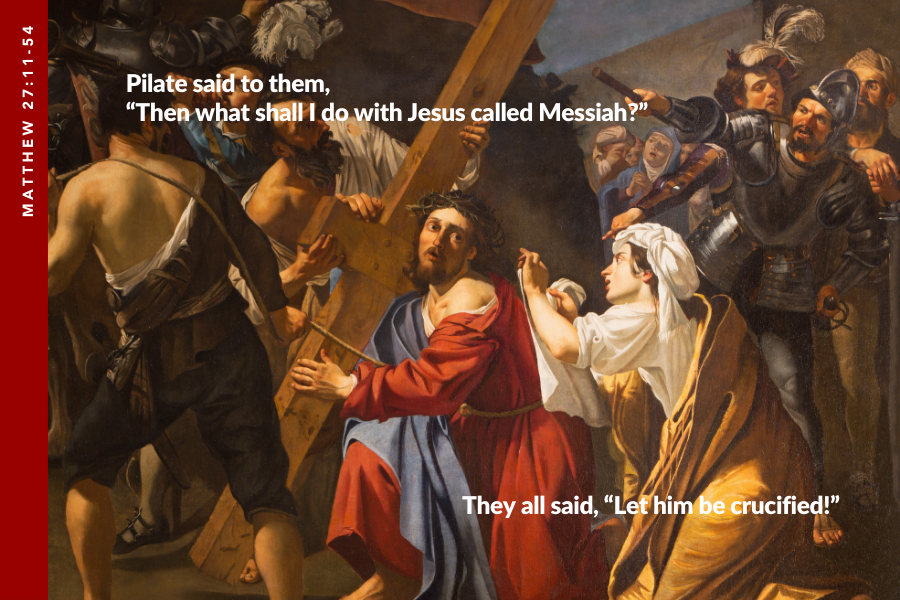
One of the Twelve, who was called Judas Iscariot, went to the chief priests and said, “What are you willing to give me if I hand him over to you?” They paid him thirty pieces of silver, and from that time on he looked for an opportunity to hand him over. On the first day of the Feast of Unleavened Bread, the disciples approached Jesus and said, “Where do you want us to prepare for you to eat the Passover?” He said, “Go into the city to a certain man and tell him, ‘The teacher says, “My appointed time draws near; in your house I shall celebrate the Passover with my disciples.”’” The disciples then did as Jesus had ordered, and prepared the Passover. When it was evening, he reclined at table with the Twelve. And while they were eating, he said, “Amen, I say to you, one of you will betray me.” Deeply distressed at this, they began to say to him one after another, “Surely it is not I, Lord?” He said in reply, “He who has dipped his hand into the dish with me is the one who will betray me. The Son of Man indeed goes, as it is written of him, but woe to that man by whom the Son of Man is betrayed. It would be better for that man if he had never been born.” Then Judas, his betrayer, said in reply, “Surely it is not I, Rabbi?” He answered, “You have said so.” While they were eating, Jesus took bread, said the blessing, broke it, and giving it to his disciples said, “Take and eat; this is my body.” Then he took a cup, gave thanks, and gave it to them, saying, “Drink from it, all of you, for this is my blood of the covenant, which will be shed on behalf of many for the forgiveness of sins. I tell you, from now on I shall not drink this fruit of the vine until the day when I drink it with you new in the kingdom of my Father.” Then, after singing a hymn, they went out to the Mount of Olives. Then Jesus said to them, “This night all of you will have your faith in me shaken, for it is written: I will strike the shepherd, and the sheep of the flock will be dispersed; but after I have been raised up, I shall go before you to Galilee.” Peter said to him in reply, “Though all may have their faith in you shaken, mine will never be.” Jesus said to him, “Amen, I say to you, this very night before the cock crows, you will deny me three times.” Peter said to him, “Even though I should have to die with you, I will not deny you.” And all the disciples spoke likewise. Then Jesus came with them to a place called Gethsemane, and he said to his disciples, “Sit here while I go over there and pray.” He took along Peter and the two sons of Zebedee, and began to feel sorrow and distress. Then he said to them, “My soul is sorrowful even to death. Remain here and keep watch with me.” He advanced a little and fell prostrate in prayer, saying, “My Father, if it is possible, let this cup pass from me; yet, not as I will, but as you will.” When he returned to his disciples he found them asleep. He said to Peter, “So you could not keep watch with me for one hour? Watch and pray that you may not undergo the test. The spirit is willing, but the flesh is weak.” Withdrawing a second time, he prayed again, “My Father, if it is not possible that this cup pass without my drinking it, your will be done!” Then he returned once more and found them asleep, for they could not keep their eyes open. He left them and withdrew again and prayed a third time, saying the same thing again. Then he returned to his disciples and said to them, “Are you still sleeping and taking your rest? Behold, the hour is at hand when the Son of Man is to be handed over to sinners. Get up, let us go. Look, my betrayer is at hand.” While he was still speaking, Judas, one of the Twelve, arrived, accompanied by a large crowd, with swords and clubs, who had come from the chief priests and the elders of the people. His betrayer had arranged a sign with them, saying, “The man I shall kiss is the one; arrest him.” Immediately he went over to Jesus and said, “Hail, Rabbi!” and he kissed him. Jesus answered him, “Friend, do what you have come for.” Then stepping forward they laid hands on Jesus and arrested him. And behold, one of those who accompanied Jesus put his hand to his sword, drew it, and struck the high priest’s servant, cutting off his ear. Then Jesus said to him, “Put your sword back into its sheath, for all who take the sword will perish by the sword. Do you think that I cannot call upon my Father and he will not provide me at this moment with more than twelve legions of angels? But then how would the Scriptures be fulfilled which say that it must come to pass in this way?” At that hour Jesus said to the crowds, “Have you come out as against a robber, with swords and clubs to seize me? Day after day I sat teaching in the temple area, yet you did not arrest me. But all this has come to pass that the writings of the prophets may be fulfilled.” Then all the disciples left him and fled. Those who had arrested Jesus led him away to Caiaphas the high priest, where the scribes and the elders were assembled. Peter was following him at a distance as far as the high priest’s courtyard, and going inside he sat down with the servants to see the outcome. The chief priests and the entire Sanhedrin kept trying to obtain false testimony against Jesus in order to put him to death, but they found none, though many false witnesses came forward. Finally two came forward who stated, “This man said, ‘I can destroy the temple of God and within three days rebuild it.’“ The high priest rose and addressed him, “Have you no answer? What are these men testifying against you?” But Jesus was silent. Then the high priest said to him, “I order you to tell us under oath before the living God whether you are the Christ, the Son of God.” Jesus said to him in reply, “You have said so. But I tell you: From now on you will see ‘the Son of Man seated at the right hand of the Power’ and ‘coming on the clouds of heaven.’” Then the high priest tore his robes and said, “He has blasphemed! What further need have we of witnesses? You have now heard the blasphemy; what is your opinion?” They said in reply, “He deserves to die!” Then they spat in his face and struck him, while some slapped him, saying, “Prophesy for us, Christ: who is it that struck you?” Now Peter was sitting outside in the courtyard. One of the maids came over to him and said, “You too were with Jesus the Galilean.” But he denied it in front of everyone, saying, “I do not know what you are talking about!” As he went out to the gate, another girl saw him and said to those who were there, “This man was with Jesus the Nazorean.” Again he denied it with an oath, “I do not know the man!” A little later the bystanders came over and said to Peter, “Surely you too are one of them; even your speech gives you away.” At that he began to curse and to swear, “I do not know the man.” And immediately a cock crowed. Then Peter remembered the word that Jesus had spoken: “Before the cock crows you will deny me three times.” He went out and began to weep bitterly. When it was morning, all the chief priests and the elders of the people took counsel against Jesus to put him to death. They bound him, led him away, and handed him over to Pilate, the governor. Then Judas, his betrayer, seeing that Jesus had been condemned, deeply regretted what he had done. He returned the thirty pieces of silver to the chief priests and elders, saying, “I have sinned in betraying innocent blood.” They said, “What is that to us? Look to it yourself.” Flinging the money into the temple, he departed and went off and hanged himself. The chief priests gathered up the money, but said, “It is not lawful to deposit this in the temple treasury, for it is the price of blood.” After consultation, they used it to buy the potter’s field as a burial place for foreigners. That is why that field even today is called the Field of Blood. Then was fulfilled what had been said through Jeremiah the prophet, And they took the thirty pieces of silver, the value of a man with a price on his head, a price set by some of the Israelites, and they paid it out for the potter’s field just as the Lord had commanded me. Now Jesus stood before the governor, and he questioned him, “Are you the king of the Jews?” Jesus said, “You say so.” And when he was accused by the chief priests and elders, he made no answer. Then Pilate said to him, “Do you not hear how many things they are testifying against you?” But he did not answer him one word, so that the governor was greatly amazed. Now on the occasion of the feast the governor was accustomed to release to the crowd one prisoner whom they wished. And at that time they had a notorious prisoner called Barabbas. So when they had assembled, Pilate said to them, “Which one do you want me to release to you, Barabbas, or Jesus called Christ?” For he knew that it was out of envy that they had handed him over. While he was still seated on the bench, his wife sent him a message, “Have nothing to do with that righteous man. I suffered much in a dream today because of him.” The chief priests and the elders persuaded the crowds to ask for Barabbas but to destroy Jesus. The governor said to them in reply, “Which of the two do you want me to release to you?” They answered, “Barabbas!” Pilate said to them, “Then what shall I do with Jesus called Christ?” They all said, “Let him be crucified!” But he said, “Why? What evil has he done?” They only shouted the louder, “Let him be crucified!” When Pilate saw that he was not succeeding at all, but that a riot was breaking out instead, he took water and washed his hands in the sight of the crowd, saying, “I am innocent of this man’s blood. Look to it yourselves.” And the whole people said in reply, “His blood be upon us and upon our children.” Then he released Barabbas to them, but after he had Jesus scourged, he handed him over to be crucified. Then the soldiers of the governor took Jesus inside the praetorium and gathered the whole cohort around him. They stripped off his clothes and threw a scarlet military cloak about him. Weaving a crown out of thorns, they placed it on his head, and a reed in his right hand. And kneeling before him, they mocked him, saying, “Hail, King of the Jews!” They spat upon him and took the reed and kept striking him on the head. And when they had mocked him, they stripped him of the cloak, dressed him in his own clothes, and led him off to crucify him. As they were going out, they met a Cyrenian named Simon; this man they pressed into service to carry his cross. And when they came to a place called Golgotha—which means Place of the Skull—, they gave Jesus wine to drink mixed with gall. But when he had tasted it, he refused to drink. After they had crucified him, they divided his garments by casting lots; then they sat down and kept watch over him there. And they placed over his head the written charge against him: This is Jesus, the King of the Jews. Two revolutionaries were crucified with him, one on his right and the other on his left. Those passing by reviled him, shaking their heads and saying, “You who would destroy the temple and rebuild it in three days, save yourself, if you are the Son of God, and come down from the cross!” Likewise the chief priests with the scribes and elders mocked him and said, “He saved others; he cannot save himself. So he is the king of Israel! Let him come down from the cross now, and we will believe in him. He trusted in God; let him deliver him now if he wants him. For he said, ‘I am the Son of God.’” The revolutionaries who were crucified with him also kept abusing him in the same way. From noon onward, darkness came over the whole land until three in the afternoon. And about three o’clock Jesus cried out in a loud voice, “Eli, Eli, lema sabachthani?” which means, “My God, my God, why have you forsaken me?” Some of the bystanders who heard it said, “This one is calling for Elijah.” Immediately one of them ran to get a sponge; he soaked it in wine, and putting it on a reed, gave it to him to drink. But the rest said, “Wait, let us see if Elijah comes to save him.” But Jesus cried out again in a loud voice, and gave up his spirit. And behold, the veil of the sanctuary was torn in two from top to bottom. The earth quaked, rocks were split, tombs were opened, and the bodies of many saints who had fallen asleep were raised. And coming forth from their tombs after his resurrection, they entered the holy city and appeared to many. The centurion and the men with him who were keeping watch over Jesus feared greatly when they saw the earthquake and all that was happening, and they said, “Truly, this was the Son of God!” There were many women there, looking on from a distance, who had followed Jesus from Galilee, ministering to him. Among them were Mary Magdalene and Mary the mother of James and Joseph, and the mother of the sons of Zebedee. When it was evening, there came a rich man from Arimathea named Joseph, who was himself a disciple of Jesus. He went to Pilate and asked for the body of Jesus; then Pilate ordered it to be handed over. Taking the body, Joseph wrapped it in clean linen and laid it in his new tomb that he had hewn in the rock. Then he rolled a huge stone across the entrance to the tomb and departed. But Mary Magdalene and the other Mary remained sitting there, facing the tomb. The next day, the one following the day of preparation, the chief priests and the Pharisees gathered before Pilate and said, “Sir, we remember that this impostor while still alive said, ‘After three days I will be raised up.’ Give orders, then, that the grave be secured until the third day, lest his disciples come and steal him and say to the people, ‘He has been raised from the dead.’ This last imposture would be worse than the first.” Pilate said to them, “The guard is yours; go, secure it as best you can.” So they went and secured the tomb by fixing a seal to the stone and setting the guard.
Opening Prayer: Jesus, thank you for dying to save me from my sins. Open my heart to hear your law of love and then write it on my heart.
Encountering Christ:
- Food for Disciples: Jesus and his disciples gathered for Passover, the Jewish Feast of Unleavened Bread. There at the Last Supper, Jesus offered his own precious Body and Blood and became our feast of unleavened bread, the Most Holy Eucharist. Christ himself became our Passover: “For our paschal lamb, Christ, has been sacrificed” (1 Cor 5:7). Jesus not only provides the feast; he is the feast. Just as Jesus provided himself as food for his first disciples, he feeds his disciples today in the same way so that we might have the strength and virtue to carry out the new commandment he gave us at the Last Supper: “… love one another. As I have loved you, so you also should love one another” (Jn 13:34). Love has become the law. When we love one another as Jesus commands, we fulfill the law of the new covenant.
- Blood of the Covenant: The Blood of Christ is the seal of our new covenant with God. Jeremiah foretold this everlasting covenant, the laws of which would be written on human hearts (cf. Jer 31:31-34). This covenant means that our sins have been forgiven through Christ’s death. St. Paul tells us, “When Christ came as high priest […] he entered once for all into the sanctuary, not with the blood of goats and calves but with his own blood, thus obtaining eternal redemption. […] For this reason he is mediator of a new covenant” (Heb 9:11-15). We live in a way that shows that this new covenant is written on our hearts when we are faithful and obedient, and, most of all, by loving one another as God has loved us.
- Stay With Jesus: What courageous love that the Blessed Virgin Mary, St. Mary Magdalene, and St. John showed when they stood at the foot of the Cross. Imagine the fear and grief that they had to overcome in order to stand in devotion to Christ at his Crucifixion. They stayed with him through his death and followed his body to be buried, keeping vigil: “Mary Magdalene and the other Mary remained sitting there, facing the tomb” (Mt 27:61). As we enter into this Holy Week, may God give us the grace to be loving, constant disciples. May we stay with Jesus as he travels from Bethany to Jerusalem to Gethsemane and to Calvary. Finally, may we sit with the women, filled with hope, and bravely face the tomb.
Conversing with Christ: Jesus, please replace my stony heart with a new heart of flesh, and then write your law of love deep inside it. Holy Spirit, come to me that I can follow the law of love by loving others as you love me (cf. Ezek 36:26-27 and Jn 13:34). Father, help me remain constant in my love for you, especially in this Holy Week.
Resolution: Lord, today by your grace I will strive to carry out your commandment to love others through my thoughts, words, and actions.
Carey Boyzuck is a wife, mother, freelance writer, and a lay member of Regnum Christi. She blogs at www.word-life-light.com.
- LATEST ARTICLES

View this profile on InstagramRegnum Christi (@regnumchristi_english) • Instagram photos and videos
- RELATED POSTS
Weekly Digest of the Regnum Christi Daily Meditations: Mar 22 – 29, 2026 Read More »

 Fr. John Bartunek was ordained in 2003. He has taught moral theology at various ecclesiastical institutions at the graduate and undergraduate levels, and has authored many books, including the Gospel companion, The Better Part, and Inside the Passion, the only authorized behind-the-scenes look at the film, for which he provided on-set spiritual support. His online retreat guides are available in multiple formats at RCSpirituality.org. Fr. John currently resides in Atlanta, where he is serving as territorial vicar for the Legionaries of Christ.