March 17, 2026

WM_LivingMercy

When Living Mercy is Personal

Dear Friends,


One of my favorite hymns in the Lenten season speaks of ways in which we can show mercy. “In these days of Lenten journey we have seen and we have heard the call to sow justice in the lives of those we serve. We reach out to those who are hopeless, hungry, weary… we will show compassion and clothe them in mercy and peace.” In taking these lyrics into prayer, I found myself considering: Where does God want me to live mercy? I found my mind moving towards the usual ways—serving in the soup kitchens, visiting the sick, stocking the food pantry in my parish, etc. I could exercise the spiritual and corporal works of mercy, and that would be beautiful. All these things are fairly easy to access and easy to do for people I do not know. But the Holy Spirit had a different idea.

My mind went to the sacrifice of Jesus. He died so that my sins could be forgiven, and perhaps He was inviting me to show mercy by forgiving from my heart every person I have encountered that brought suffering or sadness to my heart, and every person I will encounter daily. I left that prayer with a new Lenten resolution—to live mercy through intentional forgiveness. To examine my hearteach day and root out any grudges I may be holding, and forgiveness I have been withholding, laying it at the foot of the cross and leaving it there. Jesus died for the sins of all mankind, even those who deny his sacrifice. My forgiveness is not contingent on whether the person in mind “deserves” my forgiveness or not. It is freely given out of love for God. When Jesus offered his life, it was personal. He saw every person who ever lived or will live and willingly suffered for theforgiveness of their sins.

“For God so loved the world, that he gave his only begotten Son, that whoever believes in him should not perish, but have eternal life” (Jn 3:16).


Yours in the Heart of Jesus,

Donna

When Living Mercy is Personal Read More »
AltarAndAlgorithm

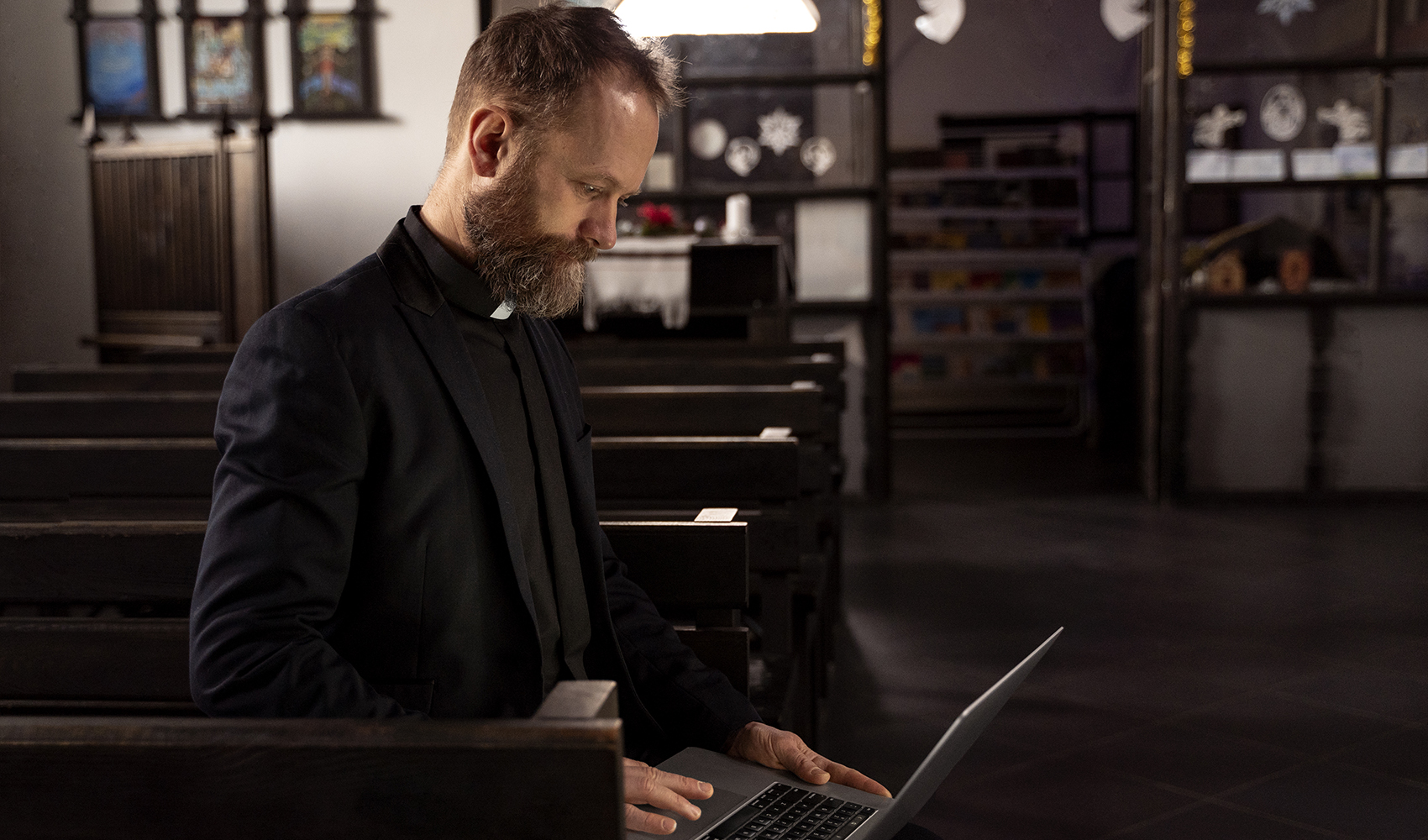
When the Altar Competes With the Algorithm: A Reflection on Fragility

There are no shortcuts to evangelical fruitfulness; it is born of hidden sacrifice united to the Lord’s and celebrated on the altar, not of public applause.

—

By Fr Benjamín Clariond, LC

I have lived long enough on earth as a priest to know that I write this more as a warning to myself than as a lesson for anyone. The temptation I want to talk about today is not new, but it has a face that our generation is just beginning to recognize.

A few days ago, I read about Fr Alberto Ravagnani, a young Italian priest—ordained in 2018—who built up an impressive social media presence: hundreds of thousands of followers on Instagram, TikTok, and YouTube. He spoke ardently about the faith, prayer, and the deep questions that young people dwell on. And he was doing it well, very well—until he decided to leave the ministry. The reasons are complex, and it is not up to us to judge them, but his story has made me think a lot recently. We pray for him with the hope that God may lead him to the fullness he is seeking.

What can this case teach us? Is social media evil? I don’t think so. The Church has always made use of the means of each era to proclaim the Gospel, and today cannot be the exception. The problem isn’t in the tool, but in something deeper that is sometimes hard for me to admit: the ease with which we can confuse service with protagonism, turning the digital world into the habitat in which we lead our lives, while neglecting the close relationships forged by pastoral charity and, above all, the personal relationship with Christ, which is the soul of all apostolate.

The Danger of Using the Wrong Measurements

Digital platforms have their own logic: likes, views, followers, engagement. Everything can be measured and compared. This logic is addictive because it gives us something we all yearn for: an immediate affirmation that what we do matters, that we are valued and accepted.

But the priesthood lives by a radically different logic. In an original reflection on this case, Father Jude Ofuani expressed it very clearly:

“Popularity demands constant growth; the priesthood demands a gradual disappearance behind the mystery that is celebrated.” This sentence struck me.

When John the Baptist said, “He must increase; I must decrease” (Jn 3:30), he was indicating the very heart of our vocation and ministry. We are not the message; at the very most, we are signs that point toward the Other. But what happens when our followers start following us and not Christ? Or when style becomes more important than content? Or when we begin to worry more about whether our digital activity “is working” than whether we are being faithful?

An Old Temptation With a New Screen

In the desert, Jesus heard, “If you are the Son of God, show yourself” (cf. Mt 4:6). This is the same voice that whispers today, “If you really have something important to say, prove it. Make it go viral. You need more outreach, more impact.”

I’m not saying that whoever uses social media to evangelize is falling into temptation. It would be absurd and arrogant to think like that; rather, we need to acknowledge the zeal and good intentions that are usually behind it. My point is that I continue to be vulnerable to that voice myself. We all are, and to some degree, we all develop a certain addiction to the dose of dopamine that social media gives us. Perhaps my younger brothers—and older ones, too—need to hear something that is not in any way intended as a reprimand, but an honest recognition of that vulnerability we share.

I have seen priests—and I have seen myself—track statistics compulsively, feel a tinge of satisfaction when something “sticks” and goes viral, or a cloud of frustration when it doesn’t. Then I wonder, “When was the moment I stopped asking myself whether I was faithful in today’s prayer and started asking myself first whether my post reached enough people?”

AltarAndAlgorithm

What Can’t Be Captured in a Photo

A good part of the priestly ministry happens in places that don’t produce content: patient listening in the confessional or in spiritual direction, visiting the sick who can’t post anything online, the hours of prayer that no one sees, periods of study to help souls better, the fatigue of repeating the same thing over and over without receiving applause. Somewhere I read that the Gospel doesn’t “work,” but “saves.” It usually exercises its transformative power in secret, in the solitude that can’t be captured in a reel or photo.

If we build our priestly identity around what is visible or measurable, or what causes reactions, what sustains us when all that disappears—which it eventually will? Algorithms change, tendencies shift, and followers leave, but the altar remains. The Eucharist remains. The cross remains. The call remains.

“Jesus Christ is the same yesterday, today, and forever”

St. Paul reminds us that “the love of Christ impels us” (2 Cor 5:14). This is not an urgency of an algorithm that demands constant content, but of experiencing the love of Christ’s heart for humanity that impels us to give of ourselves without expecting anything in return, without seeking recognition, while making use of one’s social and digital media presence. It is the urgency of one who knows that their life does not belong to them. Christ is our life, which our public image cannot be; he is the center, not us.

Words From Someone Who Needs to Hear Them, Too

I do not write this from a position of superiority. To my younger brothers, those who are in formation or are at the beginning of their priestly ministry, I can only say what I repeat to myself often:

The internet can amplify our voice, but it should not be the place where we seek to discover who we are, where our identity is defined, where we receive the affirmation we dearly need. That place is the tabernacle, the community, our superiors, the faithful we serve, the brothers who truly know us.

We may indeed use these tools, but I think we need to take care that our interior life is always stronger than our public presence. We should have clear rules and well-defined boundaries that we embrace by inner conviction, not imposed from without. We should have people around us who love us enough to tell us the truth, even when it hurts.

Authentic apostolic communication is born of an encounter with Christ, is ordered to communion, and invites us to participate in building up the Kingdom. When communication is separated from ecclesial communion and from the mission, when it becomes self-referential, then it loses its evangelizing soul. It’s not about how many people listen to us, but about whether what we communicate truly arises from our intimacy with the Lord and guides others towards him.

Above all, it is always helpful to remember that the priesthood is an offering of one’s life with Christ as Christ did, not an acting role or a realty show. When that is reversed, we lose something essential. Our self-giving should be like that of a grain of wheat that falls to the ground and dies in order to bear fruit. There are no shortcuts to evangelical fruitfulness; it is born of hidden sacrifice united to the Lord’s and celebrated on the altar, not of public applause.

One Last Thing

The case of Fr Alberto is not to condemn him or to turn him into a negative example. In a certain way, it is a sign that the whole Church needs to read with caution, care, and compassion. It reminds us that being in the digital world is not enough; we must dwell in it with our feet firmly planted in prayer, obedience, and belonging to a community.

Fragility does not decrease over time; on the contrary, every passing year confirms that without grace, we all run the same risks. Therefore, I write this as someone who also needs to be vigilant, turn to silence, and remember every morning why I kneel down and for whom I live.

May the Lord help us all—young and old—to be faithful to Christ, who has called us not to be served, but to serve (cf. Mt 20:28). At the end of the day, that is all that matters.

When the Altar Competes With the Algorithm: A Reflection on Fragility Read More »

Regnum Christi Spirituality Center Uncle Eddy

St Patrick

Dear Rick, Reading those articles you forwarded makes my blood boil.  Those people call themselves Christians, but they forget about Christ!  I guess there is room for some sociological studies and statistical analyses when it comes to evangelization, but it certainly can’t be reduced to that. God alone can grant real “success” to apostolic action, and he is its primary instigator.  If we believe in him, if we love him and make our lives an offering of love, if we trust in his omnipotence and mercy – then we will see real progress, both in our own spiritual lives and in our attempts to spread his Kingdom. Just look at today’s saint, for example. When Patrick came to evangelize the Emerald Isle (that’s Ireland, of course), it was thoroughly pagan.  The Celtic priests had a lock on the people’s hearts and minds, and the many small kingdoms were ruled by fearsome, power-mongering kings.  They terrorized the neighboring islands by raiding villages near the sea, killing the men, violating the women, and enslaving the children. Some sources indicate that they practiced human sacrifice; all agree that the magic of an advanced degree was the order of the day.  Hardly the portrait of a people primed to welcome the gospel. In fact, a few years before Patrick began his mission, Pope St Celestine I had sent the learned and talented Palladius to preach to the Irish, but he made no progress and saw no propitious prospects. After less than a year he retired hopelessly to Scotland, where, miserable, he died.   So why was Patrick able to make so much progress?  Indeed, why did his thirty-year missionary endeavor result in the wholesale conversion of all Ireland to the Catholic faith (as all historical witnesses concur)?  If you read his “Confession” (a sort of autobiography and description of the work God had done in and through him), one characteristic stands out: his utter confidence in the love and the power of God.  He wrote it in his later years (he died when he was about 70), but even just a couple sentences hint at the immense challenges that he constantly faced, as well as the secret to his inexhaustible determination and incomparable fecundity: “Daily I expect either a violent death or to be robbed and reduced to slavery or the occurrence of some such calamity… I have cast myself into the hands of the Almighty God, for he rules everything; as the Prophet says, ‘Cast your cares upon the Lord, and he himself will sustain you.’”   This wisdom had not come to him easily.  He was born of a Romano-British civil servant (who happened to be Christian a deacon as well) and a devout Christian mother.  Growing up in England, he had learned the basics of the faith, but had no interest in it. When he was 14, an Irish raiding party captured and enslaved him, and he spent the next six years of his life living outdoors in the harsh mountains where he tended his master’s sheep, and learned to pray.  He ran away from his slavery when he turned 20 and returned to England. God put it in his heart, however, to return to the land of Erin (another name for Ireland) in order to bring the true faith. It seems he went to France (called Gaul then) to study, learn the spiritual disciplines, and receive holy orders.  At about the age of forty, he returned to the country that would ever after claim him as their own St Paul, their own apostle, sent by God to lead them from pagan darkness into Christian light. That, my bright young nephew, is a Christian apostle.  Don’t let the sociologists and “experts” convince you otherwise.  The Kingdom’s expansion won’t come from more statistical studies, but it will come from more saints, because only saints trust more in God than in themselves. Happy St Patrick’s Day.  Your loving uncle, Eddy

St Patrick Read More »

26-Lent-Day-28

40 Days to Peace and Union with God: Day 28 – Stirring Things Up

“Whether I receive good or ill, I return thanks equally to God, who taught me always to trust him unreservedly.”

READ: JOHN 5:1–18

Some time after this there was a Jewish festival, and Jesus went up to Jerusalem.

Now at the Sheep Pool in Jerusalem there is a building, called Bethzatha in Hebrew, consisting of five porticos; and under these were crowds of sick people — blind, lame, paralyzed — waiting for the water to move; for at intervals the angel of the Lord came down into the pool, and the water was disturbed, and the first person to enter the water after this disturbance was cured of any ailment he suffered from. One man there had an illness which had lasted thirty-eight years, and when Jesus saw him lying there and knew he had been in this condition for a long time, he said, “Do you want to be well again?” “Sir,” replied the sick man, “I have no one to put me into the pool when the water is disturbed; and while I am still on the way, someone else gets there before me.” Jesus said, “Get up, pick up your sleeping-mat and walk.” The man was cured at once, and he picked up his mat and walked away.

Now that day happened to be the sabbath, so the Jews said to the man who had been cured, “It is the sabbath; you are not allowed to carry your sleeping-mat.” He replied, “But the man who cured me told me, ‘Pick up your mat and walk.’ ” They asked “Who is the man who said to you, ‘Pick up your mat and walk’?” The man had no idea who it was, since Jesus had disappeared into the crowd that filled the place. After a while Jesus met him in the Temple and said, “Now you are well again, be sure not to sin any more, or something worse may happen to you.” The man went back and told the Jews that it was Jesus who had cured him. It was because he did things like this on the sabbath that the Jews began to persecute Jesus. His answer to them was, “My Father goes on working, and so do I.” But that only made the Jews even more intent on killing him, because, not content with breaking the sabbath, he spoke of God as his own Father, and so made himself God’s equal.

YOUR THREE-STEP GUIDE TO DAILY MENTAL PRAYER

REFLECT

This man had been ill for thirty-eight years. It seems from Jesus’ later comment when they meet in the Temple that his own sins had been the cause of his illness. It was an illness that made him an invalid, helpless and incapable of contributing to the society around him. And to top it all off, he was a lonely man. He didn’t have any friend or family member who could help him down to the pool after the stirring of the waters. And then one day, a young rabbi comes up to him. He squats down beside him, looks into his eyes, and asks him if he wants to be cured. Jesus is always taking the initiative in our lives. He knows what we need more than we do. He knows how much we have suffered and how our sins have damaged our souls. He comes to heal and renew us.

The sick man: Of course I wanted to be cured. That’s why I was still waiting at the pool. It seemed an odd question to me. So I looked up at this man. I looked into His eyes as I told Him that I wasn’t fast enough to make it to the healing waters. What I said didn’t seem to matter. He looked at me intently but gently. I don’t know how else to describe it. And then He seemed to smile, and there was a fire in His eyes. And He told me to get up, pick up my sleeping mat, and walk. I thought to myself, “Doesn’t He see that I can’t get up, that I can’t carry anything, let alone my sleeping mat? I can’t even walk! Doesn’t He see me?” For thirty-eight years I had been lame, unable to do any of those things, and this man was telling me to stand up. It was a crazy thing to say. But His eyes weren’t crazy. He just kept looking at me intently. I was going to tell Him what a crazy idea it was, but His eyes wouldn’t let me. Somehow, the fire in His eyes kindled one in my own, and all of a sudden, I knew that I just had to do what He was telling me. But how could I? I had to try. Even as part of me objected — it was such an absurd thing that He was saying — I couldn’t help but start to hope. And He kept looking at me and, well, I don’t know how it happened, but I just started to get up, and all of a sudden, I could. And then I picked up my mat. And I started walking. After thirty-eight years! I turned to thank Him — but He was gone.

RESPOND

Why didn’t the leaders of Jerusalem believe in You? They saw Your miracles, but even that couldn’t pry their hearts away from their self-centeredness. It seems so unreasonable. And yet can I say that my faith is robust and confident? Am I not like those leaders, unable to free myself from my self-centeredness, in spite of all You have done for me? Teach me, Lord, to do Your will. Increase my faith.

Many times, the little things You ask me to do seem impossible. How can I be patient and kind to people who irritate me, who are ungrateful? How can I overcome the repugnance I feel sometimes in the face of my responsibilities? How can I simply trust You when so many things go wrong and nothing seems to work? Lord, I believe in You. If you tell me to get up and walk, I will. Thy will be done.

REST

I want to be as generous as You are, Lord. You saw this man, knew his suffering, and came to his rescue. You have made me Your ambassador; You want me to do the same for everyone around me. You want me to keep my eyes open for opportunities to serve, help, and do good. You want me to make that my obsession, as it was Yours. Give me Your grace, Lord, so that I, too, can “go on working.”

RESOLVE

How can I carry this encounter with me into the day? (Write / Journal)

CLOSING PRAYER OF THANKSGIVING

Most Blessed and Holy Trinity, Father, Son, and Holy Spirit, thank You for Your love and Your grace in allowing me this time of prayer with You.

The world, the flesh, and the devil will all propose things I should focus on and run after today. I beg You to fill me with Your Holy Spirit and help me instead to know and embrace Your will. Help me to see what You desire of me each moment of this day. Give me the wisdom, strength, and fortitude I need to avoid distractions, discern Your will, and focus on and carry out that which Wisdom reveals. Help me to work and live at a pace of peace and prayerfulness, always attentive to You, able to hear Your voice and to say no to anything that hinders my journey to You and a complete yes to every Holy prompting from You.

Help me to humbly and purposefully live, light, and lead others to the path of union with You and to tell everyone about this way of life. Amen.

About the Author

Bartunek-headshotFr. John Bartunek was ordained in 2003. He has taught moral theology at various ecclesiastical institutions at the graduate and undergraduate levels, and has authored many books, including the Gospel companion, The Better Part, and Inside the Passion, the only authorized behind-the-scenes look at the film, for which he provided on-set spiritual support. His online retreat guides are available in multiple formats at RCSpirituality.org. Fr. John currently resides in Atlanta, where he is serving as territorial vicar for the Legionaries of Christ.

40 Days to Peace and Union with God: Day 28 – Stirring Things Up Read More »

26-03-17-DM

March 17, 2026 – Desire Holiness and Healing

Fourth Sunday of Lent


John 5:1-16

There was a feast of the Jews, and Jesus went up to Jerusalem. Now there is in Jerusalem at the Sheep Gate a pool called in Hebrew Bethesda, with five porticoes. In these lay a large number of ill, blind, lame, and crippled. One man was there who had been ill for thirty-eight years. When Jesus saw him lying there and knew that he had been ill for a long time, he said to him, “Do you want to be well?” The sick man answered him, “Sir, I have no one to put me into the pool when the water is stirred up; while I am on my way, someone else gets down there before me.” Jesus said to him, “Rise, take up your mat, and walk.” Immediately the man became well, took up his mat, and walked. Now that day was a sabbath. So the Jews said to the man who was cured, “It is the sabbath, and it is not lawful for you to carry your mat.” He answered them, “The man who made me well told me, ‘Take up your mat and walk.’” They asked him, “Who is the man who told you, ‘Take it up and walk’?” The man who was healed did not know who it was, for Jesus had slipped away, since there was a crowd there. After this Jesus found him in the temple area and said to him, “Look, you are well; do not sin any more, so that nothing worse may happen to you.” The man went and told the Jews that Jesus was the one who had made him well. Therefore, the Jews began to persecute Jesus because he did this on a sabbath.

Opening Prayer: Lord Jesus, I believe that rivers of living water flow from within you. You are the source of my interior life, and I thank you for your life that you freely give to me. Lord, grant me the grace to see you as the source of living water, and to be grateful for all that you give me.

Encountering Christ:

  1. Oppressive Self-Pity: Jesus visited the pool of Bethesda specifically to seek out the poor and lame, because his heart is magnanimous and seeks to do good. At the pool he discovered a man who had been ill for thirty-eight years, a tough shake even for sturdy souls. Unfortunately, this man seemed to be focused only on himself. When Jesus approached asking, “Do you want to be well?” the man explained, “I have no one to put me into the pool when the water is stirred up.” We can sometimes complicate our relationship with Jesus by making excuses, overexplaining, or rationalizing, instead of answering his invitation to become saints by saying simply, “Yes, Lord, I want to do your will,” as life’s circumstances present themselves.


  2. Desire—Healing: The ill man’s self-pity was coupled with a fearful ingratitude. After Jesus healed him, he was questioned by the Pharisees, and he distanced himself from Jesus. He eventually revealed Jesus’ identity to the Pharisees as the one responsible for making him break the sabbath by carrying his mat. Jesus knew the man’s character. Yet, he saw the man’s desire to be healed, and that desire was enough for Jesus’ magnanimous heart to overflow with healing waters.


  3. Desire—Holiness: Jesus told the man, “Look, you are well; do not sin any more.” He says the same to us every time we go to Confession. Christ wants a total conversion from us, and the graces of Confession are what we need to sin no more. Jesus, grant us the desire for conversion and holiness!

Conversing with Christ: Lord, you know how I want to draw close to you—draw me in, more and more! Increase in me the fire of desire for holiness that you have already lit, and fan the flame with your love. Amen.

Resolution: Lord, today by your grace I will exercise patience with someone I find difficult. I will listen to them sincerely.

For Further Reflection: Do you ever say an act of contrition outside of the confessional? It’s a good practice. There are many versions available or you can use your own words. Here’s one based on the Gospels:

Father of mercy, like the prodigal son I return to you and say: “I have sinned against you and am no longer worthy to be called your child.”

Christ Jesus, Savior of the world, I pray with the repentant thief to whom you promised Paradise: “Lord, remember me in your kingdom.”

Holy Spirit, fountain of love, I call on you with trust: “Purify my heart, and help me to walk as a child of light.”

Brian Flanagan is a Regnum Christi member from Atlanta, Georgia.

March 17, 2026 – Desire Holiness and Healing Read More »

Ask a Priest: “What Is Our Obligation to Animals?”

Q: I am a non-practicing theist with an interest in Christianity, but I am very put off by my experiences with other Christians based on what I perceive to be dismissive or cruel attitudes that some Christians and other religious people have toward animals. For context, I am a strict vegan, and I believe that killing animals in situations where it is unnecessary is morally wrong. I am disgusted by the practice of factory farming and when I ask others why they do not feel sympathy for those animals or animals in general, I often hear that “animals do not have souls” or that “God put animals on earth for us to eat,” which is something that I unequivocally refuse to believe. Does the Bible or current doctrine say anything about our moral obligation toward animals or provide reasoning behind the suffering that they experience in nature? I do not want to come off as naive, but based on what I understand, many of the moral lessons provided by the New Testament and the relationship between suffering and God only seem sensible to me if you interpret them from an anthropocentric viewpoint. Thank you for your time. — Yohan

Answered by Fr. Edward McIlmail, LC:

A: The Catholic Church recognizes that God has given us the world and its animals and plants, in part, to sustain us.

It teaches that cruelty to animals is to be avoided, however, and that there should be balanced use of things in the world.

A few passages from the Catechism of the Catholic Church are worth quoting here:

Respect for the integrity of creation

2415 The seventh commandment enjoins respect for the integrity of creation. Animals, like plants and inanimate beings, are by nature destined for the common good of past, present, and future humanity. Use of the mineral, vegetable, and animal resources of the universe cannot be divorced from respect for moral imperatives. Man’s dominion over inanimate and other living beings granted by the Creator is not absolute; it is limited by concern for the quality of life of his neighbor, including generations to come; it requires a religious respect for the integrity of creation.

2416 Animals are God’s creatures. He surrounds them with his providential care. By their mere existence they bless him and give him glory. Thus men owe them kindness. We should recall the gentleness with which saints like St. Francis of Assisi or St. Philip Neri treated animals.

2417 God entrusted animals to the stewardship of those whom he created in his own image. Hence it is legitimate to use animals for food and clothing. They may be domesticated to help man in his work and leisure. Medical and scientific experimentation on animals is a morally acceptable practice, if it remains within reasonable limits and contributes to caring for or saving human lives.

2418 It is contrary to human dignity to cause animals to suffer or die needlessly. It is likewise unworthy to spend money on them that should as a priority go to the relief of human misery. One can love animals; one should not direct to them the affection due only to persons. [end quoted material]

As for the suffering that animals endure in nature: This is a bit of a complicated question since part of the pain is simply a part of natural cycles and the way an environment works. Some animals eat other animals to sustain themselves.

Then there is the pain inflicted unnecessarily by man. This can be linked to original sin — the damaged nature we inherit from Adam. But that’s another topic altogether.

The Church also teaches, as mentioned in the first chapter of Genesis, that man is made in God’s image. Animals reflect something of God’s creative glory, but they don’t have intellects or wills or immortal souls and hence aren’t on the level as humans.

God built a hierarchy of creatures in the world. It’s part of the way he revealed his glory. But that, too, is another topic altogether.

For related reading, see this Catholic Answers post.

I hope some of this helps. Count on my prayers.

Ask a Priest: “What Is Our Obligation to Animals?” Read More »

Scroll to Top

Events

Looking for another country?

Contact Regnum Christi near you

News & Resources

News & Resources

The Regnum Christi Mission

The Regnum Christi Identity

Alex Kucera

Atlanta

Alex Kucera has lived in Atlanta, GA, for the last 46 years. He is one of 9 children, married to his wife Karmen, and has 3 girls, one grandson, and a granddaughter on the way. Alex joined Regnum Christi in 2007. Out of the gate, he joined the Helping Hands Medical Missions apostolate and is still participating today with the Ghana Friendship Mission.

In 2009, Alex was asked to be the Atlanta RC Renewal Coordinator for the Atlanta Locality to help the RC members with the RC renewal process. Alex became a Group Leader in 2012 for four of the Atlanta Men’s Section Teams and continues today. Running in parallel, in 2013, Alex became a Team Leader and shepherded a large team of good men.

Alex was honored to be the Atlanta Mission Coordinator between 2010 to 2022 (12 years), coordinating 5-8 Holy Week Mission teams across Georgia. He also created and coordinated missions at a parish in Athens, GA, for 9 years. Alex continues to coordinate Holy Week Missions, Advent Missions, and Monthly missions at Good Shepherd Catholic Church in Cumming, GA.

From 2016 to 2022, Alex also served as the Men’s Section Assistant in Atlanta. He loved working with the Men’s Section Director, the Legionaries, Consecrated, and Women’s Section leadership teams.

Alex is exceptionally grateful to the Legionaries, Consecrated, and many RC members who he’s journeyed shoulder to shoulder, growing his relationship with Christ and others along the way. He knows that there is only one way, that’s Christ’s Way, with others!