Weekly Digest of the Regnum Christi Daily Meditations: Feb 22 – Mar 1, 2026
WEEKLY DIGEST OF rc
DAILY MEDITATIONS
Week of February 22 - March 1, 2026
Sunday, February 22, 2026 – Voices in the Desert
Monday, February 23, 2026 – Jesus, Where Are You Today?
Tuesday, February 24, 2026 – How to Pray. Really.
Wednesday, February 25, 2026 – Signs to Heed
Thursday, February 26, 2026 – Ask, Seek, Knock
Friday, February 27, 2026 – Come Alive!
February 22, 2026 – Voices in the Desert
First Sunday of Lent
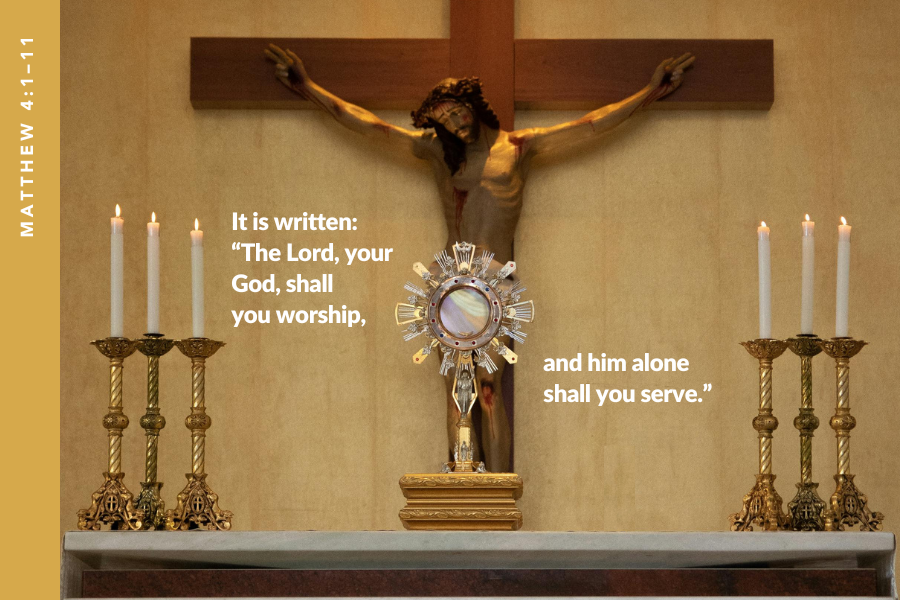
Matthew 4:1-11
At that time Jesus was led by the Spirit into the desert to be tempted by the devil. He fasted for forty days and forty nights, and afterwards he was hungry. The tempter approached and said to him, “If you are the Son of God, command that these stones become loaves of bread.” He said in reply, “It is written: ‘One does not live on bread alone, but on every word that comes forth from the mouth of God.’” Then the devil took him to the holy city, and made him stand on the parapet of the temple, and said to him, “If you are the Son of God, throw yourself down. For it is written: ‘He will command his angels concerning you and with their hands they will support you, lest you dash your foot against a stone.’” Jesus answered him, “Again it is written: ‘You shall not put the Lord, your God, to the test.’” Then the devil took him up to a very high mountain, and showed him all the kingdoms of the world in their magnificence, and he said to him, “All these I shall give to you, if you will prostrate yourself and worship me.” At this, Jesus said to him, “Get away, Satan! It is written: ‘The Lord, your God, shall you worship and him alone shall you serve.’” Then the devil left him and, behold, angels came and ministered to him.
Opening Prayer: Holy Spirit, descend upon us who are gathered all around the world today to pray. Enlighten your Church at the beginning of Lent and teach us to read and interpret Scripture in a way that reveals the loving heart of the Father through the words and deeds of Our Lord Jesus Christ.
Encountering Christ:
- Seeking a Desert Experience: When a person retreats into the desert, the noise of daily life fades away. Amidst a sandy expanse and under the speckless blue dome of the sky, the world is reduced to a basic setting. In that setting, as distractions subside, God often touches the soul. His soft voice becomes audible, his gentle touch discernable. Jesus was a man of prayer, and he sought out the right settings for profound spiritual encounters with his Father. For a disciple, following Jesus’ traces today means seeking out a place that is conducive for prayer.
- Recognizing Temptation: The desert is a favorable place to hear God’s voice. However, today’s Gospel shows that there are also other voices there. “The tempter approached.” How often are there thoughts, worries, and temptations at the back of our mind that weigh the soul down—anxieties that paralyze us, false expectations that mislead us, lies that confuse us, ambitions that seduce us. These voices can have many sources, but they are often vehicles for the tempter to pester us. In a prayerful atmosphere, we can identify these temptations that are disturbing our soul. As Jesus shows in today’s Gospel, to unmask an inner movement as a plain temptation is already half the victory.
- Eyes on the Father: To identify a temptation often clears the fog in our mind, and sometimes that is all it takes to overcome it. However, sharp wit alone is not always the solution, for it takes willpower to decide to do the right thing. And our will is often so weak, is it not? Jesus’ answers to the tempter teach us an important lesson for overcoming temptations. Every time the devil tried to mislead him with some shrewd logic, Jesus directed and redirected his heart toward God the Father: at the Father who nourishes him; at the Father whom he will not tempt; at the Father whom alone he will serve. The antidote to counteract temptation is to direct one’s heart to the Father, because to overcome a temptation does not mean merely to opt against something, but rather to opt for something—for someone who will quench our soul’s thirst rather than intoxicate it.
Conversing with Christ: My Lord, allow me to pray at your side. Allow me to wrestle with the temptations of my life at your side. I glance at you and witness your wholehearted trust in the Father. I want to imitate that loving trust. I renew my faith in the fact that, through Baptism, I participate in your life and in your grace. Kindle your love for the Father in my own heart, so that your love in my heart will overcome every temptation.
Resolution: Lord, today by your grace I will identify a temptation that has been present in the back of my mind and which has been weighing me down. I will confront it at your side during this period of Lent, while directing my heart to the Father.
For Further Reflection: Catechism of the Catholic Church, 2847:
The Holy Spirit makes us discern between trials, which are necessary for the growth of the inner man, and temptation, which leads to sin and death. We must also discern between being tempted and consenting to temptation. Finally, discernment unmasks the lie of temptation, whose object appears to be good, a “delight to the eye”’ and desirable, when in reality its fruit is death. God does not want to impose the good, but wants free beings… There is a certain usefulness to temptation. No one but God knows what our soul has received from him, not even we ourselves. But temptation reveals it in order to teach us to know ourselves, and in this way we discover our evil inclinations and are obliged to give thanks for the goods that temptation has revealed to us.
Father Gabriel von Wendt, LC, is a priest who works as a professor at the Pontifical Athenaeum Regina Apostolorum. He has a passion for philosophy and the role of Catholic faith in contemporary culture. He is a co-founding member of the Catholic Worldview Fellowship, a study-abroad program for talented college students who want to evangelize culture.
February 23, 2026 – Jesus, Where Are You Today?
Monday of the First Week of Lent
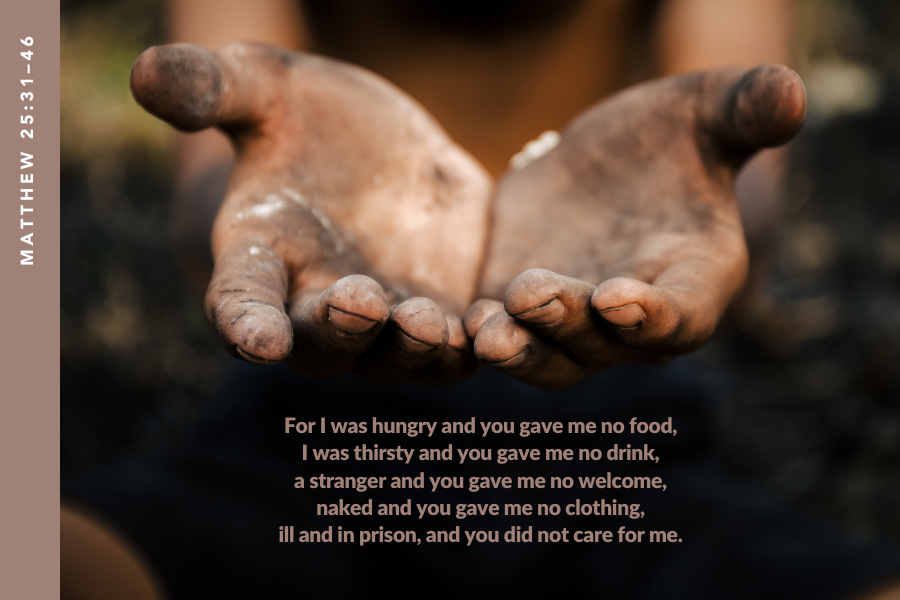
Matthew 25:31-46
Jesus said to his disciples: “When the Son of Man comes in his glory, and all the angels with him, he will sit upon his glorious throne, and all the nations will be assembled before him. And he will separate them one from another, as a shepherd separates the sheep from the goats. He will place the sheep on his right and the goats on his left. Then the king will say to those on his right, ‘Come, you who are blessed by my Father. Inherit the kingdom prepared for you from the foundation of the world. For I was hungry and you gave me food, I was thirsty and you gave me drink, a stranger and you welcomed me, naked and you clothed me, ill and you cared for me, in prison and you visited me.’ Then the righteous will answer him and say, ‘Lord, when did we see you hungry and feed you, or thirsty and give you drink? When did we see you a stranger and welcome you, or naked and clothe you? When did we see you ill or in prison, and visit you?’ And the king will say to them in reply, ‘Amen, I say to you, whatever you did for one of these least brothers of mine, you did for me.’ Then he will say to those on his left, ‘Depart from me, you accursed, into the eternal fire prepared for the Devil and his angels. For I was hungry and you gave me no food, I was thirsty and you gave me no drink, a stranger and you gave me no welcome, naked and you gave me no clothing, ill and in prison, and you did not care for me.’ Then they will answer and say, ‘Lord, when did we see you hungry or thirsty or a stranger or naked or ill or in prison, and not minister to your needs?’ He will answer them, ‘Amen, I say to you, what you did not do for one of these least ones, you did not do for me.’ And these will go off to eternal punishment, but the righteous to eternal life.”
Opening Prayer: My Lord, you invite me today to reflect on the end of my days and to prepare for the end of time. Enlighten me so that your words can fall on fertile ground in my heart. I believe in you; strengthen my faith in your loving guidance.
Encountering Christ:
- How to Draw Near: I want to encounter God. How can I do that? This is the key challenge to which every religion has sought a response. By means of certain rituals, by diligent spiritual activities, by moral behavior, or by select knowledge, the human efforts to ensure an encounter with God are countless. And they usually bear a nugget of truth in them. However, if we are honest, we must admit that we cannot do anything to ensure an encounter with the transcendent God on our own accord. It is he who has to take the initiative and come to our encounter. No ritual will ever ensnare God, no meditation will ever conjure his apparition, no merit will buy his friendship, and no insight will gain power over him. The first step to an encounter with God is his to make.
- God Reaches Out: In effect, the Almighty has always made that first step to encounter us. Throughout the history of salvation, God revealed himself to humanity and so allowed for a religious response that is more than petty attempts to breach an infinite gap. As a response to his revelation, rituals have meaning, prayers have an addressee, morality has a heart, and reason is enlightened by faith. Yes, we can encounter God, thanks to his initiative. Liturgy, prayer, good deeds, and contemplation are genuine ways to encounter him.
- Another Way to Encounter God: In addition to prayer, liturgy, and deeds, today’s Gospel introduces another way to reach God. By depicting the scene of the Last Judgment, Jesus quite clearly and even shockingly declares that a privileged way of encountering him is by encountering our neighbor—above all, the smallest and poorest among them. We want to encounter God. This is why we pray and meditate and attend the liturgy—and rightly so. Today, Jesus reminds us that he also waits for us in the many people around us who could use our help.
Conversing with Christ: My Lord, unite my heart with your heart at this moment. Allow me to look at my day through your eyes. I want to see what you see. In whom are you waiting for me today? In the needy person that waits at my doorstep? In the sad friend that waits for my call? In the angry family member that waits for my apology or for my forgiveness? Jesus, show me where you are today, so I can come encounter you.
Resolution: Lord, today by your grace I will intentionally look for you in one of my neighbors.
For Further Reflection: Catechism of the Catholic Church, 2447:
The works of mercy are charitable actions by which we come to the aid of our neighbor in his spiritual and bodily necessities. Instructing, advising, consoling, comforting are spiritual works of mercy, as are forgiving and bearing wrongs patiently. The corporal works of mercy consist especially in feeding the hungry, sheltering the homeless, clothing the naked, visiting the sick and imprisoned, and burying the dead. Among all these, giving alms to the poor is one of the chief witnesses to fraternal charity: it is also a work of justice pleasing to God.
Father Gabriel von Wendt, LC, is a priest who works as a professor at the Pontifical Athenaeum Regina Apostolorum. He has a passion for philosophy and the role of Catholic faith in contemporary culture. He is a co-founding member of the Catholic Worldview Fellowship, a study-abroad program for talented college students who want to evangelize culture.
February 24, 2026 – How to Pray. Really.
Tuesday of the First Week of Lent
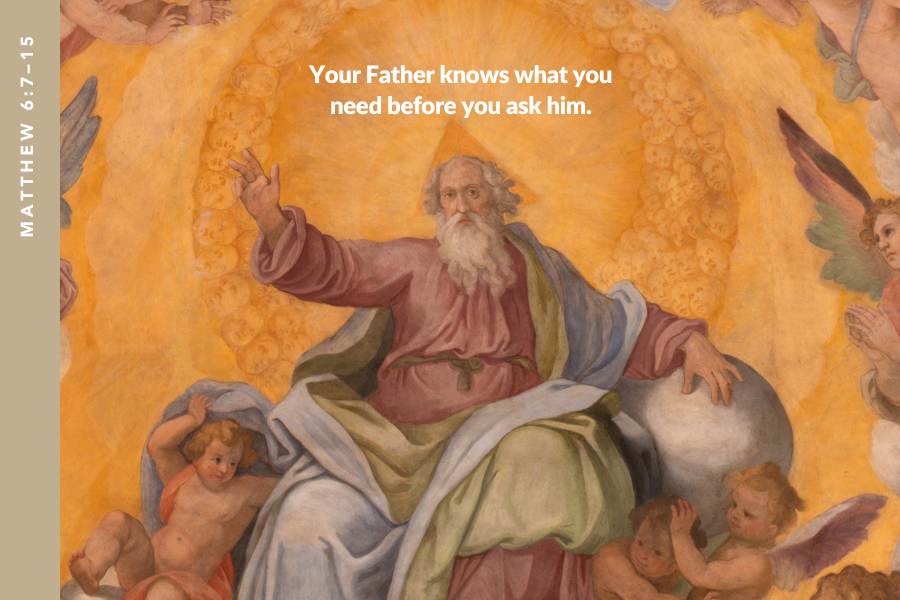
Matthew 6:7-15
Jesus said to his disciples: “In praying, do not babble like the pagans, who think that they will be heard because of their many words. Do not be like them. Your Father knows what you need before you ask him. This is how you are to pray: ‘Our Father who art in heaven, hallowed be thy name, thy kingdom come, thy will be done, on earth as it is in heaven. Give us this day our daily bread; and forgive us our trespasses, as we forgive those who trespass against us; and lead us not into temptation, but deliver us from evil.’ If you forgive men their transgressions, your heavenly Father will forgive you. But if you do not forgive men, neither will your Father forgive your transgressions.”
Opening Prayer: My Lord, teach me how to pray. I want to recollect myself and become aware of your presence here and of your words for me now.
Encountering Christ:
- Prayer Is Tricky: We can successfully teach even to the smallest child how to pray and might yet fail to explain what prayer is to the smartest person on the planet. It is simple and complicated at the same time, not just for others, but also for us. Prayer is tricky. And it appears that the most difficult part to explain is neither the technique, nor the proper intention, nor the right words. All of that can be learned. No, the trickiest part of prayer is whether there is really someone there who hears it. The hardest part is to be confident or even certain that God is there listening to what I babble, or recite, or ask.
- Prayer Begins with Faith: Before we start talking in our prayer, we must activate and renew our faith in God’s presence and loving interest in our life. This is how an intimate meditation could start each time: “God, I believe that you are with me now; enkindle my faith in your presence and in your fatherly care for me.” When the heart feels the gaze of the Almighty upon it, prayer flows on its own. This is also why children are often better at praying than adults: They usually know how to act in the presence of the Father, trusting and certain of his presence, love, and protection.
- Jesus Teaches Us: In today’s Gospel, Jesus teaches his disciples how it sounds when God’s sons or daughters talk to their Father. Each phrase of the Our Father pulses with the certainty of God’s presence. And the petitions come alive on our lips when they are fueled by the faith that Jesus revealed to us: God is present, he is our loving Father, he wants our eternal happiness and wholesomeness, and he will give us all that is conducive to our salvation.
Conversing with Christ: My Lord Jesus Christ, you have become man in order to lift us up and bestow on us the identity of being the Father’s beloved sons and daughters in you. I am a child of the loving Father. And I believe that he looks at my soul in this very moment with all his love and fatherly care. Bathed in that light, I now pray: “Our Father…”
Resolution: Lord, today by your grace I will remind myself consciously of God’s presence and of his loving gaze in the midst of my daily activities.
For Further Reflection: Catechism of the Catholic Church, 257:
“O blessed light, O Trinity and first Unity!” God is eternal blessedness, undying life, unfading light. God is love: Father, Son and Holy Spirit. God freely wills to communicate the glory of his blessed life. Such is the “plan of his loving kindness,” conceived by the Father before the foundation of the world, in his beloved Son: “He destined us in love to be his sons” and “to be conformed to the image of his Son,” through ‘the spirit of sonship.” This plan is a “grace [which] was given to us in Christ Jesus before the ages began,” stemming immediately from Trinitarian love. It unfolds in the work of creation, the whole history of salvation after the fall, and the missions of the Son and the Spirit, which are continued in the mission of the Church.
Father Gabriel von Wendt, LC, is a priest who works as a professor at the Pontifical Athenaeum Regina Apostolorum. He has a passion for philosophy and the role of Catholic faith in contemporary culture. He is a co-founding member of the Catholic Worldview Fellowship, a study-abroad program for talented college students who want to evangelize culture.
February 25, 2026 – Signs to Heed
Wednesday of the First Week of Lent
Luke 11:29-32
While still more people gathered in the crowd, Jesus said to them, “This generation is an evil generation; it seeks a sign, but no sign will be given it, except the sign of Jonah. Just as Jonah became a sign to the Ninevites, so will the Son of Man be to this generation. At the judgment the queen of the south will rise with the men of this generation and she will condemn them, because she came from the ends of the earth to hear the wisdom of Solomon, and there is something greater than Solomon here. At the judgment the men of Nineveh will arise with this generation and condemn it, because at the preaching of Jonah they repented, and there is something greater than Jonah here.”
Opening Prayer: My Lord, you have visited your children and spoken to us through words and deeds. Send down upon me your Spirit, so that I can recognize your signs and set out on a path of conversion during this Lent season.
Encountering Christ:
- Three Signs: In today’s Gospel, Jesus deals with three signs: the sign of Jonah, the sign of Solomon, and the sign of his own life and death. Jonah had been sent to the city of Nineveh to preach to an unlawful people. God had chosen Jonah to be his prophet and had thus made him into a sign to communicate his message. Against all odds, Jonah’s efforts bore fruit as the people examined their conscience and started to repent. They saw the sign and heeded its message. What would Jonah’s proclamation trigger in our own conscience if we met him today? Lent is a time in which God sends us signs that can help us to examine our thoughts, words, deeds, and omissions. Lent is a time of conversion.
- The Sign of Solomon: What kind of a sign was Solomon? Why did other rulers, such as the Queen of the South, come to see him? Solomon was a sign of wisdom, not only during his time but throughout history, as tradition keeps referring to him as the wisest among kings. Wisdom is the noblest gift of the Holy Spirit and enables a person to see the world as God sees it and to be docile to divine inspiration. Solomon was a sign of wisdom for generations, and the Spirit wants to work through signs in our life too. This Lent, let us pray for greater attentiveness to the Spirit in prayer.
- Jesus Is the Final Sign: Jesus explains that he does not intend to replace the ancient signs of Jonah or Solomon. In fact, he has come to fulfill the old signs and show the completion of their truth. Thus, Jesus reiterates the need for us to examine our conscience and to repent, and, like Solomon, he irradiates the wisdom of someone who sees the world through the eyes of God. A “wicked generation” which would not heed the former signs will not heed the sign that is Jesus himself—so he foretells. This means that the only way to approach the sign of Jesus, his loving sacrifice and glorious Resurrection, is by cultivating the attitude that the old signs were meant to prepare in God’s people: an awareness of our need for redemption, a willingness to convert, a sincere intention to follow God’s lead. If these are our attitudes, then Jesus’ words and deeds will fall on fertile ground in our hearts. Then we will see his sign and believe.
Conversing with Christ: My Lord Jesus Christ, as I make the Sign of the Cross or contemplate your Crucifixion, I remind myself of what moved you to make this sacrifice. After a time of helping humanity to recognize its state and after sowing the desire for redemption in us, you climbed Mount Calvary to gain the salvation we needed. I thank you and I praise you for redeeming me.
Resolution: Lord, today by your grace I will examine my conscience seeking God’s forgiveness and committing to conversion. This could be an occasion to prepare a good confession during this Lenten season.
For Further Reflection: Catechism of the Catholic Church, 1427-1429:
Jesus calls us to conversion. This call is an essential part of the proclamation of the kingdom: “The time is fulfilled, and the kingdom of God is at hand; repent, and believe in the gospel.” In the Church’s preaching this call is addressed first to those who do not yet know Christ and his Gospel. Also, Baptism is the principal place for the first and fundamental conversion. It is by faith in the Gospel and by Baptism that one renounces evil and gains salvation, that is, the forgiveness of all sins and the gift of new life. Christ’s call to conversion continues to resound in the lives of Christians. This second conversion is an uninterrupted task for the whole Church who, “clasping sinners to her bosom, [is] at once holy and always in need of purification, [and] follows constantly the path of penance and renewal.” This endeavor of conversion is not just a human work. It is the movement of a “contrite heart,” drawn and moved by grace to respond to the merciful love of God who loved us first. St. Peter’s conversion after he had denied his master three times bears witness to this. Jesus’ look of infinite mercy drew tears of repentance from Peter and, after the Lord’s Resurrection, a threefold affirmation of love for him. The second conversion also has a communitarian dimension, as is clear in the Lord’s call to a whole Church: “Repent!”
Father Gabriel von Wendt, LC, is a priest who works as a professor at the Pontifical Athenaeum Regina Apostolorum. He has a passion for philosophy and the role of Catholic faith in contemporary culture. He is a co-founding member of the Catholic Worldview Fellowship, a study-abroad program for talented college students who want to evangelize culture.
February 26, 2026 – Ask, Seek, Knock

Thursday of the First Week of Lent
Matthew 7:7-12
Jesus said to his disciples: “Ask and it will be given to you; seek and you will find; knock and the door will be opened to you. For everyone who asks, receives; and the one who seeks, finds; and to the one who knocks, the door will be opened. Which one of you would hand his son a stone when he asked for a loaf of bread, or a snake when he asked for a fish? If you then, who are wicked, know how to give good gifts to your children, how much more will your heavenly Father give good things to those who ask him. Do to others whatever you would have them do to you. This is the law and the prophets.”
Opening Prayer: My Lord, I stand before you as someone who has many needs. You remind me today that you are more than happy to help me out with all of my struggles. Strengthen my trust, so that I can allow you to lighten my burden.
Encountering Christ:
- “Ask And It Will Be Given to You”: What does it mean to ask for something? First, we identify a void or need within ourselves which we intend to remedy. This intention drives us to act, but instead of trying to fill the void by ourselves, we often opt to engage another person as the source of the good we desire—be it information, an object, or a benefit. In approaching the other, we acknowledge the gratuity of the other person’s response to our request. Thus, asking for something is different from fixing something by oneself. Asking is different from taking or demanding it from someone. Asking is different from controlling. Asking is dealing with a need in an open-ended way. In the spiritual life, the desire to control, to demand, or to fix things on our own are often obstacles. In the spiritual life, we must learn to ask properly. We must learn to trust. This is what Jesus wants to teach us today.
- “Seek And You Will Find”: In a similar way, Jesus encourages us to set out on the spiritual journey of discipleship by seeking. Seeking, too, is open-ended. Someone who seeks doesn’t know what he will find. On the other hand, logic suggests that we certainly cannot find anything if we do not seek. Again, here lies a truth for our spiritual life which Christ wishes to teach us: Life in general, and spiritual life in particular, often presents us with findings that surprise us, as they will not align accurately with our expectations. He who is certain about what the future brings will not react docily to findings that he did not expect. Jesus wants us to seek and find surprises so that we can learn to be docile to God’s inspirations.
- “Knock And the Door Will Be Opened to You”: Jesus encourages us to shift the weight in our spiritual life. Whether we ask for something, or seek something, or knock at a door, these actions always involve someone else on whom we depend for an answer, or for a clue, or to open the door for us. Jesus wants us to learn to depend on God as we progress on our life’s journey—to exchange control for trust, certainty for docility, self-centeredness for God-centeredness.
Conversing with Christ: My Lord Jesus Christ, here I am asking and seeking and knocking. I am willing to shift the weight of my life in your direction. I know what that means: that I depend on you, that I ask for your generosity, that I need you. I ask for your grace, I seek your will, I knock at your door to find you.
Resolution: Lord, today by your grace I will do for another (a friend, my spouse, a colleague, a family member) what I am expecting them to do for me.
For Further Reflection: Catechism of the Catholic Church, 1787-1789:
Man is sometimes confronted by situations that make moral judgments less assured and decision difficult. But he must always seriously seek what is right and good and discern the will of God expressed in divine law. To this purpose, man strives to interpret the data of experience and the signs of the times assisted by the virtue of prudence, by the advice of competent people, and by the help of the Holy Spirit and his gifts. Some rules apply in every case:
– One may never do evil so that good may result from it;
– the Golden Rule: “Whatever you wish that men would do to you, do so to them.”
– charity always proceeds by way of respect for one’s neighbor and his conscience: “Thus sinning against your brethren and wounding their conscience . . . you sin against Christ.” Therefore “it is right not to . . . do anything that makes your brother stumble.”
Father Gabriel von Wendt, LC, is a priest who works as a professor at the Pontifical Athenaeum Regina Apostolorum. He has a passion for philosophy and the role of Catholic faith in contemporary culture. He is a co-founding member of the Catholic Worldview Fellowship, a study-abroad program for talented college students who want to evangelize culture.
February 27, 2026 – Come Alive!
Friday of the First Week of Lent
Matthew 5:20-26
Jesus said to his disciples: “I tell you, unless your righteousness surpasses that of the scribes and Pharisees, you will not enter into the kingdom of heaven. You have heard that it was said to your ancestors, ‘You shall not kill; and whoever kills will be liable to judgment.’ But I say to you, whoever is angry with his brother will be liable to judgment, and whoever says to his brother, ‘Raqa,’ will be answerable to the Sanhedrin, and whoever says, ‘You fool,’ will be liable to fiery Gehenna. Therefore, if you bring your gift to the altar, and there recall that your brother has anything against you, leave your gift there at the altar, go first and be reconciled with your brother, and then come and offer your gift. Settle with your opponent quickly while on the way to court. Otherwise your opponent will hand you over to the judge, and the judge will hand you over to the guard, and you will be thrown into prison. Amen, I say to you, you will not be released until you have paid the last penny.”
Opening Prayer: My Lord, you reveal to us the fullness of what it means to become truly human. I renew my faith that your guidance will lead me to this fulfillment.
Encountering Christ:
- “Old Law”: The Ten Commandments constitute the foundation of the moral order, which God revealed to his people, and they also mirror the ethical guidelines which man can discover rationally by reflection and examination of conscience. These commandments give moral order, they point into the direction of moral goodness, and they mark borders to protect us from great moral evils. To follow the Ten Commandments means to resist our disordered tendencies towards sin. To provide us with these parameters was among God’s first projects, in order to solidify his covenant with humanity.
- “New Law”: At first glance, Jesus seems to challenge the Old Law when he calls out: “But I say to you…” However, we know that he did not intend to take away “the smallest letter from the law.” In fact, Matthew has explicitly reported this intention of Jesus in the two verses which precede today’s pericope (cf. Mt 5:18-19). If we go even further back, to the beginning of Chapter 5, we find the Beatitudes and understand that Jesus wanted to go beyond the basic rules, beyond a law that prevents man from sinning. For Jesus wanted to redeem, to renew, to re-create us. Indeed, the final project of God’s covenant with us is to lead man to his true fullness. And that fullness consists of more than following rules and restraining from falling into temptation. It constitutes a new life.
- Christ’s Law Within Us: This is what Christian ethics is ultimately about—closing the gap between being good and being holy, making the leap from merely controlling our tendency for doing evil to fostering and nourishing our tendency for doing good. This leap, this transformation into a truly virtuous person, is not the result of an external law; it is not the result of the Old Law alone. The New Man carries a New Law inside him: a law which consists of the silent whisper of the Holy Spirit in our hearts, who not only informs us, but empowers us to love the good. Thus, Jesus did not only demand higher standards by giving us a New Law, but he also empowered us to fulfill them. This is our Christian faith: We live a new life in Christ. He lives in us. His love can spread in our hearts, and thereby we come fully alive. Our true potential is not activated by avoiding the big sins. We come fully alive and whole when we live in Christ and Christ lives in us. Then we will “love and do as we will,” as St. Augustine puts it.
Conversing with Christ: My Lord Jesus Christ, while I renew my commitment to follow the laws which revelation, my reason, and the Church present to me, I also want to pay attention to your New Law inside me. I want to discover the workings of your Spirit in my heart. Help me not to resist his inspirations and help me to distinguish them from my own voice. Love through me, O Lord.
Resolution: Lord, today by your grace I will identify a moment today in which I can practice the New Law by allowing you to direct my heart toward wanting what you want.
For Further Reflection: Catechism of the Catholic Church, 1968:
The Law of the Gospel fulfills the commandments of the Law. The Lord’s Sermon on the Mount, far from abolishing or devaluing the moral prescriptions of the Old Law, releases their hidden potential and has new demands arise from them: it reveals their entire divine and human truth. It does not add new external precepts, but proceeds to reform the heart, the root of human acts, where man chooses between the pure and the impure, where faith, hope, and charity are formed and with them the other virtues. The Gospel thus brings the Law to its fullness through imitation of the perfection of the heavenly Father, through forgiveness of enemies and prayer for persecutors, in emulation of the divine generosity.
Father Gabriel von Wendt, LC, is a priest who works as a professor at the Pontifical Athenaeum Regina Apostolorum. He has a passion for philosophy and the role of Catholic faith in contemporary culture. He is a co-founding member of the Catholic Worldview Fellowship, a study-abroad program for talented college students who want to evangelize culture.
February 28, 2026 – The Heart of the World

Saturday of the First Week of Lent
Matthew 5:43-48
Jesus said to his disciples: “You have heard that it was said, You shall love your neighbor and hate your enemy. But I say to you, love your enemies, and pray for those who persecute you, that you may be children of your heavenly Father, for he makes his sun rise on the bad and the good, and causes rain to fall on the just and the unjust. For if you love those who love you, what recompense will you have? Do not the tax collectors do the same? And if you greet your brothers and sisters only, what is unusual about that? Do not the pagans do the same? So be perfect, just as your heavenly Father is perfect.”
Opening Prayer: My Lord, let your Spirit widen my heart through your words and with your wisdom. Help me to become more like you and teach me to love my neighbor as you love me.
Encountering Christ:
- Love My Enemies?: Jesus’ invitation to love one’s enemies is so well known that it has become proverbial. Nevertheless, consider how shocking this idea is! An enemy in the proper sense is someone who explicitly wants our ill. To experience such aggression is truly dark. And there seem to be only two options for reacting to it. You either respond aggressively in kind, or you swallow the injustice and assume the role of a victim. In both cases, the darkness of animosity is likely to swallow you. Animosity is a bad thing; it is a black hole that threatens to suck us in.
- Jesus Proposes a Different Option: To react to animosity with love means neither aggression nor victimization. Love does not swallow injustice but dips it in light, thus vanquishing the toxic black hole. How is such a thing possible? Who can illuminate a black hole? Only someone who is the source of light itself. Herein lies Jesus’ glorious victory. For when the enemy par excellence seized him, the source of goodness and the heart of the world, and tried to swallow him in death, death could not quench his light. On the contrary, his divine light filled the abyss of death and woke all those who had been swallowed by it. Jesus’ heart vanquished death as it resumed beating; his light erased the black hole; his love dissolved the relentless power of the enemy.
- How Can You Truly Love Your Enemy? Only in Christ. For when Jesus’ resurrected and glorified heart started to beat again on the third day, it became the pulse that animates a new creation; one in which we participate through grace beginning on the day of our Baptism. Jesus’ heart is the heart of the redeemed world and, therefore, should become our heart. When Jesus’ light started to illuminate the night, it immediately started spreading among the disciples whom he had bound to his heart as members of his body. When Jesus’ love defeated and redeemed those who had killed him—his enemies—he also called on his friends and empowered them through the gift of the Holy Spirit to participate in this love. Jesus’ heart pumps love into his friends. All of this means we can love our enemies, in a truly redeeming way, if we do so in Christ, if we allow him to love in us, if his heart becomes our heart.
Conversing with Christ: My Lord Jesus Christ, you look at me and see me. Sometimes, with grief, you see an enemy in me, someone who is capable of sinning and thus of offending you. However, you always react to my animosity in the same way: You love me and keep loving me. Your love has vanquished my sin, and you have redeemed me from its grip. And you offer me this gift time and again, as often as I fall back into the traps of evil. Today, I thank you for your love and for your mercy. And I raise my gaze to the horizon where I might see people that move against me, my enemies. Lord, I have experienced how your love has saved me from the darkness. Allow me, through your love, to love my enemies.
Resolution: Lord, today by your grace I will examine where I need your help in order to love my enemies. I want to love like you, love with you, love in you.
For Further Reflection: Catechism of the Catholic Church, 1825:
Christ died out of love for us, while we were still “enemies.” The Lord asks us to love as he does, even our enemies, to make ourselves the neighbor of those farthest away, and to love children and the poor as Christ himself. The Apostle Paul has given an incomparable depiction of charity: “Charity is patient and kind, charity is not jealous or boastful; it is not arrogant or rude. Charity does not insist on its own way; it is not irritable or resentful; it does not rejoice at wrong, but rejoices in the right. Charity bears all things, believes all things, hopes all things, endures all things.”
Father Gabriel von Wendt, LC, is a priest who works as a professor at the Pontifical Athenaeum Regina Apostolorum. He has a passion for philosophy and the role of Catholic faith in contemporary culture. He is a co-founding member of the Catholic Worldview Fellowship, a study-abroad program for talented college students who want to evangelize culture.
March 1, 2026 – Terms of Endearment
Second Sunday of Lent
Matthew 17:1-9
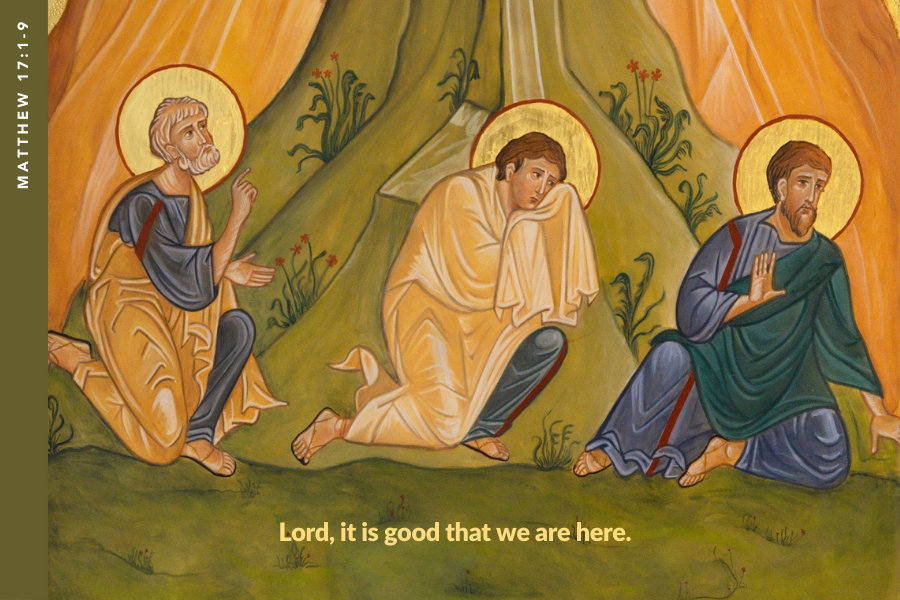
Jesus took Peter, James, and John his brother, and led them up a high mountain by themselves. And he was transfigured before them; his face shone like the sun and his clothes became white as light. And behold, Moses and Elijah appeared to them, conversing with him. Then Peter said to Jesus in reply, “Lord, it is good that we are here. If you wish, I will make three tents here, one for you, one for Moses, and one for Elijah.” While he was still speaking, behold, a bright cloud cast a shadow over them, then from the cloud came a voice that said, “This is my beloved Son, with whom I am well pleased; listen to him.” When the disciples heard this, they fell prostrate and were very much afraid. But Jesus came and touched them, saying, “Rise, and do not be afraid.” And when the disciples raised their eyes, they saw no one else but Jesus alone. As they were coming down from the mountain, Jesus charged them, “Do not tell the vision to anyone until the Son of Man has been raised from the dead.”
Opening Prayer: Holy Trinity, shine down upon me as I begin my prayer. Father, I invoke your aid. Son, I praise your majesty. Holy Spirit, I bless your glorious name. Glory be to the Father, and to the Son, and to the Holy Spirit, now and forever, Amen.
Encountering Christ:
- “And He Was Transfigured Before Them”: Why does the Church present this Gospel passage to us at the beginning of Lent? The most direct answer is that it is a preparation for Christ’s suffering and death on Good Friday. In St. Mark’s account, Jesus quizzed his friends just after coming down from the mountain: “How is it written regarding the Son of Man that he must suffer greatly and be treated with contempt?” He tried to get them thinking. “You have just seen me in glory; what would you say if I told you I would soon be in disgrace?” Christ showed himself in his glory on the mountain so that his Apostles would not be scandalized or fall away when they saw him naked and crowned with thorns. In my own life, Christ has often given me periods of clarity and consolation to prepare me for times of darkness and confusion.
- Terms of Endearment: The Holy Trinity is present on Mount Tabor. The voice is of the Father. In the cloud we see the Spirit. And the Son is glorified. Truly, the glory of God himself is present on the holy mountain! Along with the Apostles, we overhear the tender words of the Father for his dear Son: “This is my beloved Son, with whom I am well pleased.” Jesus is loved by his Father. Jesus is loved by his friends, the Apostles. He is also adored by his Blessed Mother Mary. Jesus, beloved of all hearts! “Fretted by sallies of his mother’s kisses / With light upon him from his father’s eyes!”—William Wordsworth
- Lent: Climbing up “a high mountain” is hard work. When they got there, the Apostles didn’t particularly enjoy hearing the Father’s voice: “They fell prostrate and were very much afraid.” Additionally, in the twelfth verse the disciples received some bad news: “So also will the Son of Man suffer.” Lent can be a toilsome journey up a figurative mountain. We can tend to get wrapped up in ourselves and our own crosses, forgetting that Easter will come. We endure Lenten hardships, but always with Jesus, and he rewards us on Easter Sunday with a taste of celestial glory, a bit of Paschal joy.
Conversing with Christ: Jesus, you are Lord indeed. You are the only Son of the Father, sitting at his right hand, interceding for me as I continue on this journey of Lent. You enjoy transfigured glory, heavenly glory, for all time. Encourage me by your Holy Spirit and strengthen me for this Lenten journey.
Resolution: Lord, today by your grace I will devoutly pray the Glory Be three times.
For Further Reflection: “Ode: Intimations of Immortality from Recollections of Early Childhood,” by William Wordsworth.
Fr Erik Burckel, LC was ordained to the priesthood in 2022. He writes articles and short stories for diverse purposes and publications, and can be reached at eburckel@legionaries.org.
- LATEST ARTICLES

View this profile on InstagramRegnum Christi (@regnumchristi_english) • Instagram photos and videos
- RELATED POSTS
Weekly Digest of the Regnum Christi Daily Meditations: Feb 22 – Mar 1, 2026 Read More »


 Fr. John Bartunek was ordained in 2003. He has taught moral theology at various ecclesiastical institutions at the graduate and undergraduate levels, and has authored many books, including the Gospel companion, The Better Part, and Inside the Passion, the only authorized behind-the-scenes look at the film, for which he provided on-set spiritual support. His online retreat guides are available in multiple formats at RCSpirituality.org. Fr. John currently resides in Atlanta, where he is serving as territorial vicar for the Legionaries of Christ.