Weekly Digest of the Regnum Christi Daily Meditations: Feb 15 – 22, 2026
WEEKLY DIGEST OF rc
DAILY MEDITATIONS
Week of February 15 - February 22, 2026
Sunday, February 15, 2026 – Command Me, Lord
Monday, February 16, 2026 – Sign Seeking
Tuesday, February 17, 2026 – What, No Bread?
Wednesday, February 18, 2026 – For Your Glory, Abba
Thursday, February 19, 2026 – One Day at a Time
Friday, February 20, 2026 – Rejoice, The Bridegroom is Here
February 15, 2026 – Command Me, Lord

Sunday of the Sixth Week in Ordinary Time
Matthew 5:17-37
Jesus said to his disciples: “Do not think that I have come to abolish the law or the prophets. I have come not to abolish but to fulfill. Amen, I say to you, until heaven and earth pass away, not the smallest letter or the smallest part of a letter will pass from the law, until all things have taken place. Therefore, whoever breaks one of the least of these commandments and teaches others to do so will be called least in the kingdom of heaven. But whoever obeys and teaches these commandments will be called greatest in the kingdom of heaven. I tell you, unless your righteousness surpasses that of the scribes and Pharisees, you will not enter the kingdom of heaven. You have heard that it was said to your ancestors, You shall not kill; and whoever kills will be liable to judgment. But I say to you, whoever is angry with his brother will be liable to judgment; and whoever says to his brother, ‘Raqa,’will be answerable to the Sanhedrin; and whoever says, ‘You fool,’ will be liable to fiery Gehenna. Therefore, if you bring your gift to the altar, and there recall that your brother has anything against you, leave your gift there at the altar, go first and be reconciled with your brother, and then come and offer your gift. Settle with your opponent quickly while on the way to court. Otherwise your opponent will hand you over to the judge, and the judge will hand you over to the guard, and you will be thrown into prison. Amen, I say to you, you will not be released until you have paid the last penny. You have heard that it was said, You shall not commit adultery. But I say to you, everyone who looks at a woman with lust has already committed adultery with her in his heart. If your right eye causes you to sin, tear it out and throw it away. It is better for you to lose one of your members than to have your whole body thrown into Gehenna. And if your right hand causes you to sin, cut it off and throw it away. It is better for you to lose one of your members than to have your whole body go into Gehenna. It was also said, Whoever divorces his wife must give her a bill of divorce. But I say to you, whoever divorces his wife—unless the marriage is unlawful—causes her to commit adultery, and whoever marries a divorced woman commits adultery. Again you have heard that it was said to your ancestors, Do not take a false oath, but make good to the Lord all that you vow. But I say to you, do not swear at all; not by heaven, for it is God’s throne; nor by the earth, for it is his footstool; nor by Jerusalem, for it is the city of the great King. Do not swear by your head, for you cannot make a single hair white or black. Let your ‘Yes’ mean ‘Yes,’ and your ‘No’ mean ‘No.’ Anything more is from the evil one.”
Opening Prayer: Lord Jesus, grant me the grace to embrace your most holy will, confident that what you ask of me is for my ultimate good.
Encountering Christ:
- The Commands of God: Jesus’ Sermon on the Mount echoes Exodus 24:15-18, which recounts how God’s glory appeared as a consuming fire on top of Mount Sinai. On the seventh day, the Lord called out to Moses, who ascended, went to the center of the cloud for forty days, and returned with the Ten Commandments. The commandments are like a moral compass, establishing boundaries in accordance with our dignity. But when Moses descended from God’s presence to the valley of the people, he was disappointed to find an unfaithful people. They had fallen into idol worship. How easy it is to fall below the baseline when there is no one to instruct, encourage, or motivate us. How do I perceive the commands of God, of the Church? Do I feel like they are impositions and demands of God? Do I experience any resistance towards Jesus’ words, towards the Church’s teachings? What do I wrestle with?
- The Power of God’s Word: God is not a cruel master who imposes his demands. He seeks our fulfillment as persons created in his image. Therefore, he never leaves us alone and without aid to accomplish his will. Isaiah foretold of the efficacy of God’s Word: “So shall my word be that goes forth from my mouth; It shall not return to me empty, but shall do what pleases me, achieving the end for which I sent it” (Isa 55:11). The Father could see his children struggling, and so he sent his Son, not merely to remind us of the law and the prophets, but to fulfill the law. Jesus is the Word of God. His commands are not external demands made upon us, but a way to fulfill us, to “beautify” us by grace as we fight against selfishness. He allows us to participate in the efficacy of his Word at work within us as we consent with the obedience of faith.
- The Assent: Jesus calls his listeners to live by a higher standard, yet he merely reveals what is already present within us: our internal compass for living as children of God. His commands are like “train tracks” that keep us from derailing into idol worship, the idol of self. Do Our Lord’s commands resonate with me? Do I seek to understand these words of Jesus, particularly through the teaching magisterium of the Church, as the God-given authority to interpret and teach revelation?
Conversing with Christ: Jesus, I desire to assent so as to “ascend” to meet you on that Mount. You call me out of the valley of selfishness to the heights of intimacy by inviting me to be one in mind and heart. Help me to be a faithful son or daughter of the Church.
Resolution: Lord, today by your grace I will recognize a teaching of the Church that I wrestle with or do not understand and resolve to pray and study about it.
Jennifer Ristine is a consecrated woman of Regnum Christi who is dedicated to spiritual and faith formation through teaching, conferences, writing, and spiritual direction. While serving in Ancient Magdala she wrote Mary Magdalene: Insights from Ancient Magdala.
February 16, 2026 – Sign Seeking

Monday of the Sixth Week in Ordinary Time
Mark 8:11-13
The Pharisees came forward and began to argue with Jesus, seeking from him a sign from heaven to test him. He sighed from the depth of his spirit and said, “Why does this generation seek a sign? Amen, I say to you, no sign will be given to this generation.” Then he left them, got into the boat again, and went off to the other shore.
Opening Prayer: Lord Jesus, grant me a deeper faith that assents to your ways even when I don’t receive the sign that I expect.
Encountering Christ:
- The Signs We Seek: The Pharisees had just witnessed the multiplication of the loaves and fishes, but that miracle didn’t satisfy them. Perhaps they were seeking signs according to their own presuppositions, their own logic? In those days, some believed that the bread from heaven, the manna of Exodus, would return with the coming of the Messiah. The bread from heaven was indeed before them (Jesus would allude to this in Jn 6:35, “I am the bread of life”), yet they failed to recognize him. Jesus would institute the Eucharist at the Last Supper, and they missed it, too. Do I predetermine how God will act in my life in order to have faith? Or do I exercise faith to see what is before me, allowing space for mystery?
- The Sigh and the Sign: All through the Old Testament, God sent signs, foreshadowing what was to come to fulfillment in and through Jesus Christ, his Son. But here the Pharisees, who represented those whose are blind due to presuppositions, failed to recognize the fulfillment of all signs, the most efficacious sign, the Sacrament of God that stood before them. And Jesus sighed from the depth of his spirit, disappointed at their lack of faith. It seems that the breath that once gave life to our first parents at the beginning of time has no clay to bring to life, no faith to work with.
- He Went Off to the Other Shore: What was Jesus to do? By their doubt, the Pharisees closed the door to his salvific action, so he went to the “other shore.” The Gentiles, knowing nothing of signs, would be given the opportunity to expand their horizons of faith. New life can awaken in the most remote and surprising of places because all it requires is an open heart; one willing to let go of self-righteous presuppositions; one willing to be humble before mystery.
Conversing with Christ: Jesus, increase my faith and help me live in the mystery of your unseen but always present grace. Help me to assent to your ways, not mine.
Resolution: Lord, today by your grace I will make an act of faith in your life-giving presence despite my own judgment of a situation.
Jennifer Ristine is a consecrated woman of Regnum Christi who is dedicated to spiritual and faith formation through teaching, conferences, writing, and spiritual direction. While serving in Ancient Magdala she wrote Mary Magdalene: Insights from Ancient Magdala.
February 17, 2026 – What, No Bread?
Tuesday of the Sixth Week in Ordinary Time
Mark 8:14-21
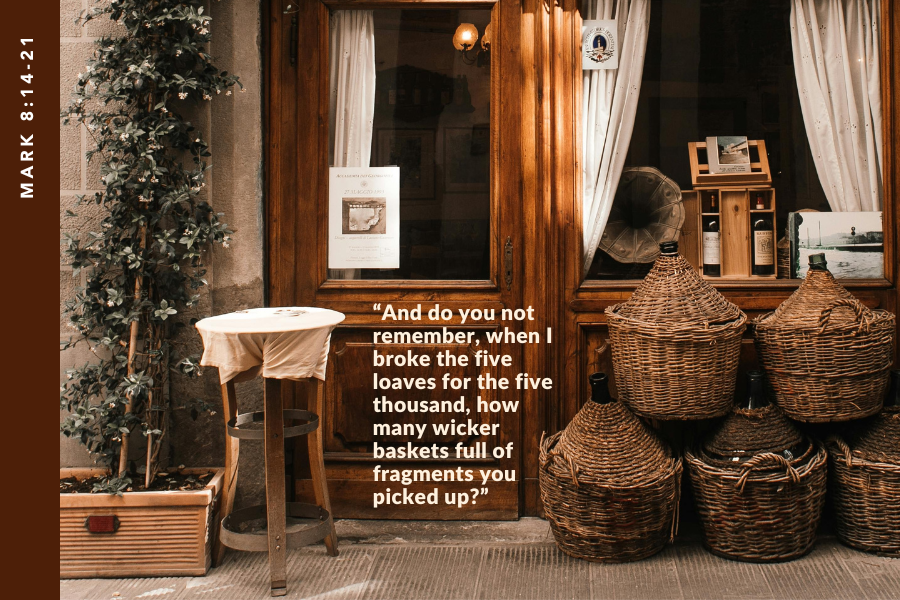
The disciples had forgotten to bring bread, and they had only one loaf with them in the boat. Jesus enjoined them, “Watch out, guard against the leaven of the Pharisees and the leaven of Herod.” They concluded among themselves that it was because they had no bread. When he became aware of this he said to them, “Why do you conclude that it is because you have no bread? Do you not yet understand or comprehend? Are your hearts hardened? Do you have eyes and not see, ears and not hear? And do you not remember, when I broke the five loaves for the five thousand, how many wicker baskets full of fragments you picked up?” They answered him, “Twelve.” “When I broke the seven loaves for the four thousand, how many full baskets of fragments did you pick up?” They answered him, “Seven.” He said to them, “Do you still not understand?”
Opening Prayer: Lord Jesus, grant me a deeper desire to encounter you in every circumstance of my life and recognize the gifts you offer me.
Encountering Christ:
- Jesus Prompts Faith: Despite their witnessing healings, raisings from the dead, expulsions of evil spirits, and power over nature, even in Jesus’ disciples faith was still lacking. He warned his disciples to beware of the leaven of the Pharisees and Herod. They represented two extreme schools: those who maintained rigidity in human laws at the expense of being open to mystery, versus those who opened themselves to all practices and lack adherence of any revealed truth. Both groups believed they were justified in their beliefs and actions; one group was justified by its law-abiding actions, the other was justified by personal whims. Both created their set of beliefs for justification and salvation according to their self-defined standards, independent of an objective truth. Both faltered in authentic faith and failed to recognize the visitation of their Lord. Jesus prompted the disciples to faith when he saw they failed to recognize him. He reminded them of his two miracles of the multiplication of the loaves (a sign of his universal salvific intent), and that he is the way to all righteousness and justification.
- Twelve and Seven: The two miracles represent Jesus’ offering of new life to both the nation of Israel and the Gentile nation. He was offering universal salvation by personally providing what they needed for the journey. Twelve baskets full represent the twelve tribes of Israel whom God first established as his chosen people to preserve belief in the one true God. The seven baskets left over represent the seven nations of the Gentiles to whom salvation is extended. While salvation is universal, the way to salvation is through Jesus. He warned his disciples to beware of the false way of salvation offered by the two extreme philosophies.
- True Bread from Heaven: The good leaven that Jesus offers is faith in his person. The miracles of the loaves echoed past signs and pointed prophetically to the future bread from heaven. The Old Testament manna fell from heaven to offer nourishment to the chosen people as they traveled through the desert to the Promised Land. It was a gift given for the journey, but it halted when they arrived. As the fullness of time approached, longing for that bread from heaven increased among those anticipating the coming of the Messiah. Jesus came to nourish that hunger. He gives us his own Body and Blood, an offering for our sustenance, as we continue the journey to our promised land, heaven. He gives us his very Body and Blood that we might have eternal life in him.
Conversing with Christ: Jesus, grant me an authentic and living faith. May I be leaven in this world by my testimony of faith in you and your Eucharist.
Resolution: Lord, today by your grace I will be attentive to any false leaven in my way of thinking, especially any thoughts that make me my own “savior” and arbiter of the way.
For Further Reflection: Catechism of the Catholic Church on Justification, #1987-1995, https://www.vatican.va/archive/ENG0015/__P6Y.HTM.
Jennifer Ristine is a consecrated woman of Regnum Christi who is dedicated to spiritual and faith formation through teaching, conferences, writing, and spiritual direction. While serving in Ancient Magdala she wrote Mary Magdalene: Insights from Ancient Magdala.
February 18, 2026 – For Your Glory, Abba
Ash Wednesday
Matthew 6:1-6, 16-18
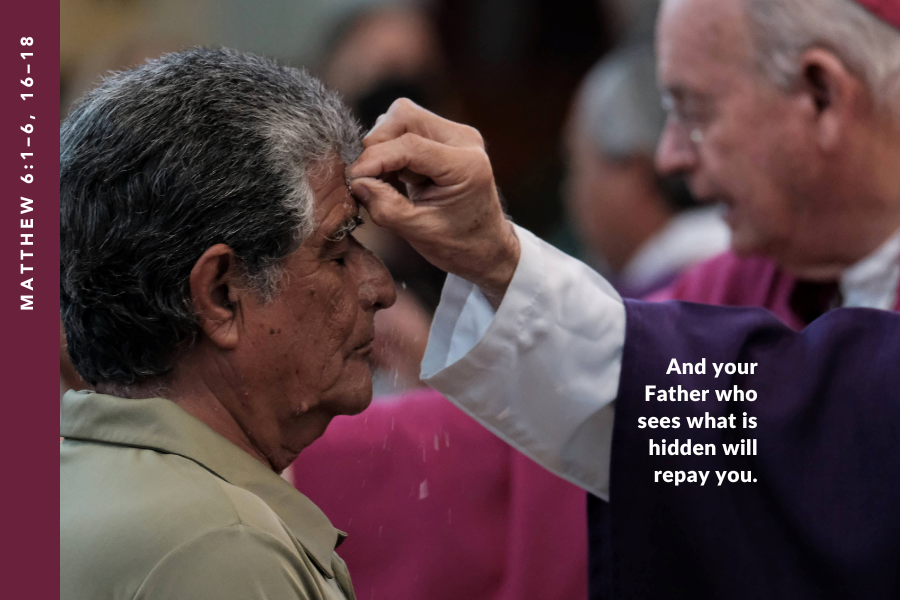
Jesus said to his disciples: “Take care not to perform righteous deeds in order that people may see them; otherwise, you will have no recompense from your heavenly Father. When you give alms, do not blow a trumpet before you, as the hypocrites do in the synagogues and in the streets to win the praise of others. Amen, I say to you, they have received their reward. But when you give alms, do not let your left hand know what your right is doing, so that your almsgiving may be secret. And your Father who sees in secret will repay you. When you pray, do not be like the hypocrites, who love to stand and pray in the synagogues and on street corners so that others may see them. Amen, I say to you, they have received their reward. But when you pray, go to your inner room, close the door, and pray to your Father in secret. And your Father who sees in secret will repay you. When you fast, do not look gloomy like the hypocrites. They neglect their appearance, so that they may appear to others to be fasting. Amen, I say to you, they have received their reward. But when you fast, anoint your head and wash your face, so that you may not appear to be fasting, except to your Father who is hidden. And your Father who sees what is hidden will repay you.”
Opening Prayer: Lord Jesus, grant me a purity of heart that seeks to love you for your sake alone.
Encountering Christ:
- The Tendencies of the Heart: In these three admonitions, Jesus warns against hypocrisy of heart. Do not pray, give alms, or fast for the sake of appearance. This human tendency of vainglory seems naturally ingrained within us. We sometimes stake a claim on our works so as to take all the credit in the eyes of others. But Jesus invites us to rediscover a deeper tendency within our heart. Prayer, almsgiving, and fasting are all noble endeavors. They reveal the human spirit’s desire to communicate with God (prayer), to selflessly provide for those in need (almsgiving), and participate in a spiritually redemptive act (fasting). Made in God’s image, we have these noble desires within, but they can get tainted by disordered self-love. Jesus invites me during this penitential season to examine and purify my love by prayer, almsgiving, and fasting.
- For the Father: As God’s children, we live in the Father’s loving gaze. Who but God knows the depths of our human intention? Rather than fearing his wrath, we are encouraged and strengthened by our Father who wants to see his children live with the selfless heart of his Son. This is a transformation process that takes time, collaboration, and grace. It is above all a growth in our identity as sons and daughters of God, in a heart-to-heart relationship. As God becomes more real, more of a Father, we respond not with a self-preserving egotism, but with a sincere and loving surrender to our heavenly Father.
- Your Reward: Jesus says that the Father who sees in secret will repay me. I can’t think of any prouder moment than when I received praise from my own father on earth. How blessed would I be to hear from my heavenly father, “This is my beloved son or daughter, in whom I am well pleased” (Mt 17:5). This Lent, I want to orient all of my actions and thoughts toward the glory of the Father, knowing beyond a shadow of a doubt that my efforts please him.
Conversing with Christ: Jesus, I desire a pure heart that loves you above all else, especially above my own self-image and ego. I trust that you will transform my heart more and more into your image. Let me hear your words, “This is my beloved son or daughter, in whom I am well pleased.”
Resolution: Lord, today by your grace I will make an act of purity of intention, offering my prayer, sacrifice, and works to please my heavenly Father above all else.
Jennifer Ristine is a consecrated woman of Regnum Christi who is dedicated to spiritual and faith formation through teaching, conferences, writing, and spiritual direction. While serving in Ancient Magdala she wrote Mary Magdalene: Insights from Ancient Magdala.
February 19, 2026 – One Day at a Time
Thursday after Ash Wednesday
Luke 9:22-25
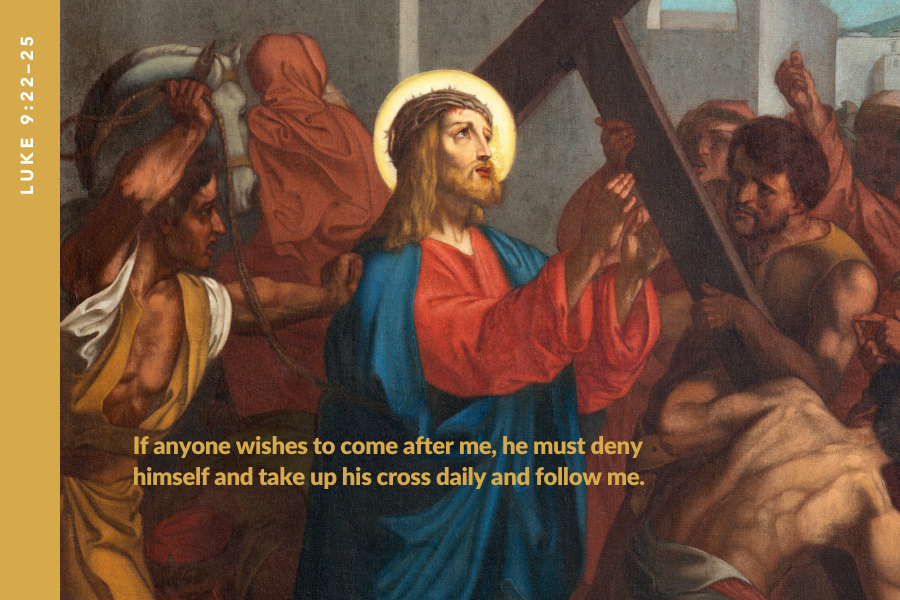
Jesus said to his disciples: “The Son of Man must suffer greatly and be rejected by the elders, the chief priests, and the scribes, and be killed and on the third day be raised.” Then he said to all, “If anyone wishes to come after me, he must deny himself and take up his cross daily and follow me. For whoever wishes to save his life will lose it, but whoever loses his life for my sake will save it. What profit is there for one to gain the whole world yet lose or forfeit himself?”
Opening Prayer: Lord Jesus, grant me what I need to be your disciple today.
Encountering Christ:
- Daily: When Luke gives an account of Jesus’ condition for discipleship he adds the word It reveals Luke’s conviction that discipleship requires daily struggle. Luke the Evangelist was not a first-generation Christian. He came to know Jesus through the teachings and preachings of eyewitnesses. He also lived in the time of great expectation of the Parousia, yet he seemed more concerned with following Jesus whole-heartedly every day. As Saint Paul’s companion, Luke experienced the daily crosses of discipleship firsthand. While he didn’t live with Jesus or hear Jesus’ words in person, he nonetheless heard Jesus speak those words to his heart every day that he intentionally chose to be Jesus’ disciple. Jesus speaks those same words to our heart whenever we avail ourselves to read the Scriptures.
- Today Is Sufficient: We are quick to count the costs of discipleship, fearing what is to come. But Jesus reminds us not to be anxious about tomorrow (cf. Mt 6). He speaks of trusting in Providence for material goods, but God provides the spiritual we need for each day as well. We should not say, “Jesus, please don’t ask me to carry a heavy cross tomorrow,” but rather, “Jesus, give me the strength to carry this one cross today.” A disciple is called upon to live in the present moment with faith, trust, and love. Jesus gives us all that we need to invest in today’s task of discipleship. Let’s invest it! Spend it today for Christ, and do not save it for tomorrow, for tomorrow may not come.
- True Profit: What if all our accumulated possessions were sent away, but we were left behind? Would we lose our grounding? Our identity? Our meaning and purpose? Jesus asks us to examine our attachments. “What profit is there for one to gain the whole world yet lose or forfeit himself?” He reminds us that real profit is in possessing eternal life through his salvific grace and our acceptance, daily, of that gift. When we keep our eyes on what we are made for (relationship with God) we find that the strength and the mercy of God help us through any daily cross that needs to be carried.
Conversing with Christ: Jesus, help me to carry my cross today. Help me to remember who I am and what I was created for. Help me to focus on the gift you give me daily to persevere in loving you and, through you, those in my life.
Resolution: Lord, by your grace I will resolve to take up my cross and follow you today.
Jennifer Ristine is a consecrated woman of Regnum Christi who is dedicated to spiritual and faith formation through teaching, conferences, writing, and spiritual direction. While serving in Ancient Magdala she wrote Mary Magdalene: Insights from Ancient Magdala.
February 20, 2026 – Rejoice, The Bridegroom is Here
Friday after Ash Wednesday
Matthew 9:14-15
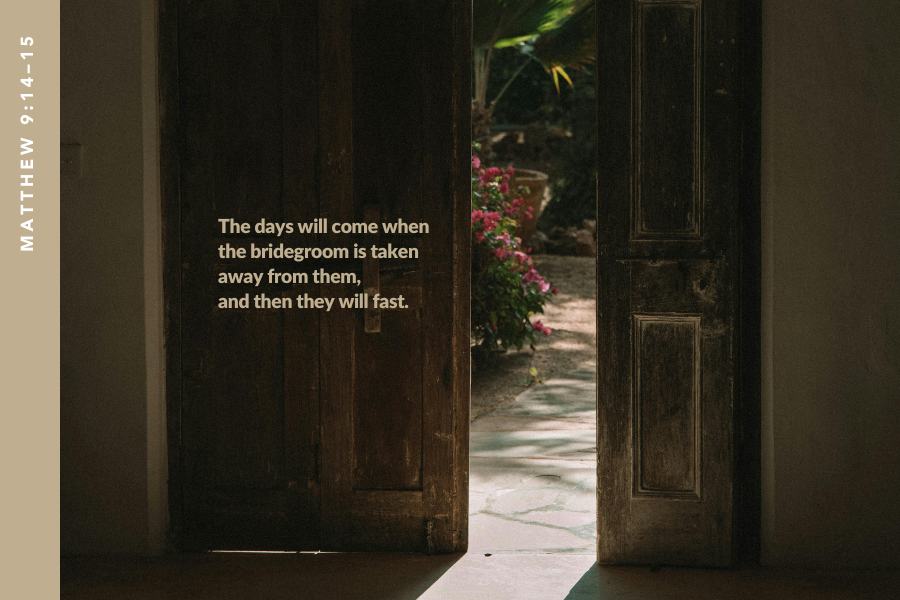
The disciples of John approached Jesus and said, “Why do we and the Pharisees fast much, but your disciples do not fast?” Jesus answered them, “Can the wedding guests mourn as long as the bridegroom is with them? The days will come when the bridegroom is taken away from them, and then they will fast.”
Opening Prayer: Lord Jesus, grant me the grace to recognize you as the bridegroom, who woos my heart and invites me to a deeper union with you. Grant that I may rejoice at your presence in my life.
Encountering Christ:
- Recognizing the Bridegroom: This passage is not so much about rules of fasting as it is about recognizing who Jesus is. Jesus is the bridegroom. In the Old Testament, God made a covenant with his people. The covenant, more than a mutual agreement, was a spousal-like commitment between God and his people that culminated with Jesus’ loving self-gift on the cross. Salvation history is a love story between God and us. Hosea revealed God’s intention: “I will betroth you to me forever: I will betroth you to me with justice and with judgment, with loyalty and with compassion; I will betroth you to me with fidelity, and you shall know the Lord… I will say to Not-My-People, ‘You are my people,’ and he will say, ‘My God!’” (Hos 2:21-22, 25). The loving union God desires with me is possible only in and through Jesus Christ, the bridegroom.
- Rejoicing in the Presence of the Bridegroom: The Incarnation, the hypostatic union of human and divine nature in the very person of the Son of God, is reason to rejoice. Elizabeth rejoiced and John the Baptist leapt for joy at the approach of Jesus in the womb of Mary. The angels rejoiced at the birth of Jesus. My heart rejoices that my bridegroom is present to me through the sacraments, in nature, in my loving relationships with others, when two or more are gathered in his name, and each morning in my daily prayer. How blessed I am to be the bride of Christ, the beloved son or daughter of the Father, a soul called to union with the triune God.
- Anticipation of the Bridegroom’s Final Coming: While the bridegroom has already come, we are told to anticipate his final coming. Jesus warns us of the danger of not having our lamps lit and ready. He invites us to have a vigilant spirit (cf. Mt 25:1-13). Vigilance is a disposition we foster daily, not out of fear for the end of the world, but in anticipation of a consummating union of the bridegroom with the bride. Until Jesus comes again, we unite ourselves to the Bridegroom in a privileged way in the Holy Sacrifice of the Mass. It is the kiss of heaven and earth, the meeting place of our human misery with the divine gift of the Son of God. He comes as the bridegroom to unite himself to us in his precious Body, Blood, soul, and divinity.
Conversing with Christ: Come, Lord Jesus! Come as the bridegroom of my soul. Grant that I may be vigilant, watching for your presence in my daily life, especially in the Eucharist.
Resolution: Lord, today by your grace I will be attentive to how I can rejoice at your coming through the grace you offer me.
Jennifer Ristine is a consecrated woman of Regnum Christi who is dedicated to spiritual and faith formation through teaching, conferences, writing, and spiritual direction. While serving in Ancient Magdala she wrote Mary Magdalene: Insights from Ancient Magdala.
February 21, 2026 – Starting Over Already?
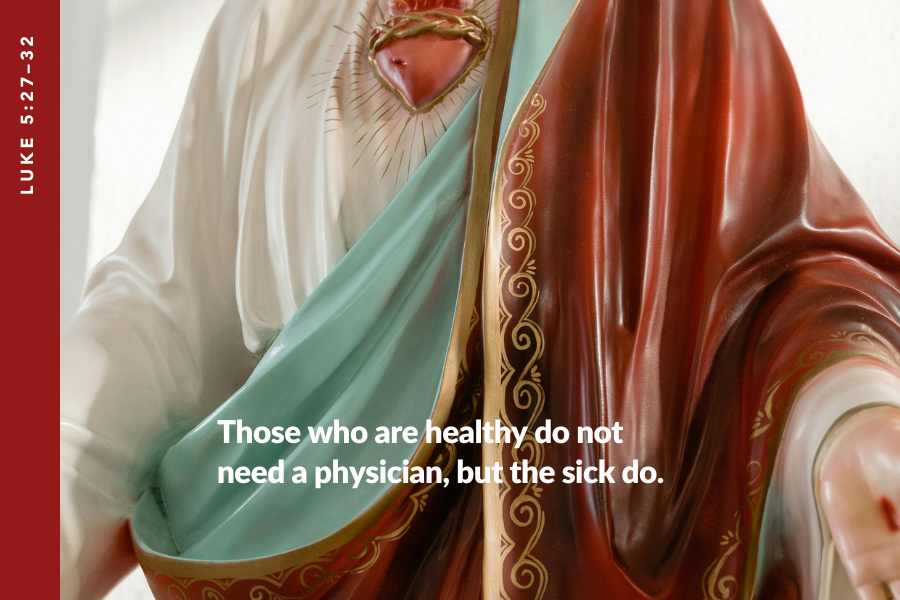
Saturday after Ash Wednesday
Luke 5:27-32
Jesus saw a tax collector named Levi sitting at the customs post. He said to him, “Follow me.” And leaving everything behind, he got up and followed him. Then Levi gave a great banquet for him in his house, and a large crowd of tax collectors and others were at table with them. The Pharisees and their scribes complained to his disciples, saying, “Why do you eat and drink with tax collectors and sinners?” Jesus said to them in reply, “Those who are healthy do not need a physician, but the sick do. I have not come to call the righteous to repentance but sinners.”
Opening Prayer: Lord Jesus, grant me the grace to follow you, leaving behind all that you ask of me.
Encountering Christ:
- Two Simple Words: “Follow me.” Matthew left it all behind. What was he thinking as he responded to those two simple words of invitation? Obviously, he was willing to detach from a lucrative business. Perhaps he was already a man of righteous leanings, and knew enough to recognize his need for Jesus and leave his career behind. “Follow me…” We know from experience that following Jesus is easier said than done. We say “yes” and persevere for a while. We fall. We begin again. Lent is about following Christ more deeply, but it’s also about starting over… and over… and over. Each time we begin again, Our Lord rejoices and re-extends the invitation, “Follow me.”
- A Banquet for the Lord: Matthew throws a great banquet for Jesus and invites many other tax collectors. Someone “leaving everything behind” might be tempted to hoard just a little bit in case the great adventure failed. But Matthew shows us how to live in the presence of the One who provides all we need. Our faith is a treasure to be shared, and Matthew chooses to use his gift of hospitality to share Jesus with his friends. I am called to share the “good news” also, using the gifts and talents Jesus has given to me.
- Who Is Invited to the Banquet of the Lord?: The great banquet Matthew threw foreshadows the heavenly banquet to which all are invited. Jesus tells the Pharisees who will be invited to the banquet: sinners. Jesus says, “I desire mercy, not sacrifice” (Mt 12:7). He extends his mercy to those who recognize their need for salvation. Those who pretend that their righteousness comes from themselves alone will not receive the invitation. On the other hand, those who recognize that the banquet is a gift, and that they are guests, will be welcome. Jesus says, “I did not come to call the righteous but sinners” (Mt 9:13). Matthew can rejoice because he knows the gift he is receiving and his need for that gift.
Conversing with Christ: Lord Jesus, thank you for the invitation to your banquet, which you offer me daily, especially in prayer and the sacraments. Help me to invite others to participate in this feast.
Resolution: Lord, today by your grace I will be attentive to how I can respond to the invitation to follow you.
Jennifer Ristine is a consecrated woman of Regnum Christi who is dedicated to spiritual and faith formation through teaching, conferences, writing, and spiritual direction. While serving in Ancient Magdala she wrote Mary Magdalene: Insights from Ancient Magdala.
February 22, 2026 – Voices in the Desert
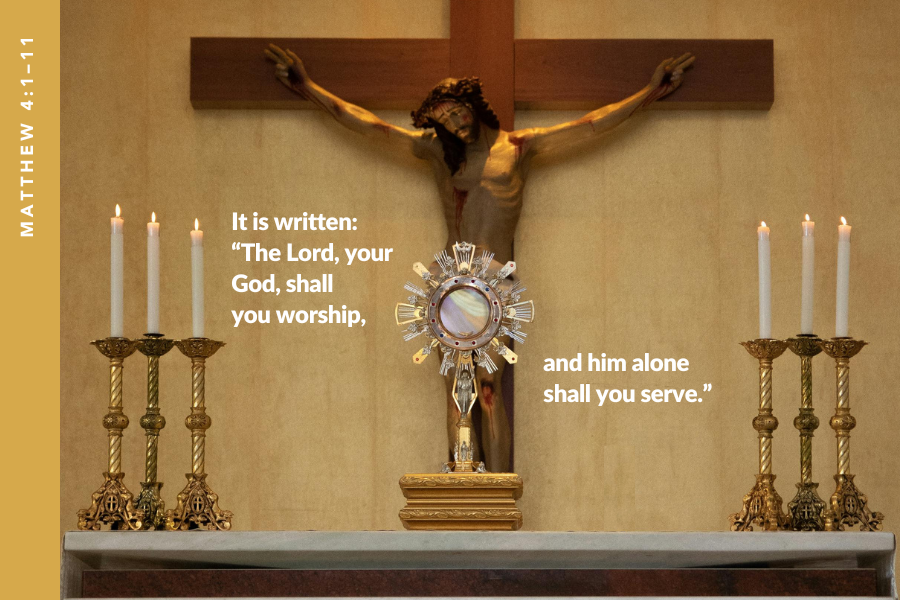
First Sunday of Lent
Matthew 4:1-11
At that time Jesus was led by the Spirit into the desert to be tempted by the devil. He fasted for forty days and forty nights, and afterwards he was hungry. The tempter approached and said to him, “If you are the Son of God, command that these stones become loaves of bread.” He said in reply, “It is written: ‘One does not live on bread alone, but on every word that comes forth from the mouth of God.’” Then the devil took him to the holy city, and made him stand on the parapet of the temple, and said to him, “If you are the Son of God, throw yourself down. For it is written: ‘He will command his angels concerning you and with their hands they will support you, lest you dash your foot against a stone.’” Jesus answered him, “Again it is written: ‘You shall not put the Lord, your God, to the test.’” Then the devil took him up to a very high mountain, and showed him all the kingdoms of the world in their magnificence, and he said to him, “All these I shall give to you, if you will prostrate yourself and worship me.” At this, Jesus said to him, “Get away, Satan! It is written: ‘The Lord, your God, shall you worship and him alone shall you serve.’” Then the devil left him and, behold, angels came and ministered to him.
Opening Prayer: Holy Spirit, descend upon us who are gathered all around the world today to pray. Enlighten your Church at the beginning of Lent and teach us to read and interpret Scripture in a way that reveals the loving heart of the Father through the words and deeds of Our Lord Jesus Christ.
Encountering Christ:
- Seeking a Desert Experience: When a person retreats into the desert, the noise of daily life fades away. Amidst a sandy expanse and under the speckless blue dome of the sky, the world is reduced to a basic setting. In that setting, as distractions subside, God often touches the soul. His soft voice becomes audible, his gentle touch discernable. Jesus was a man of prayer, and he sought out the right settings for profound spiritual encounters with his Father. For a disciple, following Jesus’ traces today means seeking out a place that is conducive for prayer.
- Recognizing Temptation: The desert is a favorable place to hear God’s voice. However, today’s Gospel shows that there are also other voices there. “The tempter approached.” How often are there thoughts, worries, and temptations at the back of our mind that weigh the soul down—anxieties that paralyze us, false expectations that mislead us, lies that confuse us, ambitions that seduce us. These voices can have many sources, but they are often vehicles for the tempter to pester us. In a prayerful atmosphere, we can identify these temptations that are disturbing our soul. As Jesus shows in today’s Gospel, to unmask an inner movement as a plain temptation is already half the victory.
- Eyes on the Father: To identify a temptation often clears the fog in our mind, and sometimes that is all it takes to overcome it. However, sharp wit alone is not always the solution, for it takes willpower to decide to do the right thing. And our will is often so weak, is it not? Jesus’ answers to the tempter teach us an important lesson for overcoming temptations. Every time the devil tried to mislead him with some shrewd logic, Jesus directed and redirected his heart toward God the Father: at the Father who nourishes him; at the Father whom he will not tempt; at the Father whom alone he will serve. The antidote to counteract temptation is to direct one’s heart to the Father, because to overcome a temptation does not mean merely to opt against something, but rather to opt for something—for someone who will quench our soul’s thirst rather than intoxicate it.
Conversing with Christ: My Lord, allow me to pray at your side. Allow me to wrestle with the temptations of my life at your side. I glance at you and witness your wholehearted trust in the Father. I want to imitate that loving trust. I renew my faith in the fact that, through Baptism, I participate in your life and in your grace. Kindle your love for the Father in my own heart, so that your love in my heart will overcome every temptation.
Resolution: Lord, today by your grace I will identify a temptation that has been present in the back of my mind and which has been weighing me down. I will confront it at your side during this period of Lent, while directing my heart to the Father.
For Further Reflection: Catechism of the Catholic Church, 2847:
The Holy Spirit makes us discern between trials, which are necessary for the growth of the inner man, and temptation, which leads to sin and death. We must also discern between being tempted and consenting to temptation. Finally, discernment unmasks the lie of temptation, whose object appears to be good, a “delight to the eye”’ and desirable, when in reality its fruit is death. God does not want to impose the good, but wants free beings… There is a certain usefulness to temptation. No one but God knows what our soul has received from him, not even we ourselves. But temptation reveals it in order to teach us to know ourselves, and in this way we discover our evil inclinations and are obliged to give thanks for the goods that temptation has revealed to us.
Father Gabriel von Wendt, LC, is a priest who works as a professor at the Pontifical Athenaeum Regina Apostolorum. He has a passion for philosophy and the role of Catholic faith in contemporary culture. He is a co-founding member of the Catholic Worldview Fellowship, a study-abroad program for talented college students who want to evangelize culture.
- LATEST ARTICLES


View this profile on InstagramRegnum Christi (@regnumchristi_english) • Instagram photos and videos
- RELATED POSTS
Weekly Digest of the Regnum Christi Daily Meditations: Feb 15 – 22, 2026 Read More »