Weekly Digest of the Regnum Christi Daily Meditations: Jan 18 – 25, 2026
WEEKLY DIGEST OF rc
DAILY MEDITATIONS
Week of January 18-25, 2026
Sunday, January 18, 2026 – A Disciple of the Lamb of God
Monday, January 19, 2026 – Preserving New Wine
Tuesday, January 20, 2026 – From Right Vision to Praise of God
Wednesday, January 21, 2026 – Lord, Open My Heart
Thursday, January 22, 2026 – Called to Profess Our Faith
Friday, January 23, 2026 – Gathered and Sent
Saturday, January 24, 2026 – Total Self-Giving
Sunday, January 25, 2026 – The Call to Missionary Discipleship
January 18, 2026 – A Disciple of the Lamb of God

Second Sunday in Ordinary Time
John 1:29-34
John the Baptist saw Jesus coming toward him and said, “Behold, the Lamb of God, who takes away the sin of the world. He is the one of whom I said, ‘A man is coming after me who ranks ahead of me because he existed before me.’ I did not know him, but the reason why I came baptizing with water was that he might be made known to Israel.” John testified further, saying, “I saw the Spirit come down like a dove from heaven and remain upon him. I did not know him, but the one who sent me to baptize with water told me, ‘On whomever you see the Spirit come down and remain, he is the one who will baptize with the Holy Spirit.’ Now I have seen and testified that he is the Son of God.”
Opening Prayer: Lord Jesus, who am I to receive such a gift as new life in you through baptism? Help me to renew my baptismal promises with a deeper conviction and commitment to discipleship.
Encountering Christ:
- Behold the Lamb: John refers to Jesus the Lamb, giving allusions to the paschal lamb slaughtered on Passover (cf. Ex 12). The blood of the lamb, spread on the door lintels, was as a “pass” from the angel of death. They consumed the lamb as nourishment as they fled from their state of slavery under the Egyptians. The lamb could also conjure images of the Suffering Servant in Isaiah 53 that was led to slaughter as an offering for the sins of the people. John’s reference makes clear that Jesus is the one who will bring a new freedom from sin through a baptism that only he can perform. That baptism will be one of fire. Thank you, Lord, for being the “Lamb of God who takes away the sin of the world.”
- Baptism of Fire: John points to Jesus as the one upon whom the Spirit came down. And he makes the distinction between his baptism with water and Jesus’ baptism with the Holy Spirit. In this passage, the Holy Spirit is manifest as a dove, a symbol of peace. True peace comes only from a life lived fully in God, which implies a turning away from sin and a turning to God. It is the path of repentance and purification. The Holy Spirit is also manifested as fire, reflecting the purifying power of God that sets our hearts ablaze with his love. It is no wonder that Jesus expresses his intention to set the earth on fire (cf. Lk 12:49). But he would never put us through what he himself did not endure first. Hence, he proclaims, “There is a baptism with which I must be baptized, and how great is my anguish until it is accomplished!” (Lk 12:50)
- A True Disciple: John the Baptist reveals qualities of a true disciple: faith, humility, and witness. John testifies that he did not know Jesus, and yet his entire life was oriented towards preparing the way. He walked in the darkness, but for the conviction of his faith. His faith was strong because he knew who he was in relation to Jesus: the one “not worthy to untie his sandal strap.” Humility was the foundation of all his other virtues, bearing fruit in a powerful witness to the Savior of the world, even to the point of death. We can pray for John’s kind of humility to live as a true disciple.
Conversing with Christ: Jesus, send your Spirit upon me. Renew my faith and deepen my love for you. How can I thank you for the gift of the baptism that you endured so that I might have eternal life in you, the Father, and the Holy Spirit?
Resolution: Lord, today by your grace I will renew my baptismal promises and make of them a prayer of thanksgiving.
Jennifer Ristine is a consecrated woman of Regnum Christi who is dedicated to spiritual and faith formation through teaching, conferences, writing, and spiritual direction. While serving in Ancient Magdala she wrote Mary Magdalene: Insights from Ancient Magdala.
January 19, 2026 – Preserving New Wine
Monday of the Second Week in Ordinary Time
Mark 2:18-22
The disciples of John and of the Pharisees were accustomed to fast. People came to him and objected, “Why do the disciples of John and the disciples of the Pharisees fast, but your disciples do not fast?” Jesus answered them, “Can the wedding guests fast while the bridegroom is with them? As long as they have the bridegroom with them they cannot fast. But the days will come when the bridegroom is taken away from them, and then they will fast on that day. No one sews a piece of unshrunken cloth on an old cloak. If he does, its fullness pulls away, the new from the old, and the tear gets worse. Likewise, no one pours new wine into old wineskins. Otherwise, the wine will burst the skins, and both the wine and the skins are ruined. Rather, new wine is poured into fresh wineskins.”
Opening Prayer: Lord Jesus, I rejoice at your presence and praise you for the ways in which you renew me with your grace.
Encountering Christ:
- Jesus the Bridegroom: Jesus uses the bridegroom motif in his response to questions about why his disciples do not fast when John the Baptist’s and the Pharisee’s disciples do. This motif most adequately gives context to the relational quality of his person and his coming. He is the bridegroom who unites in a perfect way the human and the divine. The union between God and man is complete in his person. And his mission to make way for the rest of us to be in full and loving communion with God will find its consummation on the cross in his total self-gift to the Father on our behalf.
- Rejoice!: Fasting is associated with deprivation of earthly things for the sake of putting God back in the center of our lives. It is also associated with a spirit of reparation. Jesus says that the day will come when the bridegroom is taken away from them, and then they will fast. But until then, the bridegroom is in their midst. God is present, and that is reason to rejoice. Until the final consummation of our union with God, we traverse through dark valleys and high peaks. We both fast and rejoice, entering into that dynamic through the liturgical year and through the daily Mass. We fast to prepare ourselves to receive the bridegroom in the Eucharist. And we rejoice in his presence at every Holy Mass. As pilgrims on a journey, our task of faith is to recognize both the need to fast and the reason to rejoice.
- Be New: After Jesus’ death, he reveals his resurrected and glorified body, a sign of the newness to come for us when we will live in the fullness of God’s life eternally. Until then, we live the “already, but not yet” tension. I receive “new wine,” the life of grace in my soul, but the fullness of union and happiness is yet to come. I must take care to preserve this “new wine”: a conversion experience; a fresh break from vice; a new habit of virtue being formed; a conscience that is beginning to recognize the voice of God; a pure heart that seeks to love God above all else. What are the wineskins in my life that destroy or protect that new wine?
Conversing with Christ: Jesus, you are the “bridegroom of my soul,” in the sense that you call me to a total union with you, beginning with the indwelling of the Trinity. Help me to recognize any way in which I may spoil that gift. Give me courage to protect and defend that gift. And in your presence, may I rejoice!
Resolution: Lord, today by your grace I will name the “old wineskin” that needs to be replaced by a new wineskin and ask the Holy Spirit for the courage to change.
For Further Reflection:
- Prayers for encouragement when starting afresh and going forward in new trust and hope: Isaiah 41:10, Psalms 25:4-10, 1 Peter 5:6-8, Proverbs 3:5-6.
Jennifer Ristine is a consecrated woman of Regnum Christi who is dedicated to spiritual and faith formation through teaching, conferences, writing, and spiritual direction. While serving in Ancient Magdala she wrote Mary Magdalene: Insights from Ancient Magdala.
January 20, 2026 – From Right Vision to Praise of God
Tuesday of the Second Week in Ordinary Time
Mark 2:23-28
As Jesus was passing through a field of grain on the sabbath, his disciples began to make a path while picking the heads of grain. At this the Pharisees said to him, “Look, why are they doing what is unlawful on the sabbath?” He said to them, “Have you never read what David did when he was in need and he and his companions were hungry? How he went into the house of God when Abiathar was high priest and ate the bread of offering that only the priests could lawfully eat, and shared it with his companions?” Then he said to them, “The sabbath was made for man, not man for the sabbath. That is why the Son of Man is lord even of the sabbath.”
Opening Prayer: Lord, send your Spirit to open my eyes to the bigger picture of your saving action present in this temporal world. May I praise you as you deserve.
Encountering Christ:
- Tunnel Vision: The Pharisees watch Jesus’ disciples taking the grain as they walked through the field. Their first reaction is law-based. They spot an infringement. There is no concern for the well-being of these hungry men. Is this tunnel vision? Their first judgments and first impressions dictate their response, and they fail to recognize the Messiah in their midst. More importantly, they miss an opportunity to personally encounter the Lord and be transformed by love. Where do I have tunnel vision in my reactions to people? Do I hold any self-righteous attitudes that prevent me from loving a person that my inherent dignity requires? Lord, give me a heart like yours.
- Creation of the Sabbath: The Sabbath was created by the Lord. And all created goods serve a purpose for God’s salvific intent and ultimate glory. God gives a specific command about this day of rest which we read in Exodus 20:8-10: “Remember the Sabbath day—keep it holy. Six days you may labor and do all your work but the seventh day is a Sabbath of the Lord your God. You shall not do any work…” For Christians, we designate Sunday, “the seventh day,” as a day of the Lord in remembrance of the new creation received through his Death and Resurrection. It is a moment to stop and ponder in our hearts the greatest salvific event. We find it re-presented to us in the Holy Mass, as graces flow from heaven for our taking. It is a time to stop, refocus on our goal, as we are pilgrims journeying towards our final eternal rest in God. Do I live the Day of the Lord according to the Lord’s intent?
- The Son of Man: Jesus makes use of this term, “Son of Man,” on several occasions. In it, he shows both his solidarity with humanity and his divine identity. The Old Testament made use of this term to refer both to mere mortals and to the prophets, those called by God for a divine and salvific intention. But Daniel clearly used this term to prophecy about the coming of the divine Messiah and his Lordship over all creation (cf. Dan 7:13-14). Truly, Jesus is one to whom we owe worship and for whom the Sabbath was created: “I saw coming with the clouds of heaven One like a son of man. When he reached the Ancient of Days and was presented before him, He received dominion, splendor, and kingship; all nations, peoples and tongues will serve him. His dominion is an everlasting dominion that shall not pass away, his kingship, one that shall not be destroyed.”
Conversing with Christ: Lord Jesus, you are Lord of all and giver of life. Help me to glorify you in all I do throughout the week, finding ways to worship you, my Savior and King.
Resolution: Lord, today by your grace I will examine how I live the Lord’s day and resolve to live it in a special way that reflects my gratitude to you.
For Further Reflection: The Lord’s Day, Catechism of the Catholic Church.
Jennifer Ristine is a consecrated woman of Regnum Christi who is dedicated to spiritual and faith formation through teaching, conferences, writing, and spiritual direction. While serving in Ancient Magdala she wrote Mary Magdalene: Insights from Ancient Magdala.
January 21, 2026 – Lord, Open My Heart
Memorial of Saint Agnes, Virgin and Martyr
Mark 3:1-6
Jesus entered the synagogue. There was a man there who had a withered hand. They watched Jesus closely to see if he would cure him on the sabbath so that they might accuse him. He said to the man with the withered hand, “Come up here before us.” Then he said to the Pharisees, “Is it lawful to do good on the sabbath rather than to do evil, to save life rather than to destroy it?” But they remained silent. Looking around at them with anger and grieved at their hardness of heart, Jesus said to the man, “Stretch out your hand.” He stretched it out and his hand was restored. The Pharisees went out and immediately took counsel with the Herodians against him to put him to death.
Opening Prayer: Lord Jesus, may I offer today’s prayer for those whose hearts are hardened to you, recognizing also where I need to open more to your healing grace.
Encountering Christ:
- Jesus’ Anger: See Jesus’ incredulity over the nearsightedness and hard-heartedness of those who accuse him of healing on the Sabbath. His anger is justified. But Jesus’ anger is not merely human anger. It’s a sort of divine wrath as well. His anger reminds us that only one thing blocks the heart of God from mercy—hard-heartedness. It renders Jesus powerless to do the primary mission for which he came—the salvation of souls. Hard-heartedness distances us from the Lord, the source of all life. What a responsibility freedom can be—to be made in God’s image to such a degree that we can choose to be open or closed to our own fulfillment and salvation present in the very person of Jesus.
- A Rising Tension: As Jesus continues to “scandalize” the law-enforcing religious of his time, the devil seems to delight in fostering self-righteous, narrow-minded, and hard-hearted responses. A growing tension ensues, escalating eventually in plots, treachery, arrest, and execution. The enemy will stop at nothing to snuff out the possibility of life, and Jesus is its source. That’s why when we embark on a serious path of following Christ, we can experience temptations to turn back, to give up, to quit. It can give us compassion for those who, despite having climbed great spiritual heights, find themselves fallen. Jesus never promised that the path would be easy, but he did promise that he would be with us always.
- The Open Hand: Jesus points out that it is better to save life rather than to destroy it, no matter what the circumstances are. He tells the man with the withered hand to stretch out his hand, and then he displays his healing power for all to see. The man, for his part, stretches out his hand. The gesture teaches us a life lesson. We may not feel capable of the action, but with God’s command and our obedience, healing takes place. It takes one gesture, which begins with humility, the humility to obey and open our hearts, just a little. God does the rest.
Conversing with Christ: Lord Jesus, enlighten my mind to recognize the ways in which I am hard of heart and lacking obedience to your divine will. I bow before you in humility and ask that you open my heart where I feel incapable of opening it. I offer my own prayer and struggle for those who are closed off to your saving grace.
Resolution: Lord, today by your grace I will give thanks for your mercies in my life and look for one way I can be obedient to you, whether it is in the fulfillment of my duty as a spouse, parent, coworker, etc.
For Further Reflection: Pope Francis’ Morning Homily: We Can’t Have Hardened, Closed Hearts
Jennifer Ristine is a consecrated woman of Regnum Christi who is dedicated to spiritual and faith formation through teaching, conferences, writing, and spiritual direction. While serving in Ancient Magdala she wrote Mary Magdalene: Insights from Ancient Magdala.
January 22, 2026 – Called to Profess Our Faith
Day of Prayer for the Legal Protection of Unborn Children
Mark 3:7-12
Jesus withdrew toward the sea with his disciples. A large number of people followed from Galilee and from Judea. Hearing what he was doing, a large number of people came to him also from Jerusalem, from Idumea, from beyond the Jordan, and from the neighborhood of Tyre and Sidon. He told his disciples to have a boat ready for him because of the crowd, so that they would not crush him. He had cured many and, as a result, those who had diseases were pressing upon him to touch him. And whenever unclean spirits saw him they would fall down before him and shout, “You are the Son of God.” He warned them sternly not to make him known.
Opening Prayer: Jesus, I thank you for your mercies, for calling me to the Catholic faith.
Encountering Christ:
- The Fruits of His Labors and Prudence: Imagine Jesus’ heart as he sees the people flocking to him. Far from vainglory, his heart longs for them to continue seeking him, but with purer hearts. How many come to see what they can take from him? What they can get out of him? A cure? Freedom from internal slavery? He does not cast them away. He prepares to meet the multitudes without being crushed. He wishes to continue the work that the Father sent him for, but perhaps prudence also takes precedence. He seems concerned that fame may cut short the saving message that still needs to sink deeper into the hearts of all who seek him out.
- They Come From All Over: People flock from all directions, Jews and Gentiles alike. The prophecies of Zephaniah (3:9-10) and Zechariah (8:20-23) are coming to fruition. It is a sign of the Messianic Age, when God’s universal saving message would begin to go outward towards all. God is continuing to call and form his people, under the banner of Jesus Christ. With him, in him, and through him, they will form the New Israel, the Church, the universal sacrament of salvation. God continues to call people of all nations. I marvel at the diversity of peoples attracted to the one Christ, praise God!
- Surprising Evangelization: Just as the People of God were formed to be set apart and to testify to the one true God, so too does Jesus continue to call his people to testify. In this passage, testimony comes from unexpected places. Even the evil spirits recognize the truth of who Jesus is. What are we called to testify? That Jesus Christ is Lord. Our praise and confession with our lips and our actions is the way to evangelize. We rejoice with St. Paul as he exclaimed to the Philippians (2:9-11): “… God greatly exalted him and bestowed on him the name that is above every name, that at the name of Jesus every knee should bend, of those in heaven and on earth and under the earth, and every tongue confess that Jesus Christ is Lord, to the glory of God the Father.”
Conversing with Christ: My Jesus, I confess that you are Lord of heaven and earth. Jesus, you are the Son of God. Send your Spirit that I may discern the ways in which you call me to profess my faith and bring many others to a deeper encounter with you.
Resolution: Lord, today by your grace I will be attentive to new ways in which I can witness to my faith.
Jennifer Ristine is a consecrated woman of Regnum Christi who is dedicated to spiritual and faith formation through teaching, conferences, writing, and spiritual direction. While serving in Ancient Magdala she wrote Mary Magdalene: Insights from Ancient Magdala.
January 23, 2026 – Gathered and Sent
Friday of the Second Week in Ordinary Time
Mark 3:13-19
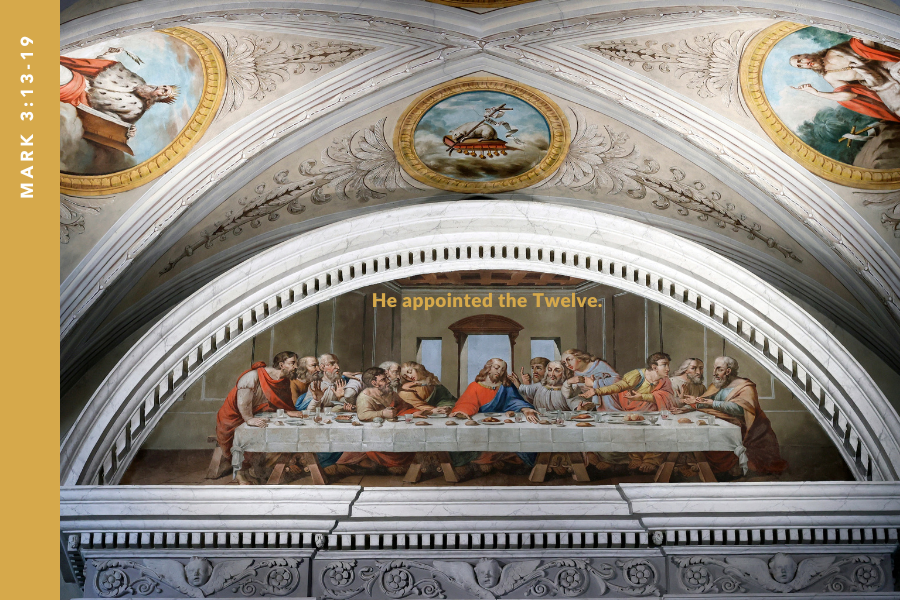
Jesus went up the mountain and summoned those whom he wanted and they came to him. He appointed Twelve, whom he also named Apostles, that they might be with him and he might send them forth to preach and to have authority to drive out demons: He appointed the Twelve: Simon, whom he named Peter; James, son of Zebedee, and John the brother of James, whom he named Boanerges, that is, sons of thunder; Andrew, Philip, Bartholomew, Matthew, Thomas, James the son of Alphaeus; Thaddeus, Simon the Cananean, and Judas Iscariot who betrayed him.
Opening Prayer: Lord Jesus, you reveal to me in Scriptures and through the Tradition and teachings of the Church your plan for humanity. Help me to recognize the gift of the Church in your plan of salvation.
Encountering Christ:
- “He Went Up the Mountain”: Throughout Sacred Scriptures, mountain summits are revelatory places: The Ten Commandments were revealed on Mount Sinai; the foreshadowing of the Messiah’s sacrifice was revealed on Mount Moriah upon which Abraham brought his son Isaac; the Transfiguration in which the Spirit and the Father revealed the Son took place on Mount Tabor. They also represent solemn moments of encounter with God in which he established some truth. We could make a parallel to our spiritual life. When we set aside some time to “go up the mountain” to pray (on a daily basis or at a retreat, for example), it often bears fruit in a deeper knowledge of God. We can return from the mountain more deeply convicted about the plan of God for our lives.
- A Chosen Twelve: In this Gospel passage, Jesus “makes” or appoints twelve Apostles. From all the other disciples he chose twelve, mysteriously even choosing one who would fall away from the fold. These twelve Apostles were chosen as the foundation stones of the Church to “be with him,” “to preach,” and “to have authority to drive out demons.” Jesus gave them the mandate to continue his mission and the power to do so. I, too, am chosen and bear gifts to bring about the Kingdom here and now.
- You Are the Eternal Shepherd: With the mandate came a promise to be with them. Christ’s presence with those appointed for this mission continues today through the apostles’ successors. The Mass Preface of the Apostles I proclaims, “You are the eternal Shepherd who never leaves his flock untended. Through the apostles you watch over us and protect us always. You made them shepherds of the flock to share in the work of your Son.” Though one may fall, they are nonetheless appointed. This truth highlights the need for the rest of the Church to pray for its leaders, that none may be lost.
Conversing with Christ: Lord Jesus, I do not always understand your ways, but help me to trust in you and your Mystical Body the Church. I pray for her leaders and all the fold, that we will be faithful to your desires for holiness and mission, bringing many more to encounter you more fully through the Church.
Resolution: Lord, today by your grace I will pray for those in leadership in the Church, that they may use their invested authority for the holiness of the Church and all peoples.
For Further Reflection: Scott Hahn on Papal Infallibility.
Jennifer Ristine is a consecrated woman of Regnum Christi who is dedicated to spiritual and faith formation through teaching, conferences, writing, and spiritual direction. While serving in Ancient Magdala she wrote Mary Magdalene: Insights from Ancient Magdala.
January 24, 2026 – Total Self-Giving
Memorial of Saint Francis de Sales, Bishop and Doctor of the Church
Mark 3:20-21
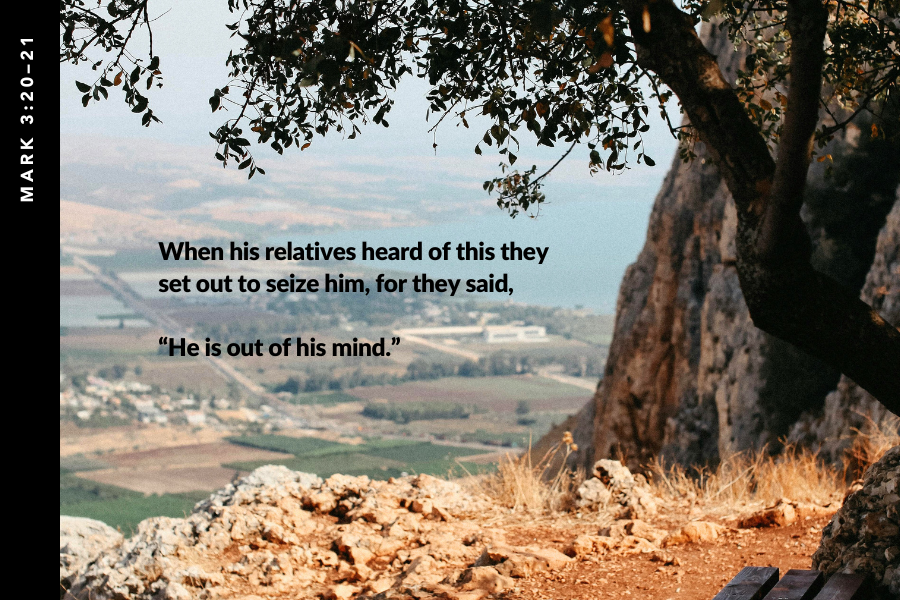
Jesus came with his disciples into the house. Again the crowd gathered, making it impossible for them even to eat. When his relatives heard of this they set out to seize him, for they said, “He is out of his mind.”
Opening Prayer: Here I am, Lord; I come to do your will. In today’s Gospel I see your commitment and self-giving. You are so generous with your time and your life. You are always present to all who need you. Help me to see and understand that the way you sacrifice and give yourself to the crowd is the way you sacrifice and give yourself to me.
Encountering Christ:
- Total Self-Giving: Jesus went home, but even there he was not able to rest or eat. Jesus was human just like us and had the same human needs that we do, but here we see how he was ready to give up everything. His family members thought he was crazy. But this was God’s answer to man’s need. God gives us everything. Sometimes there are so many demands in our lives that it seems like following Christ is crazy. Yet, as his disciples, we willingly follow his example and give everything we have.
- A Prefiguring of the Passion: This brief snapshot in the daily life of Christ prefigures what will happen in the culminating moment of his life. Men will crowd in upon him, constantly demanding more and more until they take his very life. Those who loved him did not want Christ to die on the cross and would have tried to find an escape, but that is not why God became man. He became man to give of himself for our sake. On the cross, that self-giving was made complete. Our daily self-giving is not a prefiguring of Christ’s passion, but a fulfilment of that passion in our own life.
- A Prefiguring of the Eucharist: Even today, Jesus gives everything to those who press around him and demand his attention and his love. We experience this in the Eucharist. The Eucharist is all of God given to us, to be taken into our little hearts and bodies. What a gift from God! “When you look at the crucifix, you understand how much Jesus loved you then. When you look at the sacred Host, you understand how much Jesus loves you now” (St. Teresa of Calcutta). Christ doesn’t calculate or measure; he gives us all of himself. When we receive Christ in the Eucharist, he enables us to give everything, just as he does.
Conversing with Christ: Lord Jesus, have mercy on me. I can see your boundless love in this short anecdote from your daily life. Every moment of your life was lived with this generosity. You gave all on the cross, and you give us all that you are in the Eucharist. Thank you. I never want to forget your love and generosity. Please keep me always close to you.
Resolution: Lord, today by your grace I will not be like those who try to limit Jesus’ generosity and self-giving. I will go to you many times during the day in prayer to ask you to heal me, to save me, to simply be with me. And I will spend ten minutes before the tabernacle in your Eucharistic presence.
For Further Reflection: “But when Christ came as high priest of the good things that have come to be, passing through the greater and more perfect tabernacle not made by hands, that is, not belonging to this creation, he entered once for all into the sanctuary, not with the blood of goats and calves but with his own blood, thus obtaining eternal redemption. For if the blood of goats and bulls and the sprinkling of a heifer’s ashes can sanctify those who are defiled so that their flesh is cleansed, how much more will the blood of Christ, who through the eternal spirit offered himself unblemished to God, cleanse our consciences from dead works to worship the living God. For this reason he is mediator of a new covenant: since a death has taken place for deliverance from transgressions under the first covenant, those who are called may receive the promised eternal inheritance” (Heb 9:11-15).
Father John Studer, LC, is from Atlanta, Georgia, and is currently the Director of ECYD in Mexico City.
January 25, 2026 – The Call to Missionary Discipleship
Third Sunday in Ordinary Time
Matthew 4:12-23
When Jesus heard that John had been arrested, he withdrew to Galilee. He left Nazareth and went to live in Capernaum by the sea, in the region of Zebulun and Naphtali, that what had been said through Isaiah the prophet might be fulfilled: Land of Zebulun and land of Naphtali, the way to the sea, beyond the Jordan, Galilee of the Gentiles, the people who sit in darkness have seen a great light, on those dwelling in a land overshadowed by death light has arisen. From that time on, Jesus began to preach and say, “Repent, for the kingdom of heaven is at hand.” As he was walking by the Sea of Galilee, he saw two brothers, Simon who is called Peter, and his brother Andrew, casting a net into the sea; they were fishermen. He said to them, “Come after me, and I will make you fishers of men.” At once they left their nets and followed him. He walked along from there and saw two other brothers, James, the son of Zebedee, and his brother John. They were in a boat, with their father Zebedee, mending their nets. He called them, and immediately they left their boat and their father and followed him. He went around all of Galilee, teaching in their synagogues, proclaiming the gospel of the kingdom, and curing every disease and illness among the people.
Opening Prayer: Lord Jesus, I thank you for calling me to be a fisher of men. Help me to step out in faith and to have the courage to bring your message of hope to everyone I meet today.
Encountering Christ:
- Encountering Jesus Every Day: Peter, Andrew, James, and John met Jesus on the seashore while they were doing their everyday chores. When he invited them to become fishers of men, their “yes” was immediate. Before we can evangelize others, we must first encounter Jesus in our own lives and come to know him by spending time with him in prayer. In his Apostolic Exhortation “The Joy of the Gospel,” Pope Francis invited us to this life-changing encounter: “I invite all Christians, everywhere, at this very moment, to a renewed personal encounter with Jesus Christ, or at least an openness to letting him encounter them; I ask all of you to do this unfailingly each day” (Evangelii Gaudium, 3).
- Saying “Yes” to Being a Disciple: Having encountered Jesus and heard his call to us, we must learn to follow where he leads us. The disciples immediately left their nets to follow him. We too need to be willing to leave our attachments to anything that holds us back from following the Lord. This is part of the repentance—the change of thinking and living—to which Jesus calls us.
- Being a Missionary Disciple: Jesus modeled everything he would eventually ask the disciples to do. He proclaimed the Gospel and cured every disease and illness among the people. He asked them—and he asks us—to do the same. Our mission is to be a light which shines in the darkness, offering Christ to those around us who are lost or hurting. Pope Francis said, “In virtue of their baptism, all the members of the People of God have become missionary disciples (cf. Mt 28:19)… The new evangelization calls for personal involvement on the part of each of the baptized. Every Christian is challenged, here and now, to be actively engaged in evangelization” (Evangelii Gaudium, 120). How are we responding to this call to live as missionary disciples given to us in our baptism?
Conversing with Christ: O Jesus, give me the grace to encounter you every day in my prayer and in my silence. Help me to step out of my comfort zone in order to follow where you are calling me. May your love shine through me to everyone I meet.
Resolution: Lord, today by your grace I will greet one stranger I meet today, remembering that you see them through my eyes and greet them with my voice.
Claire Grabowski is a Catholic wife, mother, grandmother, author, and speaker. With her husband, she has been active in marriage ministry for over thirty years. Learn more about her work.
- LATEST ARTICLES

View this profile on InstagramRegnum Christi (@regnumchristi_english) • Instagram photos and videos
- RELATED POSTS
Weekly Digest of the Regnum Christi Daily Meditations: Jan 18 – 25, 2026 Read More »