Weekly Digest of the Regnum Christi Daily Meditations: Jan 11 – 18, 2026
WEEKLY DIGEST OF rc
DAILY MEDITATIONS
Week of January 11-18, 2026
Sunday, January 11, 2026 – The Mystery of Baptism
Monday, January 12, 2026 – Living the Good News
Tuesday, January 13, 2026 – A Time for Order
Wednesday, January 14, 2026 – True Restoration in Relationship with God
Thursday, January 15, 2026 – “If You Wish, Lord”
Friday, January 16, 2026 – Wonder at God’s Word
Saturday, January 17, 2026 – Recognizing the Divine Physician
January 11, 2026 – The Mystery of Baptism
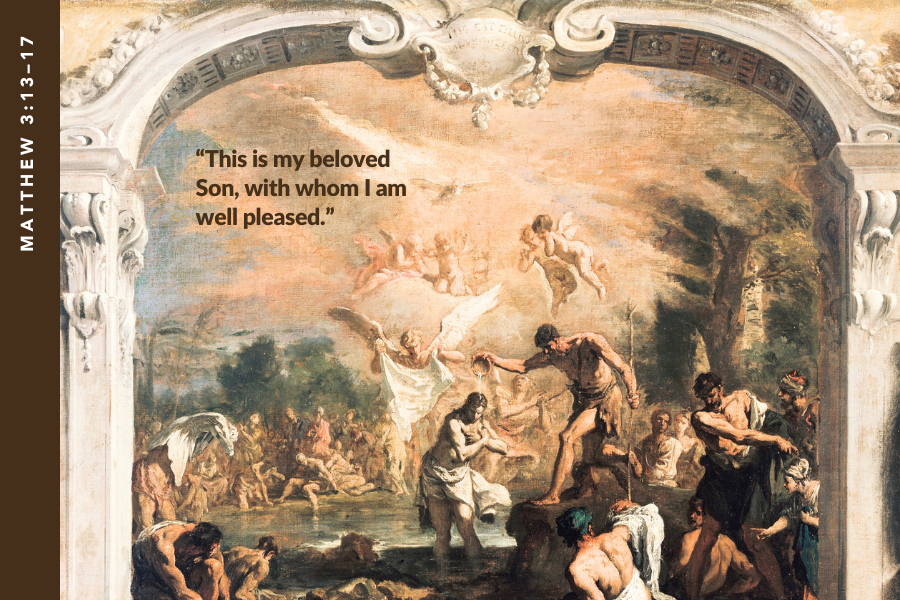
Feast of the Baptism of the Lord
Matthew 3:13-17
Jesus came from Galilee to John at the Jordan to be baptized by him. John tried to prevent him, saying, “I need to be baptized by you, and yet you are coming to me?” Jesus said to him in reply, “Allow it now, for thus it is fitting for us to fulfill all righteousness.” Then he allowed him. After Jesus was baptized, he came up from the water and behold, the heavens were opened for him, and he saw the Spirit of God descending like a dove and coming upon him. And a voice came from the heavens, saying, “This is my beloved Son, with whom I am well pleased.”
Opening Prayer: Jesus, come to my soul and teach me to do your holy will.
Encountering Christ:
- It Is Right and Just: We hear these words in the Holy Mass: “It is right and just, always and everywhere to give you thanks for your great glory…” Praise to God is the proper and just response to so great a God. Yet, in this passage Jesus is not inciting people to praise him. He approaches John to be baptized. He puts himself in the place of the unrighteous who need repentance. Jesus’ response to John reveals what it truly means to be righteous: “Allow it now, for thus it is fitting for us to fulfill all righteousness.” Jesus takes the place of sinners to fulfill God’s saving plan. That is the meaning of righteousness—obedience to the Father’s will.
- Revelation and Reward: The Father proclaims his joy at the obedience of his Son. Suddenly a voice is heard: “This is my beloved Son, with whom I am well pleased.” Jesus did not even hold onto his own “reputation” as the righteous one. He accepted the role of repentant sinner by asking to be baptized. His obedience is rewarded by the appearance of the Holy Spirit, in the form of a dove, and the affirmation of his Father. A Trinitarian revelation takes place. We get a glimpse into the dialogue of love that takes place in the communion of persons in the Trinity.
- Trinitarian Epiphany: The Dynamic of Self-Gift: Jesus’ abasement for the sake of his Father’s plan of salvation reflects his eternal gift of self to the Father. The revelation of the Father’s audible affirmation of his Son reflects the eternal love for his Son. And the Son receives that affirmation with joy and continual surrender to the Father’s desire. The Holy Spirit’s presence reflects the eternal love that exists in the dialogue of self-gift between the Father and the Son. We are invited to enter into this dynamic of self-gift. It began in our baptism. Our everyday response to be obedient to the Father creates, in a mystical sense, this Epiphany of the Trinity in our soul. Far from an abstraction and mere idea, it is a profound yet unseen reality taking place within.
Conversing with Christ: Holy Trinity dwelling in me, grant me the grace to respond with the same righteousness as Jesus. Help me to hear and be obedient to your will throughout my day and respond with an intentional and loving self-gift.
Resolution: Lord, today by your grace I will be attentive to the ways I may be living a false sense of righteousness in my judgments towards others, and the ways I can live a true righteousness in my efforts to be obedient to the Father, with charity in thought, word, and deed as the touchstone of my self-giving.
For Further Reflection:
Song: “Something in the Water” by Carrie Underwood: https://www.youtube.com/watch?v=mH9kYn4L8TI
Article: https://aleteia.org/2018/01/08/why-we-celebrate-christs-baptism-close-to-the-epiphany/.
Jennifer Ristine is a consecrated woman of Regnum Christi who is dedicated to spiritual and faith formation through teaching, conferences, writing, and spiritual direction. While serving in Ancient Magdala she wrote “Mary Magdalene: Insights from Ancient Magdala,” https://rcspirituality.org/book/mary-magdalene-insights-from-ancient-magdala/.
January 12, 2026 – Living the Good News
Monday of the First Week in Ordinary Time
Mark 1:14-20
After John had been arrested, Jesus came to Galilee proclaiming the gospel of God: “This is the time of fulfillment. The kingdom of God is at hand. Repent, and believe in the gospel.” As he passed by the Sea of Galilee, he saw Simon and his brother Andrew casting their nets into the sea; they were fishermen. Jesus said to them, “Come after me, and I will make you fishers of men.” Then they abandoned their nets and followed him. He walked along a little farther and saw James, the son of Zebedee, and his brother John. They too were in a boat mending their nets. Then he called them. So they left their father Zebedee in the boat along with the hired men and followed him.
Opening Prayer: Lord Jesus, I want to receive and share the good news of your saving grace in my life. Help me to repent, and to recognize and accept your invitation.
Encountering Christ:
- The Gospel of God: What is the Gospel of God that Jesus was preaching? “This is the time of fulfillment. The kingdom of God is at hand. Repent, and believe in the gospel.” Jesus is the Gospel. He is the good news. With him, the Kingdom of God is present. Where God reigns, the Kingdom of God is present. And Jesus is true God and true man. By his taking on humanity, he made accessible the Kingdom of God, the good news that we can live in God’s presence.
- The Condition—Repentance: The only condition for entering the Kingdom of God and receiving the good news is repentance. “A contrite, humbled heart, O God, you will not scorn” (Ps 51:19). A repentant heart kicks out the ego and makes room for God to reign supreme. Jesus goes up and down Galilee preaching repentance. How many hearts heard these words and allowed the invitation to sink in? If I heard him speak those words to me today, how would I respond?
- Invitation Accepted: A few fishermen accepted Jesus’ invitation that day. Perhaps they were lured into following Jesus because it seemed adventurous, a novelty. Repentance is not a one-time deal. The process of repentance can be instantaneous like Saul’s, who was struck at once by the error of his ways, or the process can be ongoing. Our welcome into the Kingdom of God is just the beginning of a long journey, as the fishermen of Galilee will discover over the course of three years. They accepted the invitation but will renew it again and again as Jesus reveals his identity and mission more fully. Sadly, not all will continue to accept the invitation when it involves following a crucified Christ.
Conversing with Christ: Lord Jesus, I accept the invitation to enter into your Kingdom, and I repent of my wrongdoing. Be with me as I strive to share the good news with others.
Resolution: Lord, today by your grace I will recognize the moments when I need to ask forgiveness of you and others.
For Further Reflection: Fr. Mike Schmitz on Rivals for the Heart, https://bibleinayear.fireside.fm/day-310-2025.
Jennifer Ristine is a consecrated woman of Regnum Christi who is dedicated to spiritual and faith formation through teaching, conferences, writing, and spiritual direction. While serving in Ancient Magdala she wrote Mary Magdalene: Insights from Ancient Magdala, https://rcspirituality.org/book/mary-magdalene-insights-from-ancient-magdala/.
January 13, 2026 – A Time for Order
Tuesday of the First Week in Ordinary Time
Mark 1:21-28
Jesus came to Capernaum with his followers, and on the sabbath he entered the synagogue and taught. The people were astonished at his teaching, for he taught them as one having authority and not as the scribes. In their synagogue was a man with an unclean spirit; he cried out, “What have you to do with us, Jesus of Nazareth? Have you come to destroy us? I know who you are—the Holy One of God!” Jesus rebuked him and said, “Quiet! Come out of him!” The unclean spirit convulsed him and with a loud cry came out of him. All were amazed and asked one another, “What is this? A new teaching with authority. He commands even the unclean spirits and they obey him.” His fame spread everywhere throughout the whole region of Galilee.
Opening Prayer: Jesus, grant me the grace to response to your healing touch, your Word, and your presence, and so give you glory.
Encountering Christ:
- The Pharisees’ Response to Jesus’ Healing on the Sabbath: The Pharisees continually complained about Jesus healing on the Sabbath, as it was a day of rest. Their emphasis on the absolute living of the law blindsided them to the purpose of the command—to maintain right worship of God. The Sabbath reminds us to keep God in the center of all our human activities. It reflects the culmination of creation when God rested—when all was subject to him. Saint Paul understood this, saying, “He subjected everything under his feet… When everything is subjected to him, then the Son himself will [also] be subjected to the one who subjected everything to him, so that God may be all in all” (1 Cor 15:27-28). Jesus’ healings on the Sabbath were precisely a subjection of all things to the Father.
- The Listeners’ Response to Jesus’ Teaching “As One Having Authority”: Jesus’ teachings caused a stir. Bystanders who felt the irritation of Christ’s message resisted. They couldn’t stand to let go of their own perceived control and listen to someone who spoke with authority, especially when what he was saying required a change of life. On the contrary, those who listened with open hearts were impacted by God’s Word. Saint Paul, who did not know Jesus in the flesh, had firsthand experience of the impact of God’s Word. “The word of God is living and effective” (Heb 4:12). Pope Benedict exhorted us in Spe Salvi to be open to the Gospel, as it is beyond informative—it is performative. It has the power to change our lives, open us to new horizons of hope. Jesus offers us hope of a new life when we encounter him in Word and sacrament.
- The Demons’ Response to Jesus’ Holiness: Isn’t it ironic that we are quick to deny truth when it creates discomfort, yet the demons themselves will call it by name? This Gospel invites us to a deeper examination of conscience, to recognize any resistance to the Holy Spirit, to put things in the right order, to resist the temptations of pride that causes us to refuse to relinquish our power. We bow our heads in humility before the presence of God.
Conversing with Christ: Come, Holy Spirit, illumine my mind to see what I must see and respond to you in true humility and right worship.
Resolution: Lord, today by your grace I will be attentive to the dispositions of my heart and allow Christ to be in the center of my decisions and actions.
For Further Reflection: Spe Salve 2, 3: “Faith Is Hope.”
Jennifer Ristine is a consecrated woman of Regnum Christi who is dedicated to spiritual and faith formation through teaching, conferences, writing, and spiritual direction. While serving in Ancient Magdala she wrote Mary Magdalene: Insights from Ancient Magdala, https://rcspirituality.org/book/mary-magdalene-insights-from-ancient-magdala/.
January 14, 2026 – True Restoration in Relationship with God
Wednesday of the First Week in Ordinary Time
Mark 1:29-39
On leaving the synagogue he entered the house of Simon and Andrew with James and John. Simon’s mother-in-law lay sick with a fever. They immediately told him about her. He approached, grasped her hand, and helped her up. Then the fever left her and she waited on them. When it was evening, after sunset, they brought to him all who were ill or possessed by demons. The whole town was gathered at the door. He cured many who were sick with various diseases, and he drove out many demons, not permitting them to speak because they knew him. Rising very early before dawn, he left and went off to a deserted place, where he prayed. Simon and those who were with him pursued him and on finding him said, “Everyone is looking for you.” He told them, “Let us go on to the nearby villages that I may preach there also. For this purpose have I come.” So he went into their synagogues, preaching and driving out demons throughout the whole of Galilee.
Opening Prayer: Lord Jesus, let me reflect on your contemplative and evangelizing spirit. Far from being two extremes, they are united in your one love for the Father and all people. May I discover a unity of life in loving through prayer and action.
Encountering Christ:
- Capernaum’s Octagonal Church: Even today you can enter Capernaum, or what is excavated of the fishermen’s town. A modern church stands over the ruins of an octagonal Byzantine church. Tradition relates that the ancient church was built over the house of Simon’s mother-in-law. The ancient architect captured the significance of the events through the octagonal church. Eight stands for the fullness of new life, the anticipated day when Christ will be all in all, and all of creation will be made new. As Jesus preaches, heals, and drives out demons, we get a foretaste of the complete restoration that will one day take place in eternity.
- A Deserted Place: Jesus seeks a solitary place, not to be alone, but to be in solitude with his Father. There is a difference between loneliness and solitude. Loneliness reflects a soul who feels disconnected from the richness of relationships. It speaks of a heart longing for meaningful communion, for which we are made. Solitude reflects a soul that seeks to flee the plethora of demands that fight for one’s attention. Solitude seeks simplicity, one thing only, to be with the source of all meaning and communion—God. It is good to listen to what pulls at our attention and examine if we “go to a deserted place” often enough to refocus and replenish our reserves.
- For This Purpose Have I Come: We see Jesus’ focus in his desire to go to a deserted place and be with his Father. And we see his focus once again when the disciples present the desires of the people to him. He knows why he came. He does not flee his mission, but knows that to give of himself fully, he must be in relationship with his Father. Scripture accounts for his travels around the whole of Galilee, not an easy task on foot. The crowds continued to grow as word got out. He knew that some came for curiosity’s sake, and others truly believed in him. He longed to preach so that his Word might strike at the core of their conscience and win them over for the kingdom of God. For this purpose he came.
Conversing with Christ: Jesus, for what purpose am I here? What do you desire of me? Help me to seek solitude in the cultivation of my interior life. As I discover you in prayer, help me to lovingly respond to your voice through a pathway of virtue.
Resolution: Lord, today by your grace I will examine where I can give meaning and unity to my prayer and activity by loving more purely.
For Further Reflection: The Fruitful Union of the Contemplative and the Active: https://catholicexchange.com/the-fruitful-union-of-the-contemplative-and-active.
Jennifer Ristine is a consecrated woman of Regnum Christi who is dedicated to spiritual and faith formation through teaching, conferences, writing, and spiritual direction. While serving in Ancient Magdala she wrote Mary Magdalene: Insights from Ancient Magdala, https://rcspirituality.org/book/mary-magdalene-insights-from-ancient-magdala/.
January 15, 2026 – “If You Wish, Lord”

Thursday of the First Week in Ordinary Time
Mark 1:40-45
A leper came to him and kneeling down begged him and said, “If you wish, you can make me clean.” Moved with pity, he stretched out his hand, touched the leper, and said to him, “I do will it. Be made clean.” The leprosy left him immediately, and he was made clean. Then, warning him sternly, he dismissed him at once. Then he said to him, “See that you tell no one anything, but go, show yourself to the priest and offer for your cleansing what Moses prescribed; that will be proof for them.” The man went away and began to publicize the whole matter. He spread the report abroad so that it was impossible for Jesus to enter a town openly. He remained outside in deserted places, and people kept coming to him from everywhere.
Opening Prayer: Lord Jesus, grant that in every challenging situation, my prayer will also be, “If you wish.” Let your will be what I will, too.
Encountering Christ:
- “If You Wish”: The leper teaches us a lesson in true obedience to God’s will. The proper disposition before God is a humble heart that requests what we think we need, always aware that God has the bigger picture. 1 Timothy 2:4 reminds us that “God wills everyone to be saved.” This is a far wider scope than the healing of my sore toe, a broken leg, and even the most aggressive of cancers. While the Lord is capable of healing the worst case scenario, he is also capable of working the greatest of invisible miracles—the sanctity of one’s soul through faith, sometimes the darkness of faith. Like the leper, let our prayer be steeped in the attitude of “if you wish, Lord.”
- “I Do Will It”: The leper had requested to “be made clean.” On a spiritual level, this is equivalent to purity of heart. Purity of heart, will, mind, and conscience is the cure the Lord wishes to work in our lives. When it seems that life circumstances are purifying me, I hear him say those words: “I do will it.” I seek to live by faith and trust that he can work for good for those who love God (cf. Rom 8:28).
- “Show Yourself to the Priest”: The law of Moses prescribed the ritual purification of a leper before he could return to society. Miriam was struck with a skin disease for her disobedience. The Lord commanded that she be separated from the people for seven days and then be brought back (cf. Num 12:10-15). Naaman, an army commander, was ordered to wash seven times in the Jordan to be cleansed of his leprosy (cf. 2 Kings 5:1-14). In both cases, God worked a cleansing, a purification through obedience. Miriam did not want to feel “castigated” from her people for seven days. Naaman ridiculed the notion of dipping himself seven times in the waters. But that was the Lord’s command and the required purification for reentry to communion. After Jesus cured the leper, he sent the man to the priests. His intention was not to show off his power, but to open the way for reentry into the community. Jesus also seeks to open the path to our fullness of communion. That path is marked by obedience and purification. And many times, obedience is sufficient purification!
Conversing with Christ: Lord Jesus, you desire my ultimate good, which is full communion with you in eternal life. Help me to keep the big picture in mind and assent in loving obedience to living a Christian attitude of faith, hope, and love.
Resolution: Lord, today by your grace I will examine a difficulty in light of how I am responding with faith and trust in God’s ultimate desire for my purification (holiness).
For Further Reflection: Fr. Mike Schmitz on The Meaning of Suffering, https://www.youtube.com/watch?v=tR25hk8NVio.
Jennifer Ristine is a consecrated woman of Regnum Christi who is dedicated to spiritual and faith formation through teaching, conferences, writing, and spiritual direction. While serving in Ancient Magdala she wrote Mary Magdalene: Insights from Ancient Magdala, https://rcspirituality.org/book/mary-magdalene-insights-from-ancient-magdala/.
January 16, 2026 – Wonder at God’s Word

Friday of the First Week in Ordinary Time
Mark 2:1-12
When Jesus returned to Capernaum after some days, it became known that he was at home. Many gathered together so that there was no longer room for them, not even around the door, and he preached the word to them. They came bringing to him a paralytic carried by four men. Unable to get near Jesus because of the crowd, they opened up the roof above him. After they had broken through, they let down the mat on which the paralytic was lying. When Jesus saw their faith, he said to the paralytic, “Child, your sins are forgiven.” Now some of the scribes were sitting there asking themselves, “Why does this man speak that way? He is blaspheming. Who but God alone can forgive sins?” Jesus immediately knew in his mind what they were thinking to themselves, so he said, “Why are you thinking such things in your hearts? Which is easier, to say to the paralytic, ‘Your sins are forgiven,’ or to say, ‘Rise, pick up your mat and walk’? But that you may know that the Son of Man has authority to forgive sins on earth”—he said to the paralytic, “I say to you, rise, pick up your mat, and go home.” He rose, picked up his mat at once, and went away in the sight of everyone. They were all astounded and glorified God, saying, “We have never seen anything like this.”
Opening Prayer: Lord Jesus, open my heart to hear your Word, and help me to see your saving action all around me.
Encountering Christ:
- The Word Fell Like Seed…: When Jesus returned to Capernaum, Scripture says that “he preached the word to them.” His central message was one of repentance. How he longed that his Word would fall upon fertile soil! He provoked faith where a piece of kindling was offered. He awakened consciences that dared to examine their lifestyle in the light of God’s commands. He excited hope in the possibility of promises fulfilled. How did that seed fall upon the soil of his listeners? How does his Word fall upon my spiritual ears? How does it speak to my conscience and desires?
- Getting to the Heart of the Matter: Jesus knows the deepest affliction—division between us and God, namely sin. He doesn’t beat around the bush with the paralytic man by curing him of a “superficial ailment” when the true ailment is sin. He must have been able to see the heart of this man, for God cannot forgive sin where the heart is closed. Reading between the lines, it seems that this is the story of a soul longing to return to the Father. Sincerity and a contrite heart open the path to reconciliation and healing of the rift between us and God. Jesus is the way to the Father.
- True Affliction in Hardness of Heart: The Pharisees are fixated on catching Jesus in any misdemeanor they can find. Their jealous attention blinds them to the action and power of God manifest in their presence. Hardness of heart blinds and deafens us as well. Jealousy, rancor, envy, etc., create a thick filter through which God’s light cannot penetrate. Our capacity to perceive objective reality is obscured, and we create a completely different narrative about God. It changes our relationship with him. We are not able to relate to him as we ought, praising and glorifying him for his wondrous deeds, hidden or evident. Hopefully we are among the lot whose astonishment at Jesus’ deeds turned into rejoicing.
Conversing with Christ: Lord Jesus, may your word effect in me a sincere repentance. May your goodness and mercy move me, so that I may be reconciled to you and praise and glorify you.
Resolution: Lord, today by your grace I will examine my conscience in the light of faith to see if jealousy, envy, or anger blind my capacity to wonder at your mercies in me and in others.
For Further Reflection: Conquer Spiritual Blindness, https://catholicexchange.com/conquer-spiritual-blindness.
Jennifer Ristine is a consecrated woman of Regnum Christi who is dedicated to spiritual and faith formation through teaching, conferences, writing, and spiritual direction. While serving in Ancient Magdala she wrote Mary Magdalene: Insights from Ancient Magdala, https://rcspirituality.org/book/mary-magdalene-insights-from-ancient-magdala/.
January 17, 2026 – Recognizing the Divine Physician

Memorial of Saint Anthony, Abbot
Mark 2:13-17
Jesus went out along the sea. All the crowd came to him and he taught them. As he passed by, he saw Levi, son of Alphaeus, sitting at the customs post. Jesus said to him, “Follow me.” And he got up and followed Jesus. While he was at table in his house, many tax collectors and sinners sat with Jesus and his disciples; for there were many who followed him. Some scribes who were Pharisees saw that Jesus was eating with sinners and tax collectors and said to his disciples, “Why does he eat with tax collectors and sinners?” Jesus heard this and said to them, “Those who are well do not need a physician, but the sick do. I did not come to call the righteous but sinners.”
Opening Prayer: Lord Jesus, help me to see where any false sense of righteousness binds me from opening to your healing grace.
Encountering Christ:
- Jesus’ Availability: Jesus went out once again along the sea. There are many areas along the Sea of Galilee that lend themselves to perfect gathering places for large crowds. People can come by boat or land, from the Jewish and the Gentile towns surrounding the sea. And from there, Jesus can reach many surrounding towns with great ease. His divine intention is manifest: He longs to encounter all and is willing to make himself available to all who will welcome him, no matter Jew or Gentile. Levi was one of the Gentiles and represents all those considered unworthy. But worthiness in Jesus’ eyes equals those whose hearts are sincere and allow him, in his generous availability, to enter their dwelling.
- Strike Three: Throughout the past days’ readings Jesus has had several run-ins with the Pharisees. Jesus shocks them with his response this time. It seems like he throws them a curveball. At first it doesn’t seem that he directly answers their question, “Why does he eat with tax collectors and sinners?” But then the ball hits the catcher’s mitt, strike three for the Pharisees, as Jesus answers them, “Those who are well do not need a physician, but the sick do. I did not come to call the righteous but sinners.” The Pharisees have continually maintained their self-righteousness. By doing so, they automatically disqualify themselves. Only those who recognize their need for repentance are reconciled to God.
- The Divine Physician: Jesus is the divine physician. He recognizes our ailments and comes to the rescue. Sometimes those in need are brought by friends, like the paralytic on the stretcher lowered from the roof. Some travel long distances to seek him out. Others are surprised by Jesus’ presence in their midst, and an immediate reaction of faith wins them healing. It seems that we all come to the divine physician by different paths, but the truth is Jesus is always present, always available. He simply waits for our acknowledgment that he truly can heal us. In Saint Teresa of Calcutta’s words, “we give him permission” to act as the divine physician in our lives with the disposition of the centurion, “Lord, I am not worthy that you should enter under my roof, but only say the word and my soul shall be healed” (cf. Mt 8:8).
Conversing with Christ: “Lord, I am not worthy that you should enter under my roof, but only say the word and my soul shall be healed” (cf. Mt 8:8). Let me speak these words to you with sincerity of heart and gratitude for your constant salvific presence in my life.
Resolution: Lord, today by your grace I will recognize signs of self-righteousness in myself and make a hidden act of humility.
For Further Reflection: Raising Our Children to Be in but Not of the World, by Tim Challies.
Jennifer Ristine is a consecrated woman of Regnum Christi who is dedicated to spiritual and faith formation through teaching, conferences, writing, and spiritual direction. While serving in Ancient Magdala she wrote Mary Magdalene: Insights from Ancient Magdala, https://rcspirituality.org/book/mary-magdalene-insights-from-ancient-magdala/.
January 18, 2026 – A Disciple of the Lamb of God

Second Sunday in Ordinary Time
John 1:29-34
John the Baptist saw Jesus coming toward him and said, “Behold, the Lamb of God, who takes away the sin of the world. He is the one of whom I said, ‘A man is coming after me who ranks ahead of me because he existed before me.’ I did not know him, but the reason why I came baptizing with water was that he might be made known to Israel.” John testified further, saying, “I saw the Spirit come down like a dove from heaven and remain upon him. I did not know him, but the one who sent me to baptize with water told me, ‘On whomever you see the Spirit come down and remain, he is the one who will baptize with the Holy Spirit.’ Now I have seen and testified that he is the Son of God.”
Opening Prayer: Lord Jesus, who am I to receive such a gift as new life in you through baptism? Help me to renew my baptismal promises with a deeper conviction and commitment to discipleship.
Encountering Christ:
- Behold the Lamb: John refers to Jesus the Lamb, giving allusions to the paschal lamb slaughtered on Passover (cf. Ex 12). The blood of the lamb, spread on the door lintels, was as a “pass” from the angel of death. They consumed the lamb as nourishment as they fled from their state of slavery under the Egyptians. The lamb could also conjure images of the Suffering Servant in Isaiah 53 that was led to slaughter as an offering for the sins of the people. John’s reference makes clear that Jesus is the one who will bring a new freedom from sin through a baptism that only he can perform. That baptism will be one of fire. Thank you, Lord, for being the “Lamb of God who takes away the sin of the world.”
- Baptism of Fire: John points to Jesus as the one upon whom the Spirit came down. And he makes the distinction between his baptism with water and Jesus’ baptism with the Holy Spirit. In this passage, the Holy Spirit is manifest as a dove, a symbol of peace. True peace comes only from a life lived fully in God, which implies a turning away from sin and a turning to God. It is the path of repentance and purification. The Holy Spirit is also manifested as fire, reflecting the purifying power of God that sets our hearts ablaze with his love. It is no wonder that Jesus expresses his intention to set the earth on fire (cf. Lk 12:49). But he would never put us through what he himself did not endure first. Hence, he proclaims, “There is a baptism with which I must be baptized, and how great is my anguish until it is accomplished!” (Lk 12:50)
- A True Disciple: John the Baptist reveals qualities of a true disciple: faith, humility, and witness. John testifies that he did not know Jesus, and yet his entire life was oriented towards preparing the way. He walked in the darkness, but for the conviction of his faith. His faith was strong because he knew who he was in relation to Jesus: the one “not worthy to untie his sandal strap.” Humility was the foundation of all his other virtues, bearing fruit in a powerful witness to the Savior of the world, even to the point of death. We can pray for John’s kind of humility to live as a true disciple.
Conversing with Christ: Jesus, send your Spirit upon me. Renew my faith and deepen my love for you. How can I thank you for the gift of the baptism that you endured so that I might have eternal life in you, the Father, and the Holy Spirit?
Resolution: Lord, today by your grace I will renew my baptismal promises and make of them a prayer of thanksgiving.
For Further Reflection: Renewal of the Baptismal Promises, https://www.catholic.org/prayers/prayer.php?p=1653.
Jennifer Ristine is a consecrated woman of Regnum Christi who is dedicated to spiritual and faith formation through teaching, conferences, writing, and spiritual direction. While serving in Ancient Magdala she wrote Mary Magdalene: Insights from Ancient Magdala, https://rcspirituality.org/book/mary-magdalene-insights-from-ancient-magdala/.
- LATEST ARTICLES


View this profile on InstagramRegnum Christi (@regnumchristi_english) • Instagram photos and videos
- RELATED POSTS
Weekly Digest of the Regnum Christi Daily Meditations: Jan 11 – 18, 2026 Read More »