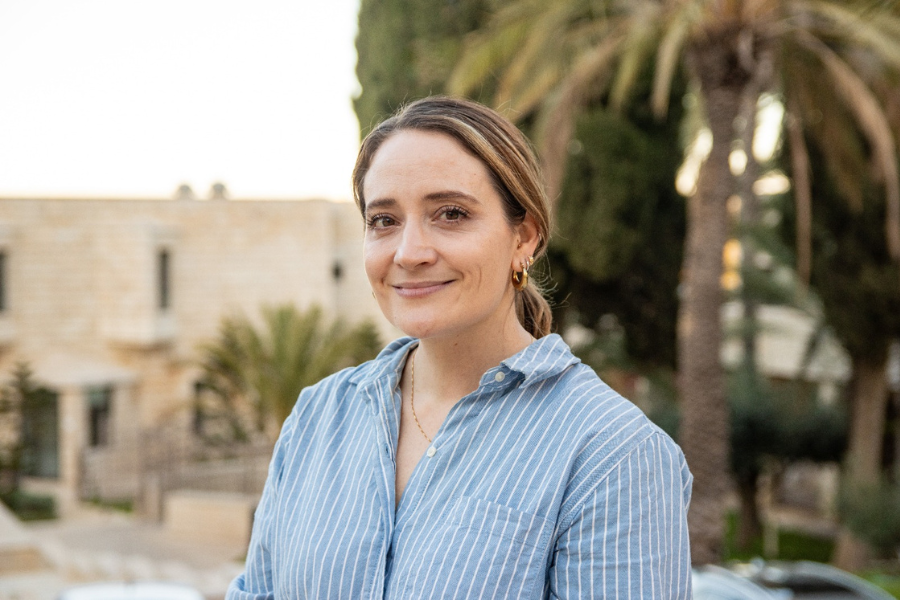
“We Can’t Be Indifferent When Confronted With War”: María José Alexander, Humanitarian in Gaza
Would you go out to help those affected in the middle of a war? What is it like to experience war as a humanitarian aid worker in the Gaza Strip? Why would you go there to help in the midst of the conflict? These questions are the starting point of a true story, lived with faith, conviction, and complete dedication. Regnum Christi member María José Alexander has been in Gaza for a year and a half, among bombings, evacuations, and a crisis that challenges the limits of hope. Her testimony not only reveals the human face of war, but also the transformative power of faith in extreme circumstances.
María José Alexander is a lay member of Regnum Christi from Mexico, and she has been working in humanitarian response efforts in the Gaza Strip for a year and a half. She became acquainted with Regnum Christi as a child in NET and was always very committed in ECYD until arriving at the section of Guadalajara, in Mexico. She now works in the Gaza Strip and in Ukraine, offering aid to those affected by war.
Why did you begin to work in Gaza?
From a young age, I felt called to social work. I have been working in humanitarian response for eight years, and I have been working in Gaza for a year and a half now. Sometimes I feel like what I do is viewed as something very extraordinary, but each person can truly change the world with their small acts of love. We are all called to put our talents at the service of God. I don’t think that I’m changing the world any more than a mother is, for example. Every person changes the world wherever they feel called. I realize that he is calling me to be in these kinds of situations, and here I am, Lord, because you have called me!
How do you live in Gaza in these times?
It’s a heartbreaking situation; it’s very difficult to see what is going on and to keep believing in humanity. But I believe. My faith is an impressive pillar, not only in this response, but throughout my professional life.
I’m also surrounded by great gifts. I am very grateful to have met Fr. Gabriel Romanelli, the pastor of the only parish in Gaza, Holy Family. He knows the Consecrated Women of Regnum Christi very well. Through them, I was able to get into contact with him and bring bread and wine to Gaza for consecration. I am in a place where I don’t often have access to Mass or to the spiritual life, and thanks to this priest, I’m in touch not only with my Catholic side, but also as a Regnum Christi member. It’s a very practical and spiritual meeting of charisms.

María José Alexander listening to Gazans. Photo: María José Alexander. (Photo credit: Regnum Christi International)
Is the Church responding to the situation in Gaza?
The Church is always present in humanitarian emergencies. It brings great hope because there are people living their faith in a tangible and practical way. The Church is always one of the first to respond. Through Caritas or another Catholic organization, and especially in the response in Gaza, the role the Church plays is essential and impressive, because it serves as a refuge.
There are now more than 500 people staying in the church, many of them elderly and children. It’s impressive how they continue to have activities for the children and to care for the sick amidst the bombing. Currently, there are orders from the Israeli army to evacuate Gaza City, and their response has always been: “No, we are staying because if we leave, it is a death sentence for the most vulnerable people.” It’s an exemplary response to remain in one’s vocation despite any circumstance, even death. Witnessing that has been a great blessing.
I’ve also seen how God’s grace has worked in them. They suffered an attack on the church, and Fr. Gabriel told me: “It’s impressive how these people don’t hold resentment, but rather forgive; all they want is peace, all they want is to live.” That’s because of Christ; it’s because of the grace of God. And this is apparent in Christians. Here, the majority are Catholic, but there are many Orthodox or other denominations, and yet they share Mass, they share the whole day, they are in the presence of God… It’s impressive to see what God does in their hearts: He places in them a very strong desire for peace.

“It is very important to be agents for peace, not becoming what we hate, not continuing to hate, because if we don’t, we are becoming part of the problem,” comments María José. (Photo credit: María José Alexander)
How do you live your faith in times of conflict there? What lessons can this experience teach us?
I see that the faith of Christians is extremely strong, and hope is what keeps them alive—not just Christians, but also Gazans in general. They always hope for a ceasefire. They are often the ones who give us this strength to keep hoping that something good will happen. Muslims as well strongly believe in God’s will, and this is a great lesson for all of us.
What has impressed me the most is how God can act in people’s hearts and produce the capacity to love and forgive, even in the midst of a war.
My faith is the pillar of my life. I don’t know how other people do it who work in humanitarian aid and don’t have faith; I am here because God helps me and because I firmly believe that if the world continues to exist, it is because he must be bringing something good out of all this. Although I am in daily contact with a great deal of human tragedy, I also see a lot of goodness. I am with volunteers, humanitarian workers, Fr. Gabriel… People who give their entire lives.
What can those of us who don’t live in this situation learn from this?
One of the most infuriating things about this war is realizing that our international system is broken. Indeed, although there are mechanisms of human or international rights to protect certain aspects of humanity, we haven’t seen how they’re working in this crisis. That’s why it is so important to be agents for peace, not becoming what we hate, not continuing to hate, because if we don’t, we are becoming part of the problem.

One of the zones in the Gaza Strip affected by the war. (Photo credit: María José Alexander)
Never before has there been so much information, so much access to information, and we are living in a war that has taken the lives of thousands of people. We cannot be indifferent. I have seen so much division in this war, so many people on one side and the other, and listening to the other side and coming out of yourself to question the possibility of being wrong is truly fighting.
I encourage people to educate themselves truly, to speak about the issue, to keep demanding peace, to donate to organizations, and not to be indifferent—and, of course, to keep praying.