
July 22, 2025

“Ask a Priest: Why Would God Create People Who Won’t Believe?”

Q: I have a few questions preventing me from really believing. I mean this in the least cynical way: How can God be all knowing yet put people in a position where in they won’t become believers? I understand the free-will argument, but if God is truly all knowing, wouldn’t he still know about what decisions people will make throughout their life? And why are there things like stillbirths and childhood cancer and infant mortality? If God has some big plan, why couldn’t he just create it that way in the first place with all our memories and ideas and personalities prefabricated? Lastly, let’s say my mom got into heaven, and I went to hell; she would be in eternal torment knowing that I will be burning forever. I think it’s almost a core part of my mother’s soul that she loves me and cares where I am. If she weren’t in torment in heaven over my fate, would she really be the same person? Thanks for reading. – Wayne

Answered by Fr. Edward McIlmail, LC A: You pose some tough questions that people have grappled with for centuries. Ample answers to your questions could fill a book. But perhaps a few ideas might help. Faith is both an act of the will (a person gives assent to a set of beliefs) and a gift of God. Some people sincerely seek the truth and yet don’t make that explicit act of Christian faith. God alone knows the heart and mind of each person. If Our Lord knows a nonbeliever has tried to live a good life as best he can, the Almighty will be merciful when judging that soul. To us believers, the fact that someone is seeking but doesn’t embrace the faith is a reminder that we have a tremendous gift from God — and that we will have to give an account of how we used that gift. “Much will be required of the person entrusted with much” (Luke 12:48). As for free will and God’s omniscience: There is no incompatibility here. An analogy might help. Let’s say we are neighbors. One day I look out the window and see you trimming the hedges in your front yard. Does my seeing you cause you to trim the hedges? No. You are freely choosing to do the yard work. I just happened to notice it. Now, imagine God, who is outside of time. For him, everything is present. He sees you trimming the hedge in your front yard now. He also sees you doing it a year from now and five years from now. You are freely choosing to do the work today, next year and five years from now. God simply sees all this at once. Admittedly, it is a bit more complicated than that. But perhaps you get the basic idea. Still, there is the underlying question of why God would create us, knowing that so many people would reject him. In fact, some of the saddest lines in Scripture touch on this mystery: “When the LORD saw how great the wickedness of human beings was on earth, and how every desire that their heart conceived was always nothing but evil, the LORD regretted making human beings on the earth, and his heart was grieved” (Genesis 6:5-6). God chose to go ahead and create the world as he did (without the prefabricated memories, etc.), knowing at least some people would respond in love. That was good enough for him. And for the record, God “wills everyone to be saved” (1 Timothy 2:4). As for physical suffering: This is a fallout of Adam’s sin, which caused a cosmic disruption and brought misery into the world. This fallout means that we inherit original sin (that is, a damaged human nature) and are prone to illness and death; hence, the tragedy of childhood suffering and death. Again, it’s hard to understand this. One explanation is that God allows evil because he can bring something good out of it. That explanation can bring a bit of comfort to some people, but not all. As for your mom in heaven and you in hell: What follows isn’t meant to sound callous but simply theological. It’s an explanation offered by some theologians. Your mom wouldn’t be sorrowful about you because in heaven she would share more deeply in God’s sense of mercy and justice. She would understand that anyone in hell is there because they rejected God. And since she knows firsthand how wonderful and beautiful God is, her love for him would far surpass her earthly attachment to you. To put it bluntly, she would understand that it’s pure justice that you ended up where you did. Again, an analogy might help. Imagine you had a childhood friend, Sam. You and Sam were best buddies. You did everything with him. You loved him like a brother. Fast forward a few years, and you meet the woman of your dreams. Sally is the sweetest, most charitable person you’ve ever met. You fall in love and get engaged to her. The day comes when you introduce Sally to Sam. The thing is, Sam isn’t impressed with her. He later comments to you that he thinks she’s bland and pudgy and even makes a joke about her ethnic background. Does this mean you dump Sally? Probably not. More likely, you cut ties with Sam. You see a crudeness and hardheartedness in him that you didn’t notice before. More to the point, you’re angry at the disrespectful way he talks about the woman you love. Something like that might happen with the souls in heaven (minus the anger). They distance themselves from those who rejected the One they so dearly love in heaven. I hope some of this helps. Count on my prayers.  

“Ask a Priest: Why Would God Create People Who Won’t Believe?” Read More »
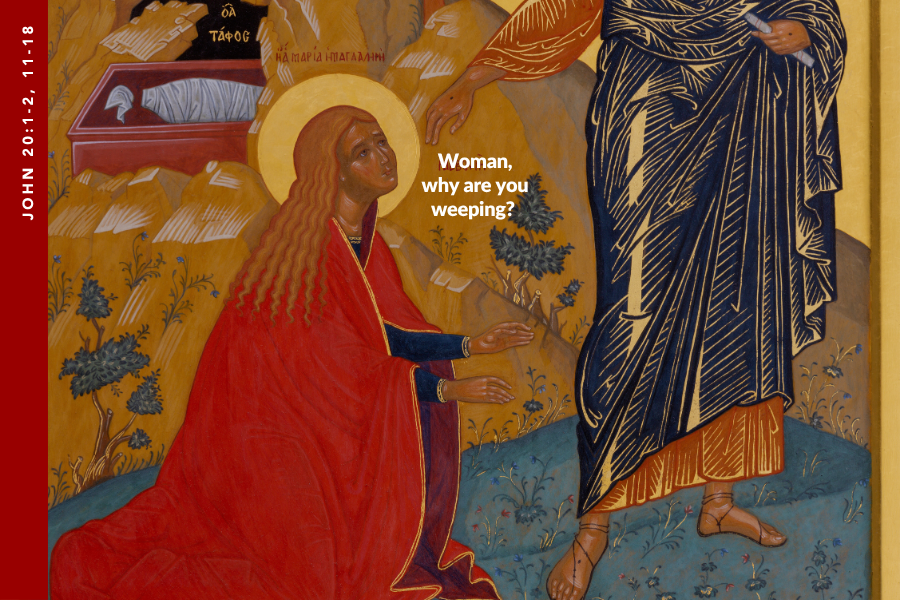
July 22, 2025 – Seeking Even in the Dark

Listen to the audio version

Feast of Saint Mary Magdalene


John 20:1-2, 11-18

On the first day of the week, Mary Magdalene came to the tomb early in the morning, while it was still dark, and saw the stone removed from the tomb. So she ran and went to Simon Peter and to the other disciple whom Jesus loved, and told them, “They have taken the Lord from the tomb, and we don’t know where they put him.” Mary stayed outside the tomb weeping. And as she wept, she bent over into the tomb and saw two angels in white sitting there, one at the head and one at the feet where the Body of Jesus had been. And they said to her, “Woman, why are you weeping?” She said to them, “They have taken my Lord, and I don’t know where they laid him.” When she had said this, she turned around and saw Jesus there, but did not know it was Jesus. Jesus said to her, “Woman, why are you weeping? Whom are you looking for?” She thought it was the gardener and said to him, “Sir, if you carried him away, tell me where you laid him, and I will take him.” Jesus said to her, “Mary!” She turned and said to him in Hebrew, “Rabbouni,” which means Teacher. Jesus said to her, “Stop holding on to me, for I have not yet ascended to the Father. But go to my brothers and tell them, ‘I am going to my Father and your Father, to my God and your God.’” Mary Magdalene went and announced to the disciples, “I have seen the Lord,” and then reported what he told her.

Opening Prayer: Jesus, I believe you are with me now as I turn to you in prayer. I want to focus on you with all my heart, mind, soul, and strength. I trust in your love for me and your desire to give me everything I need to follow you. Help me hear you call my name in this time together. I want to know what it is you ask of me so that I can live as your light in the world. Thank you for your love and for the gift of faith. Jesus, I trust in you.

Encountering Christ:

  1. It Was Still Dark: Mary loved Jesus. He had delivered her from seven demons, and she was one of the women who accompanied Jesus and his disciples, providing for Jesus and the Twelve out of their resources (cf. Lk 8:1-3). She was one of the women with St. John and the Blessed Mother at the foot of the cross, accompanying Jesus in his agony (cf. Jn 19:24-25). When Jesus died and was taken down from the cross, “Mary Magdalene and Mary the mother of Joses watched where he was laid” (Mk 15:47). The next morning, when the Sabbath ended (cf. Mk 16:1), Mary went to the tomb so early that it was still dark. She couldn’t wait to care for her Lord’s body, to anoint it with spices (cf. Mk 16:1). She sought him in the darkness, knowing that light was coming. Mary’s life had been transformed by the Lord, and she continued to seek him out and serve him even after his death. Mary’s love for Jesus was steadfast, persevering through the most difficult circumstances because her heart was full of gratitude.

  2. Mary!: Jesus taught that he is the Good Shepherd, that he calls his sheep by name, and that they recognize his voice and follow him (cf. Jn 10:3,14). Here Mary recognized Jesus when he called her by name. In her angst at not finding the Lord’s body in the tomb, she was frantic. She ran to Peter and John and told them that Jesus was missing. She was not consoled by the angels at the tomb. And she didn’t recognize Jesus himself, thinking he was a gardener. She was caught up in her sorrow. But when Jesus called her name, she recognized him instantly. Like Mary, we can easily get caught up in difficult circumstances and fail to recognize the Lord. In these situations, it is important to keep our focus on looking for Jesus. When we persevere, we will have the joy of hearing him call our name.

  3. Apostle to the Apostles: Mary Magdalene was the first person to see the risen Lord, and she “went and announced to the disciples, ‘I have seen the Lord,’ and then reported what he told her.” Describing Mary Magdalene’s role, St. Thomas Aquinas called her the “Apostle to the Apostles,” and in 2016, the Congregation for Divine Worship, “by the express wish of Pope Francis,” elevated her memorial celebration to the level of a feast, of the same significance as the other Apostles. In the General Audience for May 17, 2017, Pope Francis directed our attention to Mary: “Mary would like to embrace her Lord, but he is already oriented towards the heavenly Father, whereas she is sent to carry the news to the brethren. And so that woman, who, before encountering Jesus, had been at the mercy of evil (Lk 8:2) now becomes the Apostle of the new and greatest hope. May her intercession help us in times of woe and abandonment to listen to the Risen Jesus who calls us by name, and, with a heart full of joy, to go forth and proclaim: “I have seen the Lord!” (v. 18).

Conversing with Christ: Lord Jesus, thank you for calling me by name. As I spend this time with you, help me see your presence in those dark and difficult challenges of my life. Open my heart and mind to being sent by you to those who need to encounter you. St. Paul wrote, “The love of Christ impels us…” (2 Cor 5:14), and St. Mary Magdalene models that desire and urgency to share her experience. Help me continue to seek you as Mary Magdalene did so that I too can share your love with enthusiasm and joy.

Resolution: Lord, today by your grace I will look for an opportunity to share a story of God’s action in my life with at least one person.

For Further Reflection: A Retreat Guide: The Apostle of the Apostles is a reflection on St. Mary Magdalene and is available through the RCSpirituality center in audio, video, and written formats. Also published by RCSpirituality and available for purchase is Mary Magdalene: Insights from Ancient Magdala.

Janet McLaughlin and her husband Chris live on a mountain in rural northeastern Oregon. She puts her Master of Arts in Pastoral Studies to work as she shares the beauty and importance of the lay vocation in her writing, speaking, and teaching on spiritual topics.


July 22, 2025 – Seeking Even in the Dark Read More »

Scroll to Top

Events

Looking for another country?

Contact Regnum Christi near you

News & Resources

News & Resources

The Regnum Christi Mission

The Regnum Christi Identity

Alex Kucera

Atlanta

Alex Kucera has lived in Atlanta, GA, for the last 46 years. He is one of 9 children, married to his wife Karmen, and has 3 girls, one grandson, and a granddaughter on the way. Alex joined Regnum Christi in 2007. Out of the gate, he joined the Helping Hands Medical Missions apostolate and is still participating today with the Ghana Friendship Mission.

In 2009, Alex was asked to be the Atlanta RC Renewal Coordinator for the Atlanta Locality to help the RC members with the RC renewal process. Alex became a Group Leader in 2012 for four of the Atlanta Men’s Section Teams and continues today. Running in parallel, in 2013, Alex became a Team Leader and shepherded a large team of good men.

Alex was honored to be the Atlanta Mission Coordinator between 2010 to 2022 (12 years), coordinating 5-8 Holy Week Mission teams across Georgia. He also created and coordinated missions at a parish in Athens, GA, for 9 years. Alex continues to coordinate Holy Week Missions, Advent Missions, and Monthly missions at Good Shepherd Catholic Church in Cumming, GA.

From 2016 to 2022, Alex also served as the Men’s Section Assistant in Atlanta. He loved working with the Men’s Section Director, the Legionaries, Consecrated, and Women’s Section leadership teams.

Alex is exceptionally grateful to the Legionaries, Consecrated, and many RC members who he’s journeyed shoulder to shoulder, growing his relationship with Christ and others along the way. He knows that there is only one way, that’s Christ’s Way, with others!
