July 8, 2025

“Ask a Priest: What If a Priest Avoids ‘Men’ and ‘Man’ in the Creed?”

Q: My question has to do with the Creed and our pastor who alters several parts. He must believe that he has the authority to make changes. For instance, he will omit the word “men” (“For us men and for our salvation …”), and instead of saying “men” he is silent. Also, he will use the word “human” (saying it under his breath) when we recite, “… was incarnate of the Virgin Mary and became man.” How do you suggest I approach him in love? — John

Answered by Fr. Edward McIlmail, LC A: It’s admirable that you want to charitably offer a bit of fraternal correction to the priest, since he shouldn’t be changing the words of the Nicene Creed. He might be concerned about using inclusive language, so as not to offend women. If that is his reasoning, it is faulty. The plural male pronoun has long been used a generic term for all humans, in various languages. The same can be said of the singular pronoun (though Jesus was obviously a male). If ever the day arrives when pronouns in the Creed are tweaked, that is for the Church to decide, not individual priests. Since you know the priest, you would have a better idea of how to approach him, either face to face or via an e-mail or phone call. An e-mail might help, since this avoids the risk of triggering tension in the sacristy or vestibule right after Mass. In the e-mail you might want to start off by thanking him for his service. You could then mention how the changing of the words is distracting for you and leaving you feel uncomfortable. You could also include a link to show that your comments aren’t arbitrary. One such link could be this one at the Adoremus site. Before reaching out to the priest, it would be good to pray for him.  

“Ask a Priest: What If a Priest Avoids ‘Men’ and ‘Man’ in the Creed?” Read More »

Strength Through Fear

Hello Everyone,


 I will not fail you or forsake you… Be strong and of good courage…For the Lord your God is with you wherever you go (Joshua 1:6-9).

I believe that I shall see the goodness of the Lord in the land of the living! Wait for the Lord; be strong and let your heart take courage; yes, wait for the Lord! (Psalm 27:13-14).

In Evelyn Waugh’s extraordinary novel, Brideshead Revisited, Lord Marchmain, a lapsed Catholic, approaches death and has “no strength other than his own solitary struggle to keep alive.” Observing this, Charles Ryder comments to the doctor, “He’s got a wonderful will to live, hasn’t he?” The doctor, however, disagrees: “Would you put it like that? I should say a great fear of death.” Perplexed, Charles responds, “Is there a difference?” “Oh dear, yes,” the doctor replies. “He doesn’t derive any strength from his fear, you know. It’s wearing him out.” 

Fear, an aversion of one’s whole being to danger, is a natural emotion. We should be afraid of some things. But because of Original Sin’s effects on us, we tend to fear the wrong things or to fear in the wrong way. Fearing the wrong things or fearing in the wrong way saps our strength because it’s an attempt to live alone, under our own power. We don’t want to lose what we think we have. We don’t want to surrender our spurious control, even to God. Therefore, the fear of death is a summary of all our fears.

But it doesn’t have to be that way. The Letter to the Hebrews puts it like this: “[Christ] himself partook of the same nature, that through death he might destroy him who has the power of death, that is the devil, and deliver all those who through fear of death were subject to lifelong bondage” (Hebrews 2:14-15).  In other words, our participation in Christ’s suffering, death, and resurrection through Baptism means that we no longer live for ourselves, and we no longer die for ourselves. “Whether we live or die, we are the Lord’s” (Romans 14:8).

If we live in fear, we derive no strength from our fear. It wears us out. But when we share it with the Lord, when we open our fear to his powerful and loving presence, something begins to shift. “Courage,” the old saw says, “is simply fear that has said its prayers.” What am I most afraid of? What, perhaps, is wearing me out? And what might it mean to bring that fear trustingly and determinedly within the power of God’s loving care?

In Christ,

Fr. John Pietropaoli
Two Priests and a Mic podcaster


Strength Through Fear Read More »

July 8, 2025 – Sheep Without a Shepherd

Listen to the audio version

Tuesday of the Fourteenth Week in Ordinary Time


Matthew 9:32-38

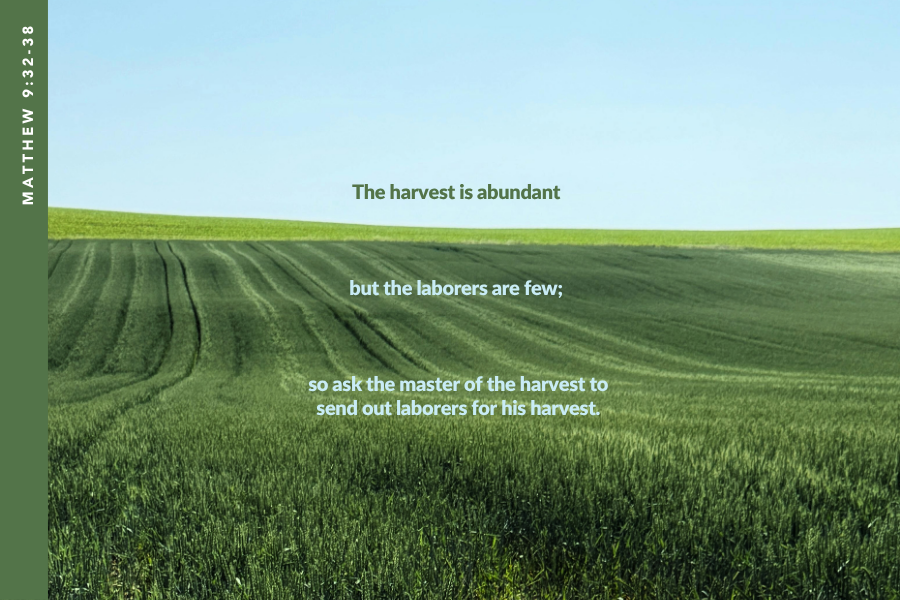
A demoniac who could not speak was brought to Jesus, and when the demon was driven out the mute man spoke. The crowds were amazed and said, “Nothing like this has ever been seen in Israel.” But the Pharisees said, “He drives out demons by the prince of demons.” Jesus went around to all the towns and villages, teaching in their synagogues, proclaiming the Gospel of the Kingdom, and curing every disease and illness. At the sight of the crowds, his heart was moved with pity for them because they were troubled and abandoned, like sheep without a shepherd. Then he said to his disciples, “The harvest is abundant but the laborers are few; so ask the master of the harvest to send out laborers for his harvest.” 

Opening Prayer: Jesus, have mercy on me. Too often, I have wandered, like a sheep, away from your truth. If it is your will to send me out as a laborer, grant me the humility to seek always your ways and your wisdom, that others may, through me, be guided back to you. 

Encountering Christ:

  1. Are We the Bringer or the One Brought?: The demons had taken away the possessed man’s very ability to speak. It is only because he was brought to Jesus, St. Matthew’s Gospel recounts, that he could be healed, and could then speak for himself. Do we (gently) bring to Jesus those who cannot even speak his name? Do we guide those around us toward an encounter with the living God of love? Or, perhaps, we are, or were, like the mute man in the story, the one brought to Jesus for restoration. In either circumstance, we should praise Jesus. “I will bless the Lord at all times; his praise shall be always in my mouth” (Ps 34:2). With the praise of Jesus on our lips we will be powerful evangelizers, sons and daughters with hearts full of gratitude for all Jesus does for us.

  2. Jesus Is Powerful, Yet He Wants Our Assistance: Jesus didn’t just heal a little bit, here and there. The Gospel reminds us he went to “all the towns and villages,” preaching the Good News, healing the sick, and driving out demons. But his work was not completed alone. Crowds began to gather, and Jesus asked his followers for their help. The “harvest” (of souls) was abundant, but the “laborers” were few, even in Jesus’ time. Later, as the infant Church was growing, the Apostles appointed the first deacons to help them with the ministry (cf. Acts 6:1-15). How do we assist him in our life? Are we open to his call and obedient to his instructions, or do we let worldly cares or technological distractions drown out his voice?

  3. How Often Do We Wander?: Jesus saw the crowds and was “moved with pity” for these “sheep without a shepherd.” Our urbanized modern world may not provide us with many encounters with sheep, but those who heard this Gospel before around 1940 had experienced what sheep can be—aimless, looking only for the next sweet patch of grass, dispersing widely when they sense a threat. Like sheep, we sometimes spend our energy on things outside of God’s will. Or we let others (who may be more lost than we are) lead us astray. When our faith is threatened, we run. Jesus, then and now, wants us to be led by him and by his Church to the truth and love that he has in store for us. He will always be our Good Shepherd. We need only turn to him and be reconciled.

Conversing with Christ: Lord, there are times when I can’t even articulate what I desire from you: your strength, your mercy, your love. In those times, allow me to be led to you. When I wander, send a shepherd to guide me back to you. Help me to hear the Good News and to bathe in the love you desire me to know.

Resolution: Lord, today by your grace, I will be reminded that you healed and preached in many places. Help me to remember that there is no place, most especially within my heart, that you are not willing to go, to bring me back to you. Help me to share this Good News—that you are my Shepherd—with a friend or family member as the opportunity arises.

For Further Reflection: Catechism of the Catholic Church 550: “The coming of God’s Kingdom means the defeat of Satan’s: ‘If it is by the Spirit of God that I cast out demons, then the Kingdom of God has come upon you.’ Jesus’ exorcisms free some individuals from the domination of demons. They anticipate Jesus’ great victory over the ‘ruler of this world.’” 

Jesus, we ask for your continued victory over the ruler of this world. If it be your will, make us willing laborers in your harvest. 

Dorothy Warner is a writer living in the Washington, D.C., area. When not engaged in writing, artisanal baking, volunteering, or gardening, she can be found working for a technology company or spending time with her husband and family, and all their pets.

July 8, 2025 – Sheep Without a Shepherd Read More »

Scroll to Top

Events

Looking for another country?

Contact Regnum Christi near you

News & Resources

News & Resources

The Regnum Christi Mission

The Regnum Christi Identity

Alex Kucera

Atlanta

Alex Kucera has lived in Atlanta, GA, for the last 46 years. He is one of 9 children, married to his wife Karmen, and has 3 girls, one grandson, and a granddaughter on the way. Alex joined Regnum Christi in 2007. Out of the gate, he joined the Helping Hands Medical Missions apostolate and is still participating today with the Ghana Friendship Mission.

In 2009, Alex was asked to be the Atlanta RC Renewal Coordinator for the Atlanta Locality to help the RC members with the RC renewal process. Alex became a Group Leader in 2012 for four of the Atlanta Men’s Section Teams and continues today. Running in parallel, in 2013, Alex became a Team Leader and shepherded a large team of good men.

Alex was honored to be the Atlanta Mission Coordinator between 2010 to 2022 (12 years), coordinating 5-8 Holy Week Mission teams across Georgia. He also created and coordinated missions at a parish in Athens, GA, for 9 years. Alex continues to coordinate Holy Week Missions, Advent Missions, and Monthly missions at Good Shepherd Catholic Church in Cumming, GA.

From 2016 to 2022, Alex also served as the Men’s Section Assistant in Atlanta. He loved working with the Men’s Section Director, the Legionaries, Consecrated, and Women’s Section leadership teams.

Alex is exceptionally grateful to the Legionaries, Consecrated, and many RC members who he’s journeyed shoulder to shoulder, growing his relationship with Christ and others along the way. He knows that there is only one way, that’s Christ’s Way, with others!