April 8, 2025

Regnum Christi Spirituality Center Ask a Priest

“Ask a Priest: What If I Was Barred From Being Confirmed?”

Q: It’s with a heavy heart that I reach out desperate for answers. I have been attending OCIA since September and have missed two classes. I was excited about confirmation and finally being able to receive the Eucharist at the Easter vigil Mass. A few days ago, I received the following shocking text message from the OCIA director that said the OCIA team and my sponsor have not witnessed a full conversion of my faith “to enter into full communion with the Church this Easter Vigil.” I am heartbroken and don’t understand. I met with the priest and my sponsor, and they made up excuses related to papers I didn’t turn in and continued to change the story as to the reason I couldn’t receive the sacraments. I honestly believe it has to do with a personal bias of the OCIA director. Please help me understand this. – R.

Answered by Fr. Edward McIlmail, LC

A: I’m sorry to hear about the situation.

But not knowing all the facts of your case, or the viewpoint of the others, it’s hard to give a simple answer.

The OCIA (formerly known as the RCIA) wants to prepare people for entrance into the Church. If someone is denied entrance, there is a serious reason.

My advice is to go back to the priest or OCIA director and ask what it would take for you to be able to complete your catechesis and receive the sacraments.

Don’t lose heart. Perhaps God has allowed this test to give you a chance to make a deeper act of faith in him. I’m sure he wants you in the Church.

Count on my prayers.


“Ask a Priest: What If I Was Barred From Being Confirmed?” Read More »

WM_Love

A Cross-Shaped Love

Dear Friends,


Faith, Hope, and Love abide, these three… (1 Corinthians 13:13)

Love, in the end, is always cruciform. Perhaps that’s what T.S. Eliot means in his
magnificent Four Quartets when he observes: “To apprehend/The point of
intersection of the timeless/With time, is an occupation for the saint/No occupation
either, but something given/And taken, in a lifetime’s death in love/Ardour and
selflessness and self-surrender.”

No matter how hard we seek substitutes, only this sort of love satisfies. No matter
how much we flee a cross-shaped love, peace will elude us until we accept it. And
the first step to acceptance is to ponder the mystery of God’s love for us, the God
who loves us and gives himself for us.

St John puts it well. “In this is love, not that we have loved God but that he has
loved us and sent his Son to be the atonement for our sins” (1 John 4:10). In other
words, we can love with a cruciform love because first, last, and always, we are
loved that way by God.

As the holiest days of the year draw near, the Church invites us to contemplate this
overwhelming love, to accept it, and to respond. I can think of no better expression
than St. Anthony of Padua’s “Sermones Dominicales et Festivi” in which he writes:
“Christ who is your life is hanging before you, so that you may look at the Cross as
in a mirror… If you look closely, you will be able to realize how great your human
dignity and value are… Nowhere other than looking at himself in the mirror of the
Cross can man better understand how much he is worth.”

And by God’s grace that understanding will lead to acceptance, and that
acceptance will lead to response, so that we, too, can love God and others with a
cross-shaped love.


God bless,

Fr. John Pietropaoli
Two Priests and a Mic podcaster

A Cross-Shaped Love Read More »

Lent 2025 – Day 35 – Renewing the Fabric of Society

Day 35 

Renewing the Fabric of Society

[Lay people’s] own field of evangelizing activity is the vast and complicated world of politics, society and economics, but also the world of culture, of the sciences and the arts, of international life, of the mass media. It also includes other realities which are open to evangelization, such as human love, the family, the education of children and adolescents, professional work, suffering. 

— St. Paul VI, Evangelii Nuntiandi, 70

The goal of the apostolate, the goal of the Church’s evangelization efforts, is to bring and constantly deepen the reign of Christ everywhere — into every human heart, family, community, and culture. We seek nothing less than to infuse every human reality with the redeeming truth of Christ’s message and the redeeming power of Christ’s grace. In Jesus’s commissioning of his Church to fulfill that mission, notice the universal scope, the unlimited boundaries of his vision: 

“Go, therefore, and make disciples of all nations, baptizing them in the name of the Father, and of the Son, and of the holy Spirit, teaching them to observe all that I have commanded you.” (Matthew 28:19–20)

All nations are to become disciples; all that Jesus taught and commanded is to be known, loved, and followed by everyone. That’s the work of evangelization. That’s our mission.

Transforming Humanity from Within

Jesus used a simple image to describe this process of cultural transformation when he explained the nature of his kingdom: “He spoke to them another parable. ‘The kingdom of heaven is like yeast that a woman took and mixed with three measures of wheat flour until the whole batch was leavened’” (Matthew 13:33).

Not Just a Pipe Dream

The development of western civilization in the Christian era demonstrates that this mission is more than a fairy tale. Greco-Roman civilization and Anglo-Germanic culture were both penetrated and transformed by the Christian ethos, creating a new culture. Over the course of a thousand years, the previously pagan scale of values was overturned by the influence of the gospel and its message of human dignity, divine mercy, and everlasting life. The institutions of European society developed under this spiritual tutorship, spreading wherever the Christians went to explore and to build. Many of the ideas found in the gospel were foreign and even contradictory to much of what the Greco-Roman and Germanic peoples adhered to. Concepts like humility and celibacy, care for the poor and inter-communitary justice (equality of human rights), and natural moral law were only vaguely present in pre-Christian worldviews, if they were present at all. Through the work and lives of Christians, they came to become common presuppositions in Western mentalities and legal systems. This led to flourishing achievements in every field of human endeavor, including science and technology, education, literature and the arts, and even politics and economics. 

Certainly it wasn’t heaven on earth, as some Western civilization apologists like to claim. In fact Jesus had promised it would never be so until his second coming. In the parable of the wheat and the weeds, he promised that good and bad would grow up side by side throughout the history of his Church, and the full purification from evil would only occur at the end of the earthly story (see Matthew13:37–43).

God’s Ambassadors to Every Sector of Society

God calls all of us to share in this aspect, too. The first Christians didn’t hunker down and go into hiding in the face of ancient Rome’s aggressive, anti-Christian paganism. Yes, they prudently guarded their worship services and formation activities from prying eyes in order to avoid unnecessary trouble, but at the same time they brought their faith to bear on the world in which they lived. They believed in the power of Christ’s message to transform the milieus in which they lived and worked.

Christian philosophers challenged and dialogued with pagan philosophers. Christian soldiers courageously imbued their military service with honor and moral integrity. Christian families rescued infants legally abandoned in forest clearings outside the city limits. Christian merchants and politicians battled corruption and worked to transform legal structures and economic customs in harmony with the true common good. Christian doctors and teachers defended moral truth and created new institutions dedicated to serving the underprivileged as well as those who could pay. In short, every sphere of society was penetrated not by “the Church” in the abstract, but by individual Christians whom God endowed and called to be missionaries within particular branches of human endeavor.

The new evangelization must include this same dimension; it must follow this same pattern. Imagine how different our culture would be if every Catholic — or even one in every ten Catholics — was fully aware and fully engaged in this kind of effort. We have no cause to wait for “the Church” to Christianize culture; we are the Church wherever we work and live. And we are present in every nook and cranny of society. God is eager to give us the courage and wisdom to proclaim and build up Christ’s kingdom right there. We just need to seize the opportunities, to believe, and to launch ourselves into the fray. If we don’t, who will?

Questions for Personal Reflection or Group Discussion

What idea in this reflection struck you most and why?

How firmly do you believe that Jesus really wants to convert the entire world, every single person? How firmly do you believe that he wants to work through you to help achieve that goal?

How can you better infuse gospel values in your workplace or other circles of influence with cultural implications?

God calls all of us to bring the gospel into the circles of society where we live and work, through our way of being, our words, and our works. 

What will you do today to use your personal gifts for God’s glory and to further the Church’s work of evangelization?

  • I will sit down with a friend and ask him or her to help me identify my top three or four personal gifts.
  • I will spend some time prayerfully reflecting on the strong desires in my heart  to take on a particular project or get involved in a certain apostolic activity, desires that have been resonating in my heart and may be indicating an invitation from the Lord, but which I haven’t yet responded to. I will write these down and ask God to show me how to take the next step.
  • I will remember the idealistic dreams of doing something great for God that motivated me in the past, and I will prayerfully reflect on what role those dreams should play in my life now.
  • (Write your own resolution) I will

Concluding Prayer

 I am created to do something or to be something for which no one else is created; I have a place in God’s counsels, in God’s world, which no one else has; whether I be rich or poor, despised or esteemed by man, God knows me and calls me by my name.

God has created me to do Him some definite service; He has committed some work to me which He has not committed to another. 

— St. John Henry Newman

Lent 2025 – Day 35 – Renewing the Fabric of Society Read More »

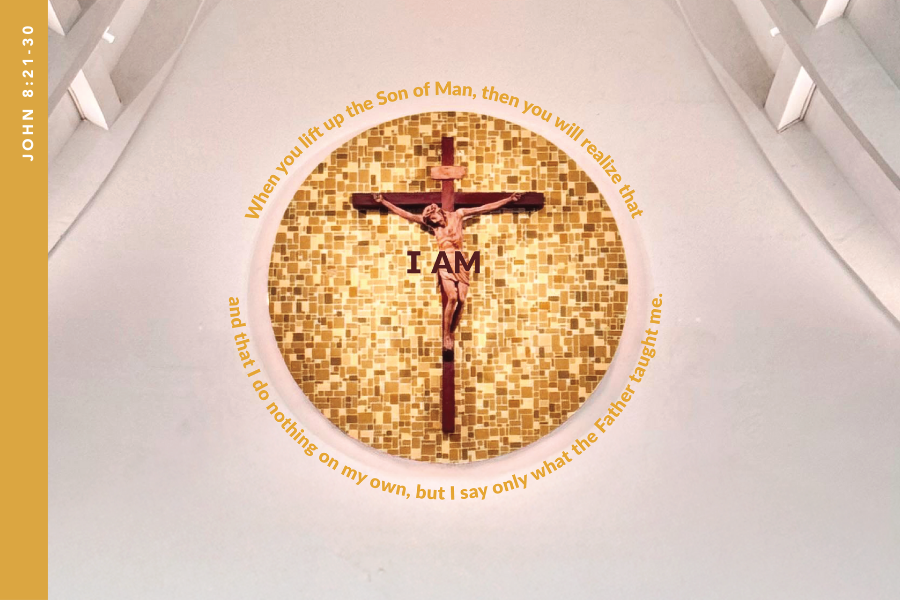
April 8, 2025 – The Great “I AM”

Listen to the audio version

Tuesday of the Fifth Week of Lent


John 8:21-30

Jesus said to the Pharisees: “I am going away and you will look for me, but you will die in your sin. Where I am going you cannot come.” So the Jews said, “He is not going to kill himself, is he, because he said, ‘Where I am going you cannot come’?” He said to them, “You belong to what is below, I belong to what is above. You belong to this world, but I do not belong to this world. That is why I told you that you will die in your sins. For if you do not believe that I AM, you will die in your sins.” So they said to him, “Who are you?” Jesus said to them, “What I told you from the beginning. I have much to say about you in condemnation. But the one who sent me is true, and what I heard from him I tell the world.” They did not realize that he was speaking to them of the Father. So Jesus said to them, “When you lift up the Son of Man, then you will realize that I AM, and that I do nothing on my own, but I say only what the Father taught me. The one who sent me is with me. He has not left me alone, because I always do what is pleasing to him.” Because he spoke this way, many came to believe in him.

Opening Prayer: Lord, I want to know you and follow you wherever you lead me. I thank you for your word that provides direction, and for your invitation to pray with the rest of your Church. Let your Holy Spirit help me better understand your word and more intimately meet you in this time of prayer.

Encountering Christ:

  1. The Great Chasm: With penetrating clarity, Christ taught the stubborn Pharisees that remaining “of this world,” refusing to believe in the Christ or the Father who sent him, carries a death sentence. This delineation of two worlds, infinitely separated upon one’s death, was further clarified by Jesus in the parable of the doomed rich man, who should have been kinder to the beggar, Lazarus: “Between us and you a great chasm is established” (Lk 16:26). The only way to have life is to believe in Jesus. Lord, may we have the grace to believe always in your name, trusting your word: “… to those who did accept him he gave power to become children of God, to those who believe in his name” (Jn 1:12).

  2. The Act of Faith: What would it take for these Pharisees whom Jesus encountered, whose fate was not yet sealed on the wrong side of the chasm, to find eternal life? Jesus plainly articulated the first step: an act of faith. Those who looked upon him when he was raised up on a cross would need to accept that this, indeed, was the Christ, the only one who could claim to be the great “I AM” from the Torah story of the burning bush (cf. Ex 3:14). Those of us with the benefit of Sacred Scripture, Sacred Tradition, and the teaching authority of the Church, must not be misled; we, too, must look to the cross and proclaim Christ, as “there is no salvation through anyone else” (Acts 4:12).

  3. Giving, Not Taking: How ironic that the Pharisees jumped to the strange conclusion that Jesus might be taking his own life. Only one thing might have surprised them more—if Jesus was contemplating giving his own life. Indeed, the King of Kings would ultimately give over his life. Following in his footsteps are others who history tells us literally laid down their lives, such as well-known martyrs St. Stephen, St. Maximillian Kolbe, and St. Teresa Benedicta of the Cross (Edith Stein). Today, our priests and consecrated souls are counter-cultural people who themselves generously give over their own lives for the sake of the Church. Let us pray for more laborers in the vineyard.

Conversing with Christ: I thank you, Lord, for your invitation to enter into prayer. You have the words of everlasting life, and you continually remind me of your willingness to meet me, whether it is in my sorrow, my doubts, my insecurity, or even in my joy. I look at you on the cross today and I recall the horrific day when my sins placed you on that hill at Golgotha. I also recall your words to the good thief, who looked to you with faith in your Kingship: “Today you will be with me in Paradise” (Lk 23:43).

Resolution: Lord, today by your grace I will pray the sorrowful mysteries of the rosary for friends or relatives who do not know Christ, and for more vocations to the priesthood and religious life.

Andrew Rawicki and his wife, JoAnna, live in Irving, Texas, near seven of their nine grandchildren. A convert from Judaism, Andrew entered the Church in 1991 and has been a member of the Regnum Christi spiritual family since 2001. He has served as the Regnum Christi Local Director for Dallas since July 2020.

April 8, 2025 – The Great “I AM” Read More »

Scroll to Top

Events

Looking for another country?

Contact Regnum Christi near you

News & Resources

News & Resources

The Regnum Christi Mission

The Regnum Christi Identity

Alex Kucera

Atlanta

Alex Kucera has lived in Atlanta, GA, for the last 46 years. He is one of 9 children, married to his wife Karmen, and has 3 girls, one grandson, and a granddaughter on the way. Alex joined Regnum Christi in 2007. Out of the gate, he joined the Helping Hands Medical Missions apostolate and is still participating today with the Ghana Friendship Mission.

In 2009, Alex was asked to be the Atlanta RC Renewal Coordinator for the Atlanta Locality to help the RC members with the RC renewal process. Alex became a Group Leader in 2012 for four of the Atlanta Men’s Section Teams and continues today. Running in parallel, in 2013, Alex became a Team Leader and shepherded a large team of good men.

Alex was honored to be the Atlanta Mission Coordinator between 2010 to 2022 (12 years), coordinating 5-8 Holy Week Mission teams across Georgia. He also created and coordinated missions at a parish in Athens, GA, for 9 years. Alex continues to coordinate Holy Week Missions, Advent Missions, and Monthly missions at Good Shepherd Catholic Church in Cumming, GA.

From 2016 to 2022, Alex also served as the Men’s Section Assistant in Atlanta. He loved working with the Men’s Section Director, the Legionaries, Consecrated, and Women’s Section leadership teams.

Alex is exceptionally grateful to the Legionaries, Consecrated, and many RC members who he’s journeyed shoulder to shoulder, growing his relationship with Christ and others along the way. He knows that there is only one way, that’s Christ’s Way, with others!