April 1, 2025

Regnum Christi Spirituality Center Ask a Priest

“Ask a Priest: What If 666 Is Connected to My Day of Birth?”

Q: I’m Catholic, I’ve got a trouble. Recently, I just realized that I was born on June 6, and coincidentally that day was Friday, the sixth day of the week. This means the 666-number of Satan and bad luck. I’m curious what this really means for me. – J.

Answered by Fr. Edward McIlmail, LC

A: Don’t worry about the alignment of numbers on the date. That kind of fear could verge on or be superstition if you let that influence your decisions.

You should put your faith in God more and worry less about numbers.

The Catechism teaches in No. 2111: “Superstition is the deviation of religious feeling and of the practices this feeling imposes. It can even affect the worship we offer the true God, e.g., when one attributes an importance in some way magical to certain practices otherwise lawful or necessary.”

Put another way, superstition about numbers, etc., can distract us from the basics of religious belief and practice.

A fixation on numbers could weaken our confidence in Our Lord and even lead us down more problematic paths, such as dabbling in horoscopes.

To avoid this problem, it would be good to cultivate a solid life of prayer and the sacraments.

And try to study the Catholic faith more. Get a copy of the Youth Catechism or the Compendium of the Catechism or the U.S. Catholic Catechism for Adults.

It might also be helpful to get involved in Church activities that will bring you in contact with faithful Catholics. Their support could help you to live the faith better and set aside any tendencies toward superstition.

I hope this helps. Count on my prayers.


“Ask a Priest: What If 666 Is Connected to My Day of Birth?” Read More »

Priestly Ordinations 2025

Time Until the 2025 Priestly Ordinations

Days
Hours
Minutes
Seconds

On Saturday, May 3, 2025, at 10:00 a.m. (Rome time),  23 Legionaries of Christ will be ordained priests . The future priests come from Mexico, Brazil, France, Colombia, Argentina, Spain, the United States, El Salvador, Germany, and Venezuela.

The ceremony, which will take place at the  Basilica of St. Paul Outside the Walls  (Rome), will  be celebrated by Cardinal Kevin Joseph Farrell,  current chamberlain of the Holy Roman Catholic Church.

Deacon Adrián Olvera, LC, a Mexican who will be ordained in Rome shares, “I can say with certainty that God always goes beyond what we imagine and surprises us in unexpected ways. We just need to be willing to let ourselves be surprised,” referring to what it means to him to become a Legionary priest.

Deacon Jaime Plasencia, LC, shares the same sentiment: “Despite the ups and downs of life, despite the winds and raging waves, despite the sunny and cloudy days, I belong to the Lord in a very special way, and that is my joy.” 

Information about ordination:

  • Date:  Saturday, May 3, 2025.
  • Time:  10:00 am (Rome)
  • Location:  Basilica of St. Paul Outside the Walls (Rome)
  • Broadcast:  Live via YouTube
  • Broadcast languages:  Italian (official language) with commentary in Spanish and English (simultaneous channels).

Although 23 Legionaries will be ordained on Saturday, May 3, a total of 27 Legionary deacons will be ordained to the priesthood in 2025. In addition to the 23 to be ordained in Rome, there are 1 Mexican, 1 El Salvadoran, 1 Brazilian, and 1 Chilean who will be ordained in their home countries. It is expected that about 20 Legionaries will be ordained as deacons  in 2025.

A special website has been created for the ordinations .  Official posters, testimonies, videos, and other useful information are available there.

A Legionary of Christ’s formative journey lasts 12 years before being ordained a priest. The elements of their preparation and formation are contained in their Ratio Institutionis Christus Vita Vestra.

Saturday
May 3, 2025

Rome Italy, 10:00 AM

North America:

  • Eastern – 4:00 AM
  • Central – 3:00 AM
  • Mtn – 2:00 AM
  • Pacific – 1:00 AM

Asia/Oceania

  • Manila – 4:00 PM
  • Seoul – 5:00 PM
  • Sydney – 7:00 PM
Basilica of St. Paul Outside the Walls

Located in the south of Rome, it is one of the four major basilicas of the city. It was built in the 4th century, under Emperor Constantine, on the site where it is believed the apostle Saint Paul was buried. The basilica is famous for its monumental architecture, with a central nave surrounded by Corinthian columns and a beautiful mosaic in the apse depicting Christ.

Cardinal Kevin Joseph Farell

Cardinal Farrell, who will preside at the Ordination Mass, was born in 1947 in Dublin, Ireland. Ordained a priest in 1978, he was appointed auxiliary bishop of Washington in 2001 and bishop of Dallas in 2007. In 2016, Pope Francis appointed him prefect of the Dicastery for the Laity, Family, and Life. He was made a cardinal in November 2016. He is the current Camerlengo of the Holy Roman Church.

Saturday
May 3, 2025
  • Rome Italy, 10:00 AM
  • North America:
    • Eastern – 4:00 AM
    • Central – 3:00 AM
    • Mountain – 2:00 AM
    • Pacific – 1:00 AM
  • Asia/Oceania
    • Manila – 4:00 PM
    • Seoul – 5:00 PM
    • Sydney – 7:00 PM
Basilica of St. Paul Outside the Walls

Located in the south of Rome, it is one of the four major basilicas of the city. It was built in the 4th century, under Emperor Constantine, on the site where it is believed the apostle Saint Paul was buried. The basilica is famous for its monumental architecture, with a central nave surrounded by Corinthian columns and a beautiful mosaic in the apse depicting Christ.

Cardinal Kevin Joseph Farell, Presider

Cardinal Farrell was born in 1947 in Dublin, Ireland. Ordained a priest in 1978, he was appointed auxiliary bishop of Washington in 2001 and bishop of Dallas in 2007. In 2016, Pope Francis appointed him prefect of the Dicastery for the Laity, Family, and Life. He was made a cardinal in November 2016. He is the current Camerlengo of the Holy Roman Church.

Priestly Ordinations 2025 Read More »

WM_Cross

What is Your Cross?

Dear Friends,


Jesus said, “Whoever wishes to come after me must deny himself, take up his cross, and follow me.”

The Cross would prove to be no mere metaphor for Our Lord when his mission took him to Calvary.

The Cross was agonizing and underscores the intensity of his love for us and our redemption.

As Christians we are called to take up our own cross with an eye toward “filling up what is lacking in the afflictions of Christ on behalf of his body, which is the church” (Colossians 1:24). For here on earth the Mystical Body of Christ, the Church, continues to suffer in imitation of her Founder.

So, what is our cross?

For each of us it can be unique: a chronic illness, an alcoholic family member, a nasty boss. Or a bad habit we can’t seem to shake.

Whatever form it takes, the cross isn’t appealing. It can even grind us down, no matter how much we struggle.

Ideally, we learn during Lent to accept the notion of a cross by our voluntary sacrifices and intensified life of prayer.

This is where the grace of God can work a kind of alchemy, changing the leaden burdens of daily life into the gold of sanctification. For rarely has anyone grown in holiness who wasn’t first brought low and humbled.

As Holy Week approaches, it’s a good moment to take stock of our Lent.

Have we been faithful to our resolutions? Have we embraced and even come to appreciate small acts of abnegation?

It’s not too late to commit to living the rest of Lent with fervor. A helpful boost might be our Retreat Guide on “A Cure for Discouragement.”

And remember, the cross is a sign of Our Lord’s desire for our holiness.

In Christ,

Father Edward McIlmail, LC
Ask a Priest contributor

What is Your Cross? Read More »

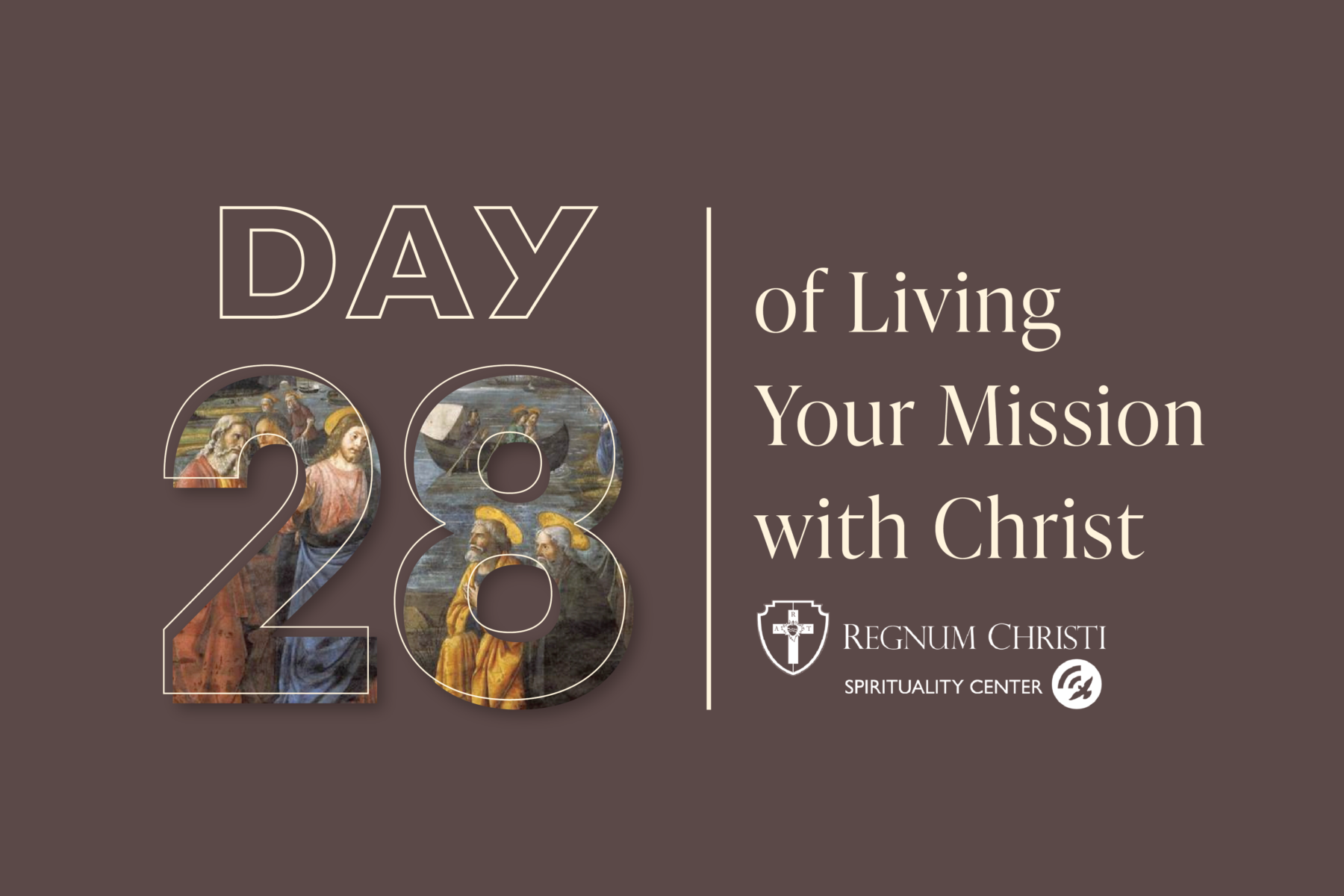
Lent 2025 – Day 28 – Daily Life Matters

Day 28

Daily Life Matters

There cannot be two parallel lives in their existence: on the one hand, the so-called “spiritual” life, with its values and demands; and on the other, the so-called “secular” life, that is, life in a family, at work, in social relationships, in the responsibilities of public life and in culture. The branch, engrafted to the vine which is Christ, bears its fruit in every sphere of existence and activity. 

— St. John Paul II, Christifideles Laici

Jesus lived for about thirty-three years here on earth. He spent the first thirty of those years in obscurity. He lived most of that period in a small town off the beaten path, Nazareth. He spent his days learning from his mother, Mary, and his foster father, Joseph, who ran a carpenter shop and probably served as the village handyman. For thirty years the Savior of the world, the Son of God, the incarnate second person of the Blessed Trinity lived the most normal of human lives. No miracles, no extraordinary manifestations of anything, no special privileges, no prodigious signs after the amazing night of his birth. Just normal daily life.

The Value of the Present Moment

Why? Why did Jesus choose this path? Did he spend those thirty years twiddling his thumbs and waiting around for the moment when he would begin to preach and teach and redeem the world? Not at all. Everything Jesus did and said was part of God’s divine revelation. It all has a lesson for us. It teaches us about how God sees the world, and about how we are created and called to live our lives. And the thirty years during which Jesus and the Blessed Virgin Mary lived outside the spotlight teaches us that daily life matters.

The relationships, experiences, and activities of daily life construct the primary arena where we love our neighbors as ourselves, where we fulfill our mission. Too often we overlook this. Too often we fantasize about different circumstances that, or so we think, would give us a chance to live life to the full and be all we can be. Too often we think that “mission” necessarily implies going to far-off places. Too often we forget the wise irony contained in the proverbial phrase “the grass is always greener on the other side of the fence.” 

Living in a state of perpetual regret and self-pity because of the challenges of our daily circumstances — thinking that “real life” is actually waiting somewhere around the corner and off in the future — distracts the soul. In fact, it can blind us to the real graces and opportunities that the Lord never ceases to present to us: “At every time and in every place, God draws close to man. He calls man to seek him, to know him, to love him with all his strength,” the Catechism reminds us. “He never ceases to call every man to seek him, so as to find life and happiness . . .  God never ceases to draw man to himself” (CCC, 1, 30, 27). Jesus didn’t wait until he left Nazareth to redeem the world; the redemption of the world, in fact, necessarily passed through those thirty years in Nazareth. And our contribution to that work of redemption necessarily passes through our Nazareth.

Not All Saints Are Supernovas

We see this truth reflected in the lives of the saints. The most well-known saints are those who were called by God to truly extraordinary lives and missions. St. Francis of Assisi received the stigmata and preached miraculously even to wild animals. St. Faustina Kowalska received mystical visions and had mystical conversations with the Lord on a regular basis throughout her entire consecrated life. St. Patrick exercised such spiritual force — in his preaching, leadership, and miracles — that he converted the entire Irish people to Christianity in his own lifetime. . . . Because of their dramatic character, these extraordinary manifestations of grace capture our attention and can make us think that holiness consists in being like them.

And yet plenty of other saints reached the pinnacle of holiness and fulfilled their mission on earth without ever leaving the confines of their Nazareth. St. Bede entered the monastery as a seven-year-old boy when his parents entrusted his education to the monks. He died there more than sixty years later, having never left the borders of the double monastery in Jarrow, England. St. Thérèse of Lisieux, whose autobiography led to her being named a Doctor of the Church, died at the young age of twenty-four. At the time of her death, the sisters in her convent were at a loss as to what they should put into the death notice that was customary to send to the other convents — that’s how normal and unremarkable her brief consecrated life had been, at least from the outside. 

St. Gianna Beretta Molla was an Italian wife, mother, and pediatrician. She liked skiing and fashion and lived amid the normal hustle and bustle of family life. Her holiness took root and flourished there, in her Nazareth. And of course St. Joseph himself, patron saint of the Universal Church, lived and died in the dusty obscurity of the literal Nazareth, speaking nary a single word in the Scriptures. 

Redemption Is Rooted in Nazareth

The extraordinary manifestations of grace that capture our attention are gifts God gives to the Church in order to boost our faith. But they are not the substance of holiness and happiness. They are not necessary ingredients in the recipe for Christian faithfulness. Rather, they are simply providential works of grace overflowing from daily lives lived in communion with God. To discover and fulfill our mission in life, to love our neighbor as ourselves and thereby build up the kingdom of God, we must not seek first what is extraordinary and dramatic. We must not vainly hanker after spectacular shows of spiritual power. Rather we must strive to be authentic Christians, fully present and engaged in each duty and interaction that meets us in our Nazareth, where redemption is truly rooted. What flows from that, whether dramatic or not, is up to God.

Moses put it well in his last sermon before the Chosen People of Israel crossed into the Promised Land:

For this command which I am giving you today is not too wondrous or remote for you. It is not in the heavens, that you should say, “Who will go up to the heavens to get it for us and tell us of it, that we may do it?” Nor is it across the sea, that you should say, “Who will cross the sea to get it for us and tell us of it, that we may do it?” No, it is something very near to you, in your mouth and in your heart, to do it. (Deuteronomy 30:11–14)

The principles, virtues, and activities explored in these reflections are all related to how we can help love our neighbors by spreading Christ’s kingdom. But they can all be applied — indeed, they must be applied — first and foremost in our daily lives. God’s providence has placed us there. God’s love longs to meet us there. God’s grace will flow through us there, leading us step-by-step to the fullness of our calling.

Questions for Personal Reflection or Group Discussion

What idea in this reflection struck you most and why?

Describe the circumstances of your Nazareth: the duties, relationships, and activities that form the warp and woof of your daily life. Where is God inviting you to love more in them?

How easy or hard is it for you to believe that God is at work through you in those daily circumstances? Speak to God right now and express your faith that he is present and active in your Nazareth. Ask for the grace to find and follow him there.

Hypocrisy is one of the biggest obstacles to building up the kingdom of Christ. When we profess to be Christians, followers of Christ, we are claiming to have certain standards of behavior. When we habitually fail to live up to those standards, or when we habitually make no effort to do so, we create a disconnect between what we say and what we do. When people notice that, it makes them doubt the authenticity of the Christian faith. If Jesus were real, they think to themselves, then his followers would be more coherent. 

What will you do today to root out any remnants of hypocrisy in your life?

  • I will go to confession as a concrete expression of my sincere desire to let God’s grace root out my self-centered tendencies.
  • I will pay special attention to one relationship that is challenging for me, asking God to help me see that person as he does, and to help me “love my neighbor as myself” in that particular case.
  • I will ask forgiveness from someone I may have offended, consciously or not.
  • (Write your own resolution) I will

Concluding Prayer

O God, who cause the minds of the faithful to unite in a single purpose, grant your people to love what you command and to desire what you promise, that, amid the uncertainties of this world, our hearts may be fixed on that place where true gladness is found.

May your grace, O Lord, we pray, at all times go before us and follow after and make us always determined to carry out good works.

Through our Lord Jesus Christ, your Son,

who lives and reigns with you in the unity of the Holy Spirit,

one God, for ever and ever. Amen.

— Roman Missal, Collects for the Twenty-First and Twenty-Eighth Sundays in Ordinary Time

Lent 2025 – Day 28 – Daily Life Matters Read More »

April 1, 2025 – Mercy and Grace

Listen to the audio version

Tuesday of the Fourth Week of Lent

John 5:1-16

There was a feast of the Jews, and Jesus went up to Jerusalem. Now there is in Jerusalem at the Sheep Gate a pool called in Hebrew Bethesda, with five porticoes. In these lay a large number of ill, blind, lame, and crippled. One man was there who had been ill for thirty-eight years. When Jesus saw him lying there and knew that he had been ill for a long time, he said to him, “Do you want to be well?” The sick man answered him, “Sir, I have no one to put me into the pool when the water is stirred up; while I am on my way, someone else gets down there before me.” Jesus said to him, “Rise, take up your mat, and walk.” Immediately the man became well, took up his mat, and walked. Now that day was a Sabbath. So the Jews said to the man who was cured, “It is the Sabbath, and it is not lawful for you to carry your mat.” He answered them, “The man who made me well told me, ‘Take up your mat and walk.’” They asked him, “Who is the man who told you, ‘Take it up and walk’?” The man who was healed did not know who it was, for Jesus had slipped away, since there was a crowd there. After this Jesus found him in the temple area and said to him, “Look, you are well; do not sin any more, so that nothing worse may happen to you.” The man went and told the Jews that Jesus was the one who had made him well. Therefore, the Jews began to persecute Jesus because he did this on a Sabbath.


Opening Prayer: Jesus, I want to be healed. Help me to be open to receiving your mercy and grace so I can live an abundant life here and now and have eternal life with you in the next.

Encountering Christ:


  1. Desert Wandering: Today’s Gospel passage continues the Johannine theme of miraculous healing. Just before this in the Gospel of John (also yesterday’s Gospel reading), Jesus healed the royal official’s son. Here he healed a man who had been ill for thirty-eight years. Thirty-eight years is significant because that is how long Israel wandered in the wilderness of Paran (cf. Num 33). Moses wrote: “Now thirty-eight years had elapsed between our departure from Kadesh-barnea and the crossing of the Wadi Zered; in the meantime the whole generation of soldiers had perished from the camp, as the Lord had sworn they should” (Deut 2:14). This man had been crippled, sitting near a pool of healing water but unable to access it, for thirty-eight years; he was “wandering in a desert.” Bethesda means “house of mercy” or “house of grace” in Hebrew. The man was in need of mercy and grace, but he could not access it. He needed Jesus to extend mercy and grace to him in order to restore him to life. Is there any place in our life when we have been wandering away from Jesus’ mercy and grace?

  2. Come to the Water: Jesus asked the man if he wanted to be healed. Jesus wants to heal us too, but we must consent to be healed by believing that he has the power to heal us from everything that afflicts us, most importantly our sins and vices. Jesus’ mercy and grace flow out of him as “living water” (cf. Jn 4:10). We are called to come to his pool of mercy and grace and submerge ourselves in it. Each time we approach Jesus to confess our sins in the sacrament of Reconciliation, we come to this deep pool of mercy. We open our hearts, allowing our sins to come out of us, and Jesus pours his living water of mercy into them, purifying and restoring them. We receive mercy for our sins and grace to strengthen us against future temptation.

  3. Jesus, Font of Healing: Jesus Christ is the new temple (cf. Jn 2:21). In our first reading today, Ezekiel had a vision of this new temple with a wonderful stream flowing ever deeper from its right side (cf. Ezek 47:1). This stream made salt water fresh and dirty water clean. Wherever it flowed, it brought health and life in abundance (cf. Ezek 47:8-12). The new temple mount is Calvary, where the sweet waters of baptism flowed out of Christ’s side: “… one soldier thrust his lance into his side, and immediately blood and water flowed out” (Jn 19:34). The man wanted to get to the healing water in the pool; in his abundant mercy Jesus, the font of healing, came to him.

Conversing with Christ: Jesus, thank you for coming to save and heal me. Help me to come to your living waters of mercy and grace. I know that I cannot save myself, but I need you to come and bring me salvation and restore my wholeness.

Resolution: Lord, today by your grace I will make a plan to receive the sacrament of Reconciliation soon.

Carey Boyzuck is a wife, mother, freelance writer, and lay member of Regnum Christi. 

April 1, 2025 – Mercy and Grace Read More »

Scroll to Top

Events

Looking for another country?

Contact Regnum Christi near you

News & Resources

News & Resources

The Regnum Christi Mission

The Regnum Christi Identity

Alex Kucera

Atlanta

Alex Kucera has lived in Atlanta, GA, for the last 46 years. He is one of 9 children, married to his wife Karmen, and has 3 girls, one grandson, and a granddaughter on the way. Alex joined Regnum Christi in 2007. Out of the gate, he joined the Helping Hands Medical Missions apostolate and is still participating today with the Ghana Friendship Mission.

In 2009, Alex was asked to be the Atlanta RC Renewal Coordinator for the Atlanta Locality to help the RC members with the RC renewal process. Alex became a Group Leader in 2012 for four of the Atlanta Men’s Section Teams and continues today. Running in parallel, in 2013, Alex became a Team Leader and shepherded a large team of good men.

Alex was honored to be the Atlanta Mission Coordinator between 2010 to 2022 (12 years), coordinating 5-8 Holy Week Mission teams across Georgia. He also created and coordinated missions at a parish in Athens, GA, for 9 years. Alex continues to coordinate Holy Week Missions, Advent Missions, and Monthly missions at Good Shepherd Catholic Church in Cumming, GA.

From 2016 to 2022, Alex also served as the Men’s Section Assistant in Atlanta. He loved working with the Men’s Section Director, the Legionaries, Consecrated, and Women’s Section leadership teams.

Alex is exceptionally grateful to the Legionaries, Consecrated, and many RC members who he’s journeyed shoulder to shoulder, growing his relationship with Christ and others along the way. He knows that there is only one way, that’s Christ’s Way, with others!