March 11, 2025

Regnum Christi Spirituality Center Ask a Priest

“Ask a Priest: May I See a Medium If the Event Is a Birthday Gift?”

Q: I was given a ticket to see a medium for my birthday by a family member. There is a group of people going, and the event is in less than a week. I hadn’t thought anything of it until, while listening to a Bible podcast, a priest mentioned that seeking a medium is sinful and against the First Commandment. My question is this: Is attending the event sinful? While I am not specifically seeking a medium, I realize I would be putting myself into a situation where there’s potential for a reading whether I want it or not. I don’t want the family member to be offended if I reject the gift, but I won’t willfully enter a sinful situation. Thank you for your guidance. – T.

Answered by Fr. Edward McIlmail, LC

A: Going to a medium is strictly prohibited. It violates the commandment about loving God above all things.

The Catechism in No. 2116 says:

“All forms of divination are to be rejected: recourse to Satan or demons, conjuring up the dead or other practices falsely supposed to ‘unveil’ the future. Consulting horoscopes, astrology, palm reading, interpretation of omens and lots, the phenomena of clairvoyance, and recourse to mediums all conceal a desire for power over time, history, and, in the last analysis, other human beings, as well as a wish to conciliate hidden powers. They contradict the honor, respect, and loving fear that we owe to God alone.”

Just going to a medium could be scandalous and fuel this family member’s problems (and those of the group). Your attendance could imply either a belief in mediums or a carefree attitude toward them.

The family member who gave you the ticket might not have intended any evil. But in this case ignorance is not bliss.

It might be good to have a heart-to-heart with the relative and charitably explain that recourse to a medium isn’t fun and games. It is offensive to God and can open the door to evil forces.

Put another way, you should worry less about offending the relative and worry more about offending Our Lord.

On a positive note, this is a teaching moment. Handled well, it can stave off big problems down the line.

It might be good to pray for this family member first and ask the Holy Spirit for guidance.

For related reading, see the 2020 letter from the bishop of Rockville Centre. And count on my prayers.


“Ask a Priest: May I See a Medium If the Event Is a Birthday Gift?” Read More »

Lent 2025 – Day 7 – Nourishing my Heart

Day 7

Nourishing My Heart

There is no doubt that spiritual formation ought to occupy a privileged place in a person’s life. Everyone is called to grow continually in intimate union with Jesus Christ, in conformity to the Father’s will, in devotion to others in charity and justice.

— St. John Paul II, Christifideles Laici, 60

Loving God with all your heart means desiring him above all things and making your intimate, personal relationship with him into the highest priority of your life, the center around which every other facet of your existence finds its proper and glorious place. But how do you do that? How do you make that happen?

The heart expresses itself through the other three modes that Jesus identifies in the greatest commandment: loving God with all our soul, mind, and strength. Attending to each of those arenas, therefore, produces an indirect effect on the heart as well, educating and purifying it, and nourishing its Christian core. Nevertheless, you can also attend to the heart directly. 

Thoughts of the Heart

We spend a lot of time thinking about the things we desire. When we treasure something, it occupies our mind. And, conversely, the more we think about something, the more we tend to desire it. 

This is part of human nature; it flows from the connection between the two spiritual faculties that human nature possesses — intelligence and will, the power to know, and the power to choose. For us human beings, these faculties utilize instruments to operate: our senses, our imagination, our memory, our emotions, and our passions. Unlike angels, whose access to truth and goodness is purely spiritual and immediate, human persons discover truth and goodness gradually, through the mediation of spatial-temporal experience. This is why we can figure out a solution to a complex problem by making diagrams and pictures, doodling, trying various alternatives in our imagination, and discussing it with others. 

And so, what we choose to look at, think about, and daydream about will affect the desires that grow and mature in our heart. The intensity of our love for a certain object can increase or decrease according to how much attention we pay to that object and how much space it takes up in our external and internal senses (memory and imagination). 

Tricks of the Devil 

The devil understands this reality and uses it in the dynamics of temptation. St. James explains how temptation begins with something that stirs up a self-centered desire, and then, if we choose to pay attention to that desire, it grows. If we feed it with more attention, we will eventually act on it, committing sin. If we continue to act on it, the sin can become a habit and even choke off the life of grace:

Each person is tempted when he is lured and enticed by his own desire. Then desire conceives and brings forth sin, and when sin reaches maturity it gives birth to death. (James 1:14–15)

The devil, agitating our fallen nature and the fallen world in which we live, will try to monopolize our attention with images, ideas, thoughts, and invitations that can lure us into self-absorption and eventually into destructive self-indulgence. The enemy of our souls wants to occupy our minds with a multiplicity of inputs that can divide our hearts, draining our desire for God and filling up our desires for any number of petty idols.

Spiritual Heart Supplements

Forming our heart in Christ follows the contrary path. To feed our desire for God and our desire to make our relationship with him the core and fountain of everything we do requires thinking frequently about him and his magnificent plan for our lives. Just as a little boy will feed his desire for a new bike by looking at a picture of that bike every day, so too we need to gaze at the Lord and savor his dream for us as often as we can. We need to feed the central desire of our Christian heart with thoughts that are in harmony with that desire. And we need to intentionally stir up those thoughts all the time. The psalms frequently make choosing to think about God and his plans (his name, promise, judgments, testimonies) a central theme for prayer:

In my heart I treasure your promise, that I may not sin against you. . . . At all times my soul is stirred with longing for your judgments. . . . Direct my heart toward your testimonies and away from gain. Avert my eyes from what is worthless; by your way give me life. When I recite your judgments of old . . . I am comforted, Lord. Even at night I remember your name in observance of your law, Lord. (from Psalm 119)

Most of the traditional pious practices associated with Christianity have this as their goal. Displaying images of Jesus, Mary, and the saints on our walls, desks, rearview mirrors, and screen savers; wearing a cross or a crucifix around our necks; wearing blessed medals; dropping by a church and making the Sign of the Cross with holy water; asking for a priest’s blessing; praying before meals — practices like these set reminders for us to think about God. They can nourish the core desire of our hearts.

Eating Right

But the meat and potatoes of forming the Christian heart remain prayer and the sacraments (we will dive into these realities more fully in later chapters). Without a real, growing life of prayer — in all of its forms, but most essentially in a daily, personal God-time — our core desire for God will always remain undernourished, and our spiritual growth will be stunted. Infrequent or superficial contact with the sacraments, especially the Eucharist and confession, robs our souls of essential spiritual nutrients. Jesus made this clear so many times:

On Prayer: “Then Jesus told them a parable about the necessity for them to pray always without becoming weary . . . ” (Luke 18:1); “If you remain in me and my words remain in you, ask for whatever you want and it will be done for you.” (John 15:7)

On the Eucharist: “Jesus said to them, ‘Amen, amen, I say to you, unless you eat the flesh of the Son of Man and drink his blood, you do not have life within you. Whoever eats my flesh and drinks my blood has eternal life, and I will raise him on the last day. For my flesh is true food, and my blood is true drink. Whoever eats my flesh and drinks my blood remains in me and I in him. Just as the living Father sent me and I have life because of the Father, so also the one who feeds on me will have life because of me.’” (John 6:53–57)

On confession (Jesus to his apostles): “Whose sins you forgive are forgiven them, and whose sins you retain are retained.” (John 20:23)

God himself gives us a new heart when we become Christians, but he leaves it up to us to make that heart grow.

Questions for Personal Reflection or Group Discussion

What idea in this reflection struck you most and why?

Are you a better pray-er than you were a year ago, five years ago, ten years ago? Why or why not?

In a normal day, how often do you think about God and his plan for your life and for the world?

An old Native American story tells of a young brave talking with an elderly warrior. The old warrior explains that there are two wolves fighting a fierce battle against each other inside every human heart. One wolf fights to destroy all that is good through indulging in greed, lust, and cowardice. The other one fights to protect all that is good through fighting greed, lust, and cowardice. The young brave asks his elder which wolf will win the fight, and the wise warrior replies: “Whichever one you feed.” 

What will you do today to feed the core desire of your life, the desire to make your relationship with God the organizing principle of everything you do?

  • I will replace superficial images on my walls, desk, screen saver, and mobile devices with images that really mean something.
  • I will take some time in the evening to reflect, prayerfully, on my behavior during the day, identifying how I can better reflect God’s goodness tomorrow.
  • I will avoid reading or watching things that cause unhealthy turbulence or distraction in my soul.
  • (Write your own resolution) I will

Concluding Prayer

O God, let me know you and love you so that I may find my joy in you; and if I cannot do so fully in this life, let me at least make some progress every day, until at last that knowledge, love and joy come to me in all their plenitude. 

While I am here on earth let me learn to know you better, so that in heaven I may know you fully; let my love for you grow deeper here, so that there I may love you fully. 

 On earth then I shall have great joy in hope, and in heaven complete joy in the fulfillment of my hope.

— from the Proslogion of St. Anselm of Canterbury

Lent 2025 – Day 7 – Nourishing my Heart Read More »

Our Ultimate Hope

Dear Friends,


Faith, Hope, and Love abide, these three… (1 Corinthians 13:13)

In his Ballad of Reading Gaol, Oscar Wilde offered a pithy diagnosis: “We did not dare to breathe a prayer/Or give our anguish scope/Something was dead in each of us/And what was dead was Hope.” In our world there are many hopes: hopes for better houses, better cars and better jobs; hopes for health and eradication of illness; hope for happiness. These hopes are not wrong. But if they are not anchored in an ultimate Hope, in the end they are not enough. They wither and die.

In his magnificent encyclical Saved in Hope, Pope Benedict XVI recalled the life of Blessed Josephine Bakhita, an enslaved Sudanese girl who suffered horrific trauma. When she discovered Christianity she discovered a new hope, a hope not bound by the circles of this world. As Pope Benedict put it, “Now she had ‘hope’—no longer simply the modest hope of finding masters who would be less cruel, but the great hope: ‘I am definitively loved and whatever happens to me—I am awaited by this Love. And so my life is good.’”

I am definitively loved, and whatever happens to me—I am awaited by this Love… And so my life is good. This is the theological virtue of hope, by which we desire God, our ultimate Hope, above all else. Each Christian received this hope at baptism; the Lord invites us to exercise it. And Lent is an especially apt moment to do precisely that.

Every time we pray, we exercise hope. We are placing our hope not in immediate results but in our ultimate Hope, in the living God who loves us and hears us and is always acting for our good.

Every time we fast, we exercise hope. We are praying with our bodies, telling the Lord that we long for him more than we long for the good things of this world.

Every time we show mercy to others (the meaning of the word “almsgiving”), we exercise hope. We are sharing the Lord’s desire that all be saved and come to the knowledge of the truth (1 Timothy 2:4), often through ways known only to him.  

As we pray, as we fast and as we show mercy this Lent, perhaps these words from St. Paul provide a fitting inspiration: “Hope does not disappoint us, because God’s love has been poured into our hearts through the Holy Spirit who has been given to us” (Romans 5:5).   

God bless,

Fr. John Pietropaoli
Two Priests and a Mic podcaster

Our Ultimate Hope Read More »

March 11, 2025 – The Lord’s Prayer

Listen to the audio version

Tuesday of the First Week of Lent

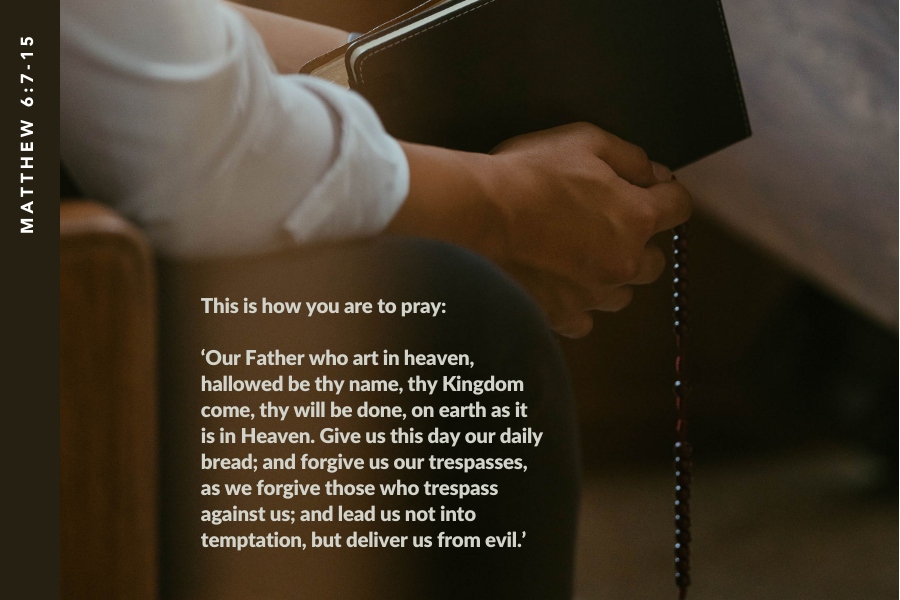
Matthew 6:7-15

Jesus said to his disciples: “In praying, do not babble like the pagans, who think that they will be heard because of their many words. Do not be like them. Your Father knows what you need before you ask him. This is how you are to pray: ‘Our Father who art in heaven, hallowed be thy name, thy Kingdom come, thy will be done, on earth as it is in Heaven. Give us this day our daily bread; and forgive us our trespasses, as we forgive those who trespass against us; and lead us not into temptation, but deliver us from evil.’ If you forgive men their transgressions, your heavenly Father will forgive you. But if you do not forgive men, neither will your Father forgive your transgressions.”

Opening Prayer: Lord Jesus, teach me to pray as you pray to the Father. I want to join in your mission for our salvation and your communion with the Holy Trinity. I want to pray like you.

Encountering Christ:

  1. Many Words: The Our Father is one of the most, if not the most, frequently recited traditional prayers of the Church. It is offered daily at every Mass and in the Divine Office, which is prayed by every Roman Catholic priest and by many orders of religious sisters and laypeople as well. Also called the Lord’s Prayer, the Our Father introduces each of the five decades of the rosary. It is reasonable to assume, therefore, that the Our Father is prayed many, many thousands of times a day. Because it’s so familiar, we can sometimes find ourselves reciting this beautiful prayer thoughtlessly, babbling like the pagans. Our Lord understands this tendency, but when we catch ourselves being distracted, we can simply return our mind to heartfelt prayer, which pleases him. As St. Edmund reminds us, “It is better to say one Our Father fervently and devoutly than a thousand with no devotion and full of distraction.” 
     
  2. Your Father Knows What You Need: Vocal prayers like the Our Father are said repeatedly and sometimes distractedly, but they are nevertheless an important component of the prayer life of the Church. The Catechism states, “The Tradition of the Church proposes to the faithful certain rhythms of praying intended to nourish continual prayer” (2698). Vocal prayer is an essential element of the Christian life. When we’re vigilant and attentive during vocal prayer, we are engaging in the rhythm of the Church. As we make an effort to say our prayers fervently, the Lord blesses and nourishes our relationship with him. 
     
  3. This Is How You Are to Pray: Reciting the Our Father can lift our hearts, since Jesus prays with and for us to God our Father. The experience can lead us to profound gratitude. Our Father who art in Heaven, hallowed be thy name: thank you, God and Creator, for loving us as your children and allowing us to call you “Father.” Thy Kingdom come, thy will be done on earth as it is in Heaven: Thank you, Jesus, for including us in your Kingdom here on earth and for sending your Holy Spirit to guide us to heaven. Give us this day our daily bread: Thank you, Jesus, for being truly present with us in the Eucharist. Forgive us our trespasses: Thank you, Lord, for your forgiveness every time we sin and for strengthening us against further sin through the sacrament of Reconciliation. As we forgive those who trespass against us: Thank you, Holy Spirit, who gives us the strength and desire to forgive others. Lead us not into temptation: Thank you, Lord, for the Church, which teaches us right from wrong and good from evil, and provides the sacraments so we can always choose right and good. But deliver us from evil: Thank you for the gift of our guardian angel and St. Michael to protect us and bring us safely home to you.

Conversing with Christ: Lord, thank you for teaching me how to pray. Thank you for showing me how to worship the Father and how to be his child. Grant me the grace to be more attentive at Mass and whenever I pray the Our Father so that I can offer my prayer with, in, and through you.

Resolution: Lord, today by your grace I will pay special attention while I recite an Our Father, so that I can offer my heart and not just say these words.

Nan Balfour is a grateful Catholic whose greatest desire is to make our Lord Jesus more loved. She seeks to accomplish this through her vocation to womanhood, marriage, motherhood, and God’s gifts of writing and speaking.  

March 11, 2025 – The Lord’s Prayer Read More »

Scroll to Top

Events

Looking for another country?

Contact Regnum Christi near you

News & Resources

News & Resources

The Regnum Christi Mission

The Regnum Christi Identity

Alex Kucera

Atlanta

Alex Kucera has lived in Atlanta, GA, for the last 46 years. He is one of 9 children, married to his wife Karmen, and has 3 girls, one grandson, and a granddaughter on the way. Alex joined Regnum Christi in 2007. Out of the gate, he joined the Helping Hands Medical Missions apostolate and is still participating today with the Ghana Friendship Mission.

In 2009, Alex was asked to be the Atlanta RC Renewal Coordinator for the Atlanta Locality to help the RC members with the RC renewal process. Alex became a Group Leader in 2012 for four of the Atlanta Men’s Section Teams and continues today. Running in parallel, in 2013, Alex became a Team Leader and shepherded a large team of good men.

Alex was honored to be the Atlanta Mission Coordinator between 2010 to 2022 (12 years), coordinating 5-8 Holy Week Mission teams across Georgia. He also created and coordinated missions at a parish in Athens, GA, for 9 years. Alex continues to coordinate Holy Week Missions, Advent Missions, and Monthly missions at Good Shepherd Catholic Church in Cumming, GA.

From 2016 to 2022, Alex also served as the Men’s Section Assistant in Atlanta. He loved working with the Men’s Section Director, the Legionaries, Consecrated, and Women’s Section leadership teams.

Alex is exceptionally grateful to the Legionaries, Consecrated, and many RC members who he’s journeyed shoulder to shoulder, growing his relationship with Christ and others along the way. He knows that there is only one way, that’s Christ’s Way, with others!