January 31, 2025

Calling all Chefs! Send in your Recipes for the new RC Recipe Book!

We are reaching out with a fun project we have heating up here at the Novitiate & College of Humanities in Cheshire and would love your help!

The seminary is putting together a special cookbook as a fundraiser for the seminary and Regnum Christi, and we’d like you to be a part of it by including your favorite recipes! We are asking for recipes from all Localities and Regnum Christi sections!

We want recipes from people of all RC vocations! What a great way to enjoy communion in RC—whether it’s Legionary Lasagna, Consecrated Crêpes, Lay Member Lemon Cake, or ECYD Enchiladas—send them all in!

Send your recipes to Anne Ciacciarella in Cheshire at annec@legionofchrist.org by March 15.

This cookbook is a wonderful way for our Legionary & Regnum Christi family to celebrate the food traditions that bring us together and to share the best recipes from the best cooks!

If you have any questions or need help with the submission process, please don’t hesitate to reach out. Thank you so much for participating!

Calling all Chefs! Send in your Recipes for the new RC Recipe Book! Read More »

The Regnum Christi Book

This new full-color 12″x12″ coffee table book explores the RC identity, the vocations that make up Regnum Christi, and the RC mission in clear, easy to understand ways with vibrant and powerful images of the Charism at work in the world and in the lives of its members.

Available in hardcover and softcover versions. See sample below!

The Regnum Christi Book Read More »

Regnum Christi Spirituality Center Ask a Priest

“Ask a Priest: Does the Bible Really Teach About LGBTQ?”

Q: I’m non-denominational, essentially Baptist. I’m “Asking a Priest” because in my experience, Catholics are the most against LGBTQ out of all the denominations (Thank you!). I was reading about LGBTQ because I go to a public school and get bombarded with it all day, so I kind of need to go back to the Bible constantly to stay strong in my faith. I saw a lot of websites that claim how the Bible doesn’t really say that LGBTQ is wrong. But I have this problem — I am absurdly gullible. Really gullible. Remaining in my faith in this world is a full-time job. What does the Bible say in the original language about LGBTQ? I’ve heard like Leviticus is “just an old list of laws they don’t follow today.” One site says that in 1 Corinthians 6:9, “The original words [could be] translated to ‘softy’ and ‘lust’ and didn’t mean homosexuality.” What does the original Latin say? Sorry, I’m pretty sure this is a bit less professional than most of your questions. Thanks. – M.B.

Answered by Fr. Edward McIlmail, LC

A: You raise fine questions, and it’s great that you sent them.

If I may go back a step in your biblical questions, it would be good to focus on Genesis 1:27-28, which says:

“God created mankind in his image; in the image of God he created them; male and female he created them. God blessed them and God said to them: Be fertile and multiply ….”

So, Our Lord’s plan for intercourse was for procreation. The Catholic Church also understands that physical intimacy has a unitive dimension for a husband and wife that enhances their complementarity — all within the lifelong commitment of marriage.

The basic problem with homosexual activity is that it is inherently sterile and doesn’t reflect the complementarity that God designed into the bodies of men and women. It’s a pleasure-seeking activity without regard for God’s plan.

Now, the Book of Leviticus, written in Hebrew, has no ambiguities about homosexual activity.

Verse 20:13, for instance, says, “If a man lies with a male as with a woman, they have committed an abomination; the two of them shall be put to death; their bloodguilt is upon them.” There is no doubt about the meaning.

(True, the death penalty for homosexual activity doesn’t apply today, at least in most places. It was, however, a crime in most of the U.S. until relatively recently.)

The opposition to homosexual behavior persisted into the New Testament.

Let’s turn to 1 Corinthians 6:9, which was written originally in Greek, not Latin. A key word in this passage is arsenokoitai.

Arsen means man or masculine. Koite or koitas or koitai — depending on a verb or a noun — means bed. It can also refer to actual intercourse (hence, coitus).

The word, which St. Paul composed, means men who sleep with men. That’s the bottom line.

(By the way, the concept of LGBTQ would have been unthinkable to biblical writers.)

I guess people can reinterpret words all they want. Nevertheless, both traditional Judaism and Catholicism have always understood homosexuality to be a grave sin.

Sexual practices outside of a man-woman marriage are distortions of the biblical notion of love, and even if there is no explicit condemnation of LGBTQ forms, it is obvious from the nature of love that they cannot be acceptable.

This understanding requires a theology of love. A few books that expand on this are Faith, Hope, Love, by Josef Pieper, and various Theology of the Body volumes. Also helpful might be Male, Female, Other?, by Jason Evert.

A clarification if I may: You mention that Catholics are the ones most against LGBTQ. We aren’t against any people; we are against the sin.

The Catechism of the Catholic Church gives this overview, under the heading “Chastity and homosexuality”:

2357 Homosexuality refers to relations between men or between women who experience an exclusive or predominant sexual attraction toward persons of the same sex. It has taken a great variety of forms through the centuries and in different cultures. Its psychological genesis remains largely unexplained. Basing itself on Sacred Scripture, which presents homosexual acts as acts of grave depravity, tradition has always declared that “homosexual acts are intrinsically disordered.” They are contrary to the natural law. They close the sexual act to the gift of life. They do not proceed from a genuine affective and sexual complementarity. Under no circumstances can they be approved.

2358 The number of men and women who have deep-seated homosexual tendencies is not negligible. They do not choose their homosexual condition; for most of them it is a trial. They must be accepted with respect, compassion, and sensitivity. Every sign of unjust discrimination in their regard should be avoided. These persons are called to fulfill God’s will in their lives and, if they are Christians, to unite to the sacrifice of the Lord’s Cross the difficulties they may encounter from their condition.

2359 Homosexual persons are called to chastity. By the virtues of self-mastery that teach them inner freedom, at times by the support of disinterested friendship, by prayer and sacramental grace, they can and should gradually and resolutely approach Christian perfection. [end quoted material]

Notice that the Church believes people with same-sex attraction can achieve holiness if they lead lives of purity and have a strong prayer life and sacramental life.

This in contrast to the world, with its debased view of sex, which is content to let people wallow in their lusts.

The Catholic Church believes that people have a higher calling. With the grace of God, we can all become saints. But we need to do our part.

I hope some of this helps. Count on my prayers.

 

“Ask a Priest: Does the Bible Really Teach About LGBTQ?” Read More »

January 31, 2025 – Mysteries of the Kingdom


Memorial of Saint John Bosco, Priest


Mark 4:26-34


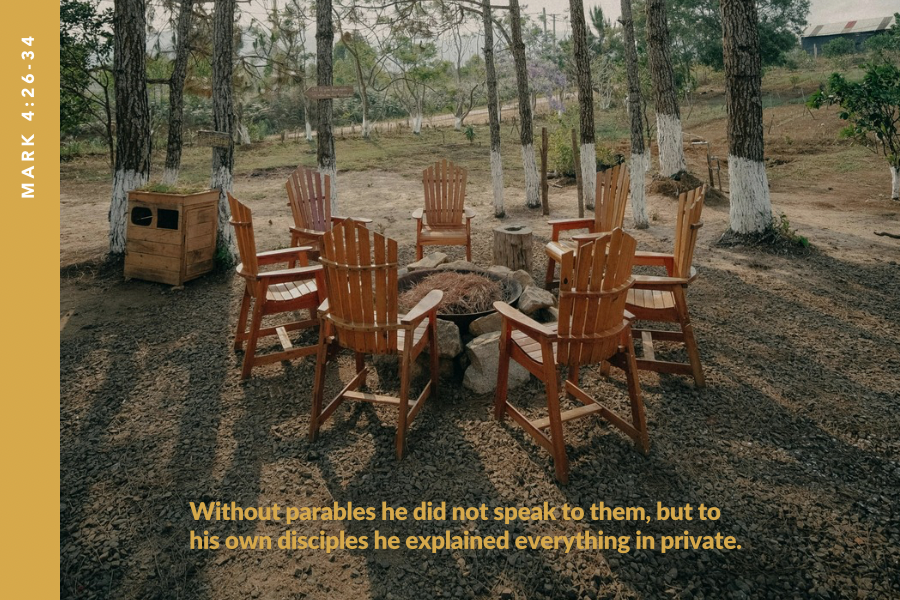
Jesus said to the crowds: “This is how it is with the Kingdom of God; it is as if a man were to scatter seed on the land and would sleep and rise night and day and the seed would sprout and grow, he knows not how. Of its own accord the land yields fruit, first the blade, then the ear, then the full grain in the ear. And when the grain is ripe, he wields the sickle at once, for the harvest has come.” He said, “To what shall we compare the Kingdom of God, or what parable can we use for it? It is like a mustard seed that, when it is sown in the ground, is the smallest of all the seeds on the earth. But once it is sown, it springs up and becomes the largest of plants and puts forth large branches so that the birds of the sky can dwell in its shade.” With many such parables he spoke the word to them as they were able to understand it. Without parables he did not speak to them, but to his own disciples he explained everything in private.


Opening Prayer: Lord Jesus, I come before you today sinful and sorrowful, but also full of hope in your mercy. You spoke in parables to the men and women with whom you walked this earth, but you speak the truth clearly to me through your Church. You are the King of the universe, but you have loved me from all eternity. Give me the grace today to look at the mysteries of your Kingdom and see what you would have me see.


Encountering Christ:


1. Veiled: Jesus began this parable on the Kingdom of God by reminding us that there will be things that occur, but we “know not how.” Perhaps yesterday, in solidarity with the whole Church, you prayed the luminous mysteries of the rosary, meditating for one decade on the Proclamation of the Kingdom. Perhaps you focused on scenes from the Gospel like the one today. Perhaps your mind wandered to mysterious occurrences in your own life or in history. How did a friend or relative beat a serious illness? How did a child manage to maintain their faith in the midst of overwhelming secular influences? How did people survive the Holocaust, or the Rwandan genocide, or the Soviet gulags, and not harbor hatred in their hearts? Max Glauben, a survivor of the Warsaw ghetto and then six Nazi labor camps, spent time each year of the last decade accompanying young people on a March of the Living, retracing many of his steps from seven decades earlier, recounting his memories and asking others to join his fight to eradicate hatred. One participant once mentioned to him, “You’re the reason I believe in God now.” In our own search for reason and meaning, let us lift the veil on the mysterious, the miraculous, and the mundane, and see where we are being called to a closer encounter with Jesus Christ, who is the Way, the Truth, and the Life (cf. Jn 14:6).


2. When the Grain Is Ripe: God, in his mercy, often adds years to our life so that we can learn wisdom and produce in our actions fruit that is worthy of eternity. How much do I value the opportunities I have each day to do simple acts of charity or leave messages that have a beneficial effect on others? How often do I pray for others? Each day I should be attentive to the small and big opportunities the Lord gives me to help establish his Kingdom more deeply in my soul and in the souls of others.


3. From Small Seeds: Researching any kingdom, we might want to study its ruler, its intent, and its extent. In today’s Gospel, Jesus presents an image to us which, on the surface, doesn’t tell us much about these key attributes of a kingdom. However, the brief discussion of a mustard seed’s life cycle, whether we are gardeners or not, is well worth contemplating. Who can discern the smallest of seeds, and who might plant one? The ruler of our Kingdom, Jesus Christ. For what intent would such a small seed be planted? So that it could be nourished to reach its potential. To what extent might this seed expand? Jesus tells us that it will grow surprisingly large and will be a place of safe harbor, of shade and respite from the burning sun. Elsewhere in the Gospels, Jesus compares not the Kingdom but the theological virtue of faith to this same mustard seed: “If you have faith the size of a mustard seed…” (Mt 17:20). With a faith sown by Christ himself, with an intent to nourish this faith with prayer and the sacraments, and a willingness to extend this faith to those I encounter, why should we doubt that we can move mountains?


Conversing with Christ: Lord, thank you for the workings of your grace in so many souls. I want to be united with your grace throughout this day and throughout my life. Help me to use this day in such a way that I will be planting your love around me.


Resolution: Lord, today by your grace I will pray the rosary with my family, taking time to contemplate each of the mysteries and what they might be saying to me personally.

January 31, 2025 – Mysteries of the Kingdom Read More »

Scroll to Top

Events

Looking for another country?

Contact Regnum Christi near you

News & Resources

News & Resources

The Regnum Christi Mission

The Regnum Christi Identity

Alex Kucera

Atlanta

Alex Kucera has lived in Atlanta, GA, for the last 46 years. He is one of 9 children, married to his wife Karmen, and has 3 girls, one grandson, and a granddaughter on the way. Alex joined Regnum Christi in 2007. Out of the gate, he joined the Helping Hands Medical Missions apostolate and is still participating today with the Ghana Friendship Mission.

In 2009, Alex was asked to be the Atlanta RC Renewal Coordinator for the Atlanta Locality to help the RC members with the RC renewal process. Alex became a Group Leader in 2012 for four of the Atlanta Men’s Section Teams and continues today. Running in parallel, in 2013, Alex became a Team Leader and shepherded a large team of good men.

Alex was honored to be the Atlanta Mission Coordinator between 2010 to 2022 (12 years), coordinating 5-8 Holy Week Mission teams across Georgia. He also created and coordinated missions at a parish in Athens, GA, for 9 years. Alex continues to coordinate Holy Week Missions, Advent Missions, and Monthly missions at Good Shepherd Catholic Church in Cumming, GA.

From 2016 to 2022, Alex also served as the Men’s Section Assistant in Atlanta. He loved working with the Men’s Section Director, the Legionaries, Consecrated, and Women’s Section leadership teams.

Alex is exceptionally grateful to the Legionaries, Consecrated, and many RC members who he’s journeyed shoulder to shoulder, growing his relationship with Christ and others along the way. He knows that there is only one way, that’s Christ’s Way, with others!