
August 4, 2023

Jorge Lam Explains the Lay Consecrated Men’s Vocation to Legionary Seminarians

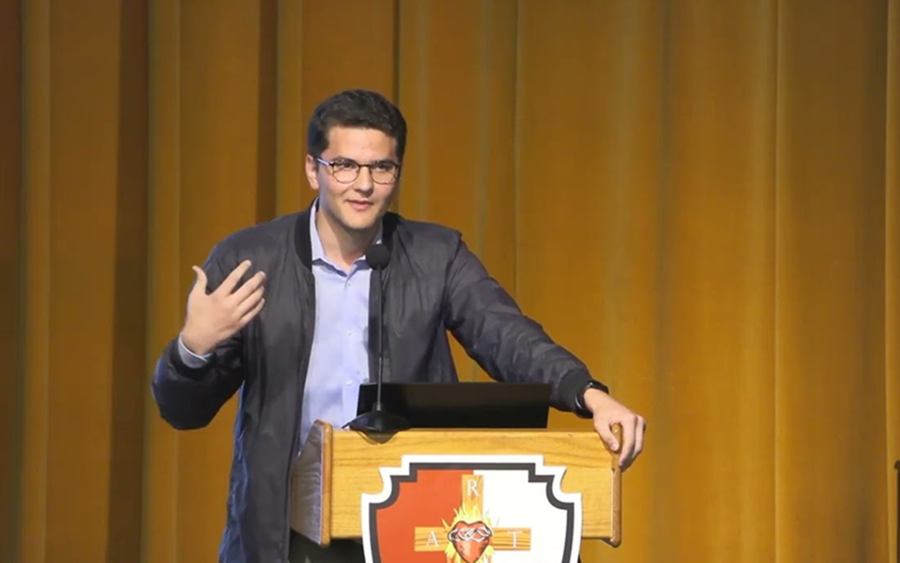
On May 7th, 2023, Jorge Lam, who is in his first year of candidacy with the Consecrated Lay Men of Regnum Christi, had the opportunity to visit the Legionary of Christ’s seminary in Cheshire, Connecticut (USA). During his visit, he gave the Sunday Talk to the novices and humanities students, in which he spoke of the vocation of the Lay Consecrated Men of Regnum Christi. In his presentation, he explained that, in order to understand this vocation, it is necessary to grasp three concepts: layperson, Regnum Christi, and consecrated.

“Personally, it was very enriching experience… I think it was very accurate to choose points of reference and explain his identity to us. It has helped me to understand his vocation better in many ways.” – Br Marcelo Castro Páez, LC

He began the talk by describing the lay vocation and its role of redeeming temporal realities, that is, to transform all the aspects of our lives, such as work, family, rest, communication, the economy, politics, health, education, ecology and art, among others, so that they become spaces where we can encounter God, freeing them from the influences of sin and egoism. Thus, laypeople have a fundamental role in bringing the Gospel to all areas of society in order to transform it from within. Then, Jorge shared his perspective about how Lay Consecrated Men are “one of the people,” and this allows them to have a close relationship with people when evangelizing and sharing the faith. In this sense, Lay Consecrated Men act as the leaven of the dough, as an image of Christ by their words, their work, and the offering of their lives in everyday issues. He then shared his vocational testimony, explaining how he feels called to place his professional talents at the service of the Church, to evangelize by means of digital media. In this way, he highlighted the importance of using and developing our gifts professionally in order to reach people and bring them the message of the Good News.


“In the lifestyle of the Lay Consecrated Man, he spoke about professionalism. This is an aspect that I have always noticed when I see a Lay Consecrated Man, but I never knew it is a key part of their vocation.” – Br Mateo Marín, LC

In the talk, he touched on Regnum Christi as a family in which each vocation contributes something unique. Whether or not the members know each other, when they meet, be they Legionaries, Consecrated Women, Lay Consecrated Men, or laypeople, they naturally treat each other as family. The simple fact that they are united in the mission invites them to value each vocation, and this impels Regnum Christi to create and encourage a vocational culture, in which all vocations are promoted.


Finally, he discussed the prophetic witness that Lay Consecrated Men give through the vows of poverty, chastity, and obedience. He emphasized that this lets them remind laypeople of the true meaning of temporal realities and their self-giving and total readiness for Regnum Christi’s mission.


“The Lay Consecrated Men of Regnum Christi was an almost unknown reality for me… I really liked the professionalism of the presentation; I think this is something very characteristic of Regnum Christi. Something that struck me about the Lay Consecrated Men is that they specialize in a specific area of society, and so they can evangelize in a more effective way. It gives me great joy to share my vocation to Regnum Christi with my consecrated brothers, working for the same mission.” – Br Nahym Márquez, LC

Ultimately, Jorge’s visit to the seminary was a great experience of communion for everyone present. Each encounter among the different branches is a gift of God that gives us the opportunity to keep reflecting on and contemplating the charismatic beauty of Regnum Christi.


You can see the entire video in the link below.


Video Link

Jorge Lam Explains the Lay Consecrated Men’s Vocation to Legionary Seminarians Read More »

Regnum Christi Spirituality Center Ask a Priest

“Ask a Priest: As a Chef, How Could I Evangelize at Work?”

Q: I’m a chef and work in a very secular environment. I tend to get along with everybody, and people easily open up to me. A few co-workers have talked to me in a manner that clearly supports the LGBTQ movement. I make no secret of my Christianity, and when they speak of these things, they don’t do it in a “challenge the Christian boy” kind of way; they just talk about it. One girl told me that she’s bisexual and spoke of a Christian at a previous job who said, “I don’t accept your sins, but I still love you.” That hurt her. Another girl casually speaks of her girlfriend from time to time, and another told me about her frustrations with her conservative family, describing them as “homophobic [expletive].” I know it’s wrong to remain silent, but I simply don’t know how to respond, especially in a way that won’t invite conflict. Again, they aren’t arguing with me, just casually mentioning this stuff. Working in a kitchen isn’t really the time or place to get involved in debates, so I’m kind of at a loss. Any advice you can offer would be appreciated. – P.T.

Answered by Fr. Edward McIlmail, LC

A: Your question is a very relevant one. These situations are becoming more common.

Obviously, these are waters that you need to navigate day by day. The situation could change month by month, for the better or the worse, and sometimes it will go different ways with each co-worker. Some might be receptive to what you say; others might grow hostile.

You mention that working in a kitchen isn’t the time and place for debates. Yet, your co-workers seem to have no problem with speaking about their beliefs and ideas and situations.

While you need not stir up heated debates (kitchens tend to be hot enough), this particular workplace apparently allows for some sharing of personal beliefs.

To the extent that they share their beliefs, maybe you can share yours. You don’t have to do it in a confrontational way, of course. You might look to state your beliefs positively. “I learned a lot from Genesis where God creates man and woman and commands them to be fruitful. That tells me he has a plan for intimate relations.”

It might be no coincidence that co-workers are revealing aspects of their private lives with “the Christian boy.” Perhaps a few of them are having second thoughts about their lifestyles and looking for a perspective from someone with whom they feel comfortable speaking.

You might invite them to reflect on issue through the Socratic approach; that is, by asking questions in order to understand them. In the questions themselves, your co-workers will explore the truth or inadequacy of their answers. Some examples:

— “Do you think some things are the right thing to do in some circumstances, no matter what? What things?”

— “If someone tells you something you consider right is wrong, how does that make you feel? How do you process that?”

— “Is happiness deeper than feelings?”

— “Is the right thing to do deeper than good/bad feelings?”

— “When that Christian said that hurtful thing to you, do you think she said it to hurt you?”

— “Is your family afraid of what you are, or concerned about what you are? … Concern is not necessarily a bad thing, is it?”

These are the kinds of questions that can give food for thought in a non-confrontational way.

In the meantime, you might want to intensify your prayers for your co-workers. Ask the Holy Spirit to open their hearts and minds to the Gospel. And keep letting people know where you stand, through subtle signals such as wearing a religious symbol.

It’s a way to sow seeds. Remember that it’s the Spirit who will cause those seeds to sprout.

You might want to tune into Catholic radio programs if they are available in your area. Shows such as Relevant Radio and Catholic Answers Live are resources for learning more about the faith and the Church’s views on moral issues.

I hope some of this helps. Count on my prayers.

“Ask a Priest: As a Chef, How Could I Evangelize at Work?” Read More »

Regnum Christi Spirituality Center Ask a Priest

“Ask a Priest: What is the Church’s teaching on the redistribution of wealth under the Affordable Care Act?”

Q: Can you please help me understand the teaching of the Catholic faith and the teaching of the U.S. bishops’ conference regarding the redistribution of wealth under the Affordable Care Act? My understanding is there are three ways to transfer wealth in society: charity, taxation and revolution. I thought the Church’s only desired method of transferring wealth was through charity. In charity all the blessing promised in the Scriptures are potentially created for both the giver and the receiver, and charity thus is an image of what Christ showed us perfectly on the cross. Taxation, it seems, takes the giver and requires him to surrender his wealth under the threat of incarceration, thus eliminating his free will and the blessings of being charitable with his money. On the receiver’s side, the one receiving the benefits from the government no longer is connected to the giver, he only sees the government handing out the money and does not feel gratitude to the taxpayers, only to the politician who determines how much they receive. Taxation appears to sterilize the act of transferring wealth. Since I understood the Catholic Church to teach that we are a faith of proposition not imposition, taxation would seem contrary to the Church’s teaching since it imposes charity. Shouldn’t the Church be in support of developing charity in the country and not taxation? -D.A.

Answered by Fr. Edward McIlmail, LC

A: Thanks for a very timely question. It will help if we break the question down into two parts: one focused on principles, the other on particulars.

First, the principles. The Church is not against taxation when it is fair. Jesus himself did not consider it unjust to pay taxes to the Roman emperor. “Repay to Caesar what belongs to Caesar” (Mark 12:17). St. Paul likewise insisted, “Pay to all their dues, taxes to whom taxes are due” (Romans 13:7). The Catechism, No. 2240, says: “Submission to authority and co-responsibility for the common good make it morally obligatory to pay taxes ….” There is no hint that taxation in and of itself violates our free will; doing something that contributes to the common good would, in fact, be a laudable use of our will.

Taxation in principle neither contradicts the practice of charity nor exempts us from the duty to help the poor. (We recall that the individual mandate of Affordable Care Act was upheld in court as a tax.) Nor is taxation as a means of redistribution of wealth a bad thing in itself. It is worth quoting extensively from No. 355 of the Compendium of the Social Doctrine of the Church: “Tax revenues and public spending take on crucial economic importance for every civil and political community. The goal to be sought is public financing that is itself capable of becoming an instrument of development and solidarity. Just, efficient and effective public financing will have very positive effects on the economy, because it will encourage employment growth and sustain business and non-profit activities and help to increase the credibility of the State as the guarantor of systems of social insurance and protection that are designed above all to protect the weakest members of society.”

That said, the Church recognizes that it is not its place to dictate civil policies. “If by the autonomy of earthly affairs we mean that created things and societies themselves enjoy their own laws and values which must be gradually deciphered, put to use and regulated by men, then it is entirely right to demand that autonomy” (Compendium, No. 45). For further reading you can check out the U.S. bishops’ conference website on key themes of Church social teaching that can be found here.

Now, let’s shift to particulars. The Affordable Care Act (“Obamacare”) has generated its share of debate. The Church applauds the parts of the law that help the truly needy. But it has and will continue to speak up about parts of the law and related federal directives that violate religious liberty (such as forcing Catholic institutions to pay for contraception and sterilizations). The U.S. bishops’ conference has a webpage dedicated to its statements on various health issues (click here).

Hitting the right balance between fair taxation, ethical laws, respect for religious liberty, and the proper autonomy between church and state is an ongoing work. Where taxation or any kind of government unduly limits the practice of religious liberty, it has overstepped its bounds. Where taxation is so high that it leaves little or no money for private or church-related acts of charity, it has overstepped its bounds. Where government programs foster an entitlement mentality in people (“gimme, gimme”) or where such programs discourage personal work and effort, they have gone too far and need to be reconsidered.

It is not always easy to locate the exact line at which government programs or taxes start to do more harm than good. Obamacare, like any law, can be improved (even its biggest supporters have already tried to do so). That is why citizens, including Catholics, need to keep an eye on public policies and speak up when something needs to be changed. Building a better society is always a work in progress, and the Church does not have a “concrete solution” to every problem (see Gaudium et Spes, 43). I pray that you do your best as a citizen to help build the country.

“Ask a Priest: What is the Church’s teaching on the redistribution of wealth under the Affordable Care Act?” Read More »

Scroll to Top

Events

Looking for another country?

Contact Regnum Christi near you

News & Resources

News & Resources

The Regnum Christi Mission

The Regnum Christi Identity

Alex Kucera

Atlanta

Alex Kucera has lived in Atlanta, GA, for the last 46 years. He is one of 9 children, married to his wife Karmen, and has 3 girls, one grandson, and a granddaughter on the way. Alex joined Regnum Christi in 2007. Out of the gate, he joined the Helping Hands Medical Missions apostolate and is still participating today with the Ghana Friendship Mission.

In 2009, Alex was asked to be the Atlanta RC Renewal Coordinator for the Atlanta Locality to help the RC members with the RC renewal process. Alex became a Group Leader in 2012 for four of the Atlanta Men’s Section Teams and continues today. Running in parallel, in 2013, Alex became a Team Leader and shepherded a large team of good men.

Alex was honored to be the Atlanta Mission Coordinator between 2010 to 2022 (12 years), coordinating 5-8 Holy Week Mission teams across Georgia. He also created and coordinated missions at a parish in Athens, GA, for 9 years. Alex continues to coordinate Holy Week Missions, Advent Missions, and Monthly missions at Good Shepherd Catholic Church in Cumming, GA.

From 2016 to 2022, Alex also served as the Men’s Section Assistant in Atlanta. He loved working with the Men’s Section Director, the Legionaries, Consecrated, and Women’s Section leadership teams.

Alex is exceptionally grateful to the Legionaries, Consecrated, and many RC members who he’s journeyed shoulder to shoulder, growing his relationship with Christ and others along the way. He knows that there is only one way, that’s Christ’s Way, with others!
